Saturday, 16 December 2023

Annuals Revisited


Part One: The 1960s

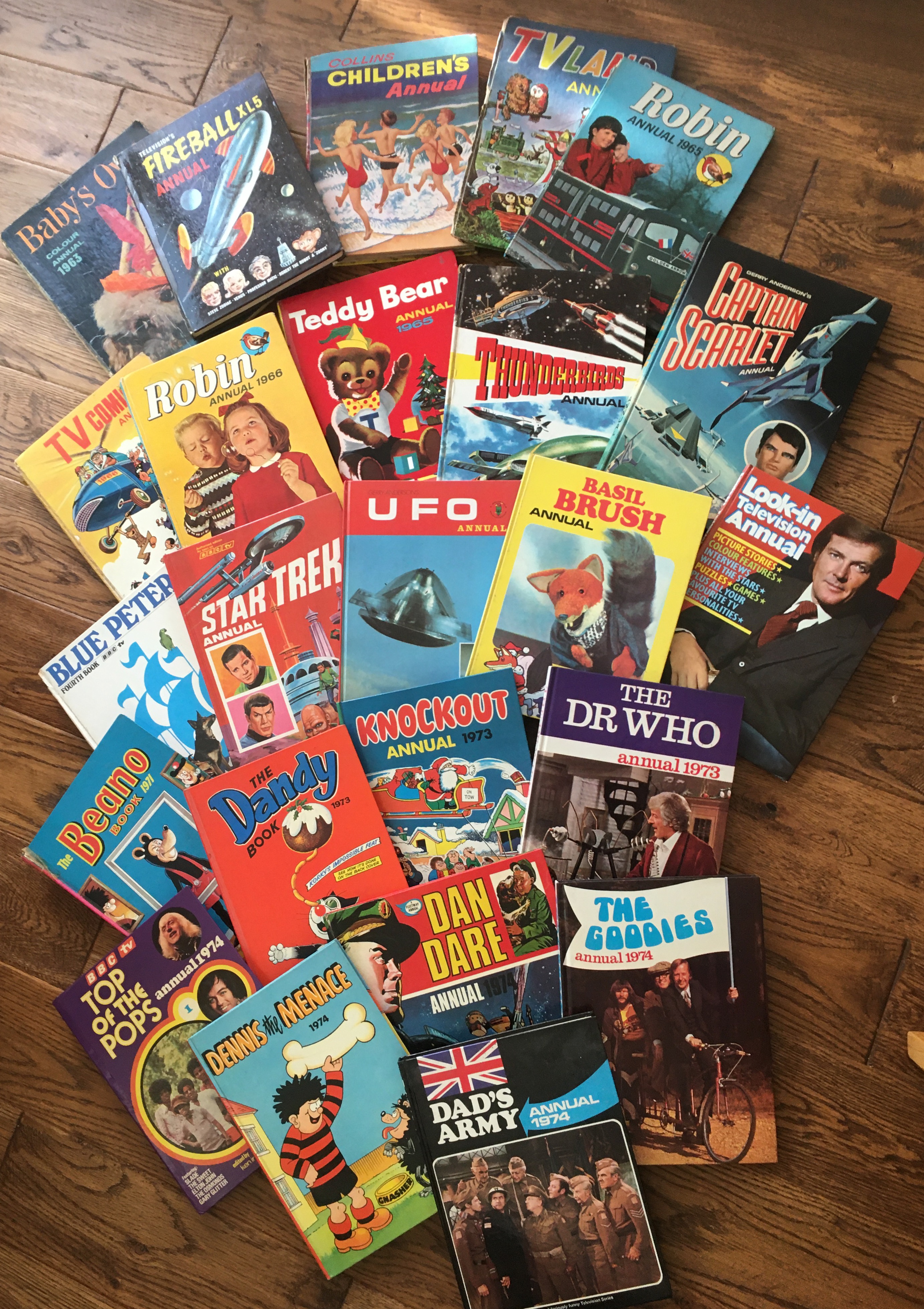
Back in the 1960s and 70s, no Christmas was complete without annuals. I had them bought for me every year until I was in my mid teens. I still have the very first of them, Baby’s Own, a Fleetway publication printed in 1962. In the days before I’d learned to read, the bright colour illustrations in this book left a huge impression on my developing imagination. By the late 60s, the sight of annuals in the shops was an exciting reminder that Christmas wasn’t too far away. I can clearly recall seeing 1967’s Captain Scarlet Annual piled up in WH Smiths, brand new and still fresh from the printer, with its distinctive new-printed smell.

Every Christmas brought a fresh crop of annuals, some years providing a bumper harvest, and between my brother and myself, we probably got around half a dozen new annuals every year. Most of them are still in my possession, and it occurred to me to make a list of all the ones we had, going right back to 1962. Which were the most popular? Which survived intact? And which was the very last?

As mentioned above, Baby’s Own set the ball rolling back in 1962 when I was a mere eighteen months old. In addition to this, I had earlier been given two of the so called ‘Big Noddy Books’, annual-sized publications that had been published on a semi-regular basis since the early 50s. So, as of Christmas 1962, my collection of annuals stood at three. Now, let’s count off the rest, year by year…


1963

Fireball XL5 Annual – the first of four, from publishers WM Collins and son, and a clear favourite judging by the distressed condition in which it survives to this day. All four in the series followed the same format, with full colour printing at the beginning, middle and end, and single colour/ spot colour on heavy pulp paper elsewhere. Such 1930s production values were on the way out, and would not endure beyond the mid-1960s.

Collins’ Childrens’ Annual – a blend of mostly text stories, ranging from fairytale whimsy to Enid Blytonesque rollicking adventure, the Children’s Annual had been going for years by the time I was given my one and only copy. It survives to this day in very good condition, testament to the fact that I didn’t care much for it, although one particular story – Lost in the Snow – became a childhood favourite. 

Bobby Bear’s Annual
Dean and Son’s Bobby Bear had been a fixture of the Daily Herald newspaper since 1919, making him even older than Rupert, and his annuals went all the way back to the 1920s. The Herald had undergone a change of ownership in 1961 and would be revamped into The Sun just over a year later, so Bobby’s days were numbered. This annual was clearly well-loved, and suffered the same fate as Fireball XL5, losing its board covers and several pages. More recently, I bought myself this mint condition copy off ebay.


1964

Fireball XL5 Annual – the second of the series, this one survived rather better than its predcessor, though I must have given it away in the 1970s as the original is no longer in my possession, having been replaced by a cleaner copy. The stories were written by Alan Fennell, who had contributed about half of the scripts for the TV series, so they were very much in the style of the original. With the TV series only on air once a week, and often absent from the screen altogether, the Fireball Annuals became as important to me as the programme itself.

Robin Annual – Cover-dated 1965, this was another favourite, alongside the following year’s edition. I’m not sure if we were ever bought the Robin comic on anything like a regular basis, and these two annuals were the only examples we ever owned. Our mum gave them away in the 1970s, but I later found replacement copies. Some of the stories from this year’s edition became beloved childhood favourites and just to look at the illustrations is to evoke a rush of nostalgia for winter afternoons in front of the fire. TV characters like Andy Pandy and Bill and Ben rub shoulders here with the likes of Bizzy Beaver, Nutty Squirrel and Richard Lion; but Robin’s most intriguing character was based on Mr Woppit, the teddy bear mascot that accompanied speed demon Donald Campbell in his various Bluebirds (and was rescued from the final tragic wreck on Coniston Water). Originating in the 50s, by 1964 Woppit looked more like a pig than a bear, and was accompanied by his friends Mokey the donkey, and Tiptop, a clown.

TV Land Annual – TV Land was a short-lived comic, launched as a junior companion to TV Comic when the latter revamped its contents to appeal to a slightly older readership. The comic’s original cover star, Pussy Cat Willum, was long gone by the time this annual was published. It was, I believe, bought for my brother, and survives intact to this day. Stories include Noggin the Nog and Ivor the Engine (both with illustrations by Peter Firmin); The Woodentops; and a cartoon elephant called Packi, created by Tony Hart.

Teddy Bear Annual – Teddy Bear was a Fleetway publication, promoted as being ‘the only story paper for mothers with young children written by a mother with young children’, and had been appearing weekly since late 1963. Its title character was a charming little bear who lived with his family in ‘Bear Green’ (clearly inspired by the real life Beare Green in Surrey), and other regulars included a pre-Denis Healey Silly Billy, Nurse Susan and Dr. David and Paddy-Paws the puppy (of which I own several original art boards). Creator/writer Barbara Hayes appears to have been a prolific contributor to Amalgamated Press and Fleetway publications, and in 2010 published a book on ‘How to be a Successful Writer’. So she must have done all right out of it.


1965

Fireball XL5 Annual – Ex-Eagle artist Eric Eden's fine artwork had featured in the first two volumes but this year the comic strips were supplied by another Eagle contributor, Desmond Walduck. His illustrations of Fireball made the ship look as if it had eaten all the pies in Space City. The stories were still excellent stuff, and included a couple of classics. Eden remained on board, providing paintings for the cover and endpapers, but by 1965 had found weekly employment on TV21, illustrating the Lady Penelope strip.

Robin Annual – Although the original was long gone, many years later I chanced upon a copy of this year’s Robin Annual in an antiquarian bookseller in Lichfield. I hadn’t had sight of the contents for over thirty years, and when I opened it up, it was a full-on hit of forgotten childhood. Robin, like its older sibling Eagle, used the best illustrators in the business, and this year’s annual includes some fine work from John M. Burns and Gerry Embleton.

TV Comic Annual – TV Land having ceased publication, my brother was bought this in its place. The line-up of characters seemed designed to put me off as a reader, as it included several series I found hard to take on the television: not only did we have Dr. Who, but Space Patrol and (horrors!) The Telegoons. On the printed page, they were somewhat less disturbing, but I still tried to avoid looking at the colour endpaper photographs of the Space Patrol crew. The original copy has survived to this day. 

Teddy Bear Annual – Author/editor Barbara Hayes was really working her socks off, turning out every week’s edition of the comic (for which she received sole writer credit) and a couple of annuals every year. Artists are hard to identify, except for the prolific Jesus Blasco, better known for his action-oriented strips, but who could turn his hand to fairytale whimsy when the occasion demanded. I own a panel of his artwork from this year's annual, which accompanied the tale of 'Barbara One-Shoe'. I told you she was working her socks off...


1966

Thunderbirds Annual – International Rescue had arrived on the small screen in the autumn of 1965, which was too late for that year’s crop of annuals, so it was another year before Thunderbirds scored its own annual. TV21 publisher City Magazines was responsible, and this was the first of their publications to appear in a new large format. The inclusion of colour photographs added interest, but the contents were for the most part illustrations, rendered in the same cheap line and wash printing technique that City used on all of their annuals. Nevertheless, I was pleased to get it and can remember opening it on Christmas Day when it was still dark outside...

Fireball XL5 Annual – This was to be the last of Collins’ Gerry Anderson tie-ins, and with the series itself fast disappearing from screens, there must have seemed little point in continuing. The covers of the first three had all been provided by Eric Eden, but this year saw him demoted to the endpapers, with TV21’s Fireball artist Mike Noble doing the honours on the cover. Unlike the cobalt blue space backgrounds that appeared in the TV21 comic strip, Noble here bowed to convention and provided a solid black space background, giving the four Fireball annuals a kind of visual continuity. Of the four, this was my least favourite, mostly on account of what I felt was somewhat inferior artwork (I was a hard taskmaster at the age of five).
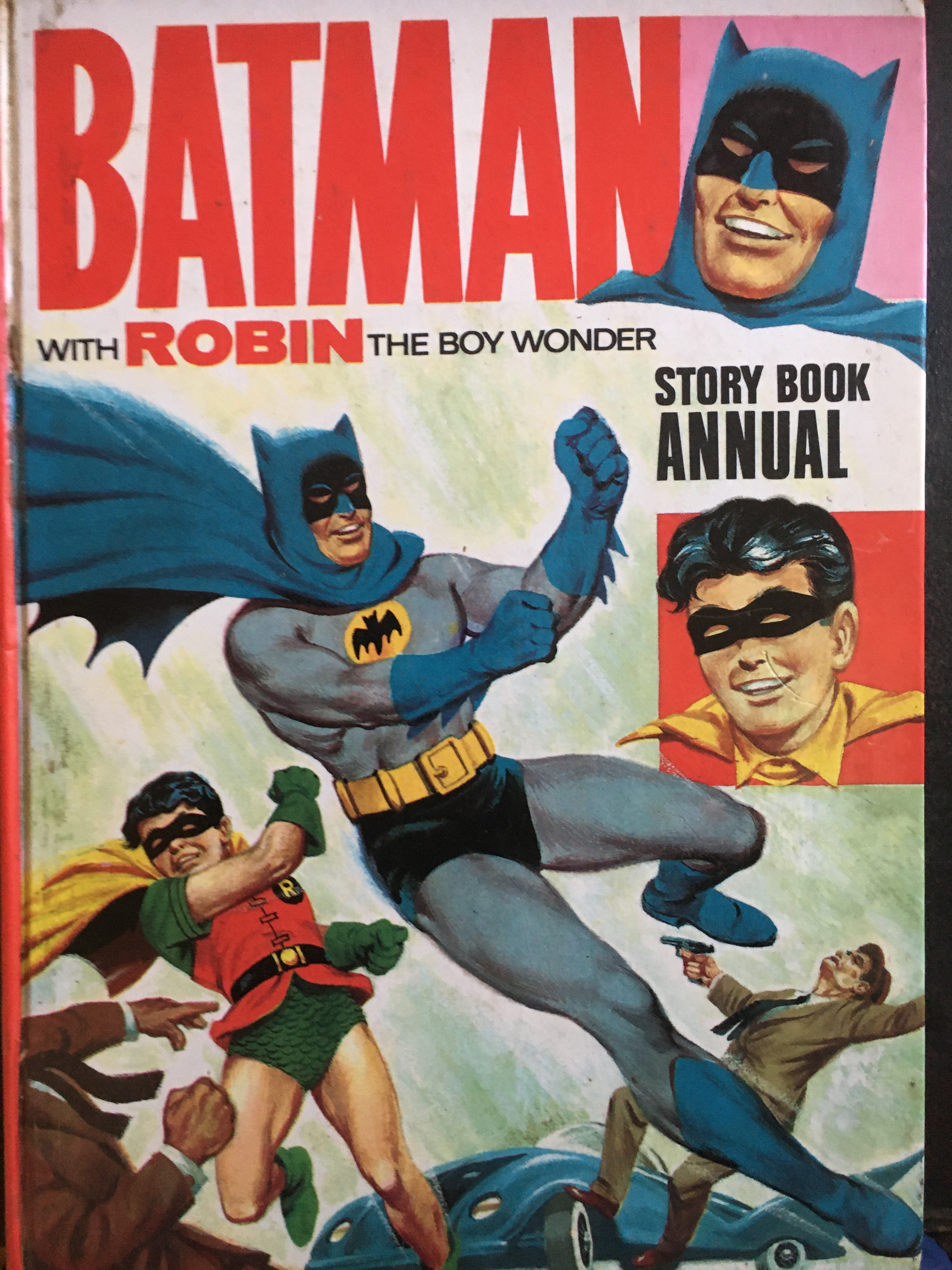


Batman Story Book Annual – The Caped Crusader had been the year’s must-see television event, and by the autumn was spawning merchandising spin-offs including toys, bubble gum cards and this cheap cash-in from Manchester-based publishing house World Distributors. World’s annuals often looked like rush jobs, abd Batman was no exception. Comic strips took time to produce and were expensive to commission, so all too often these publications consisted of nothing but text stories, illustrated in haste by one Walter Howarth – a name revered by Dr. Who fans for his work on that series’ annuals. Howarth could turn out excellent likenesses of key actors, but his technique was rushed – hardly surprising considering his workload – and the cheap Ben Day dot printing process didn’t add much to his slick linework. The cover artist looks to have been under orders to avoid any resemblance to Adam West...


1967 

Blue Peter Book – I’d been watching Blue Peter on television since we’d had a set in the house, but this was the first year I’d had one of the ‘Blue Peter Books’ bought for me. The programme was at a point of transition, with John Noakes having recently joined, and Peter Purves waiting in the wings, so the cover designer played safe by photographing the show’s line-up of pets, arrayed around the Blue Peter emblem. The contents included an illustrated guide to making your own Christmas ‘advent crown’ (coathangers and tinsel), which proves that this kitsch classic had been a staple of the programme since the mid 60s. I would continue to receive the Blue Peter books every christmas for the next four or five years, by which time I’d stopped watching the programme.

These were great annuals for Christmas day reading, with their blend of easy-to-read features (generally reprising material from the TV episodes), puzzles and stories featuring William ‘Tim’ Timmins’ perennial favourites Bengo the boxer pup, and junior space adventurers Bleep and Booster.

Captain Scarlet Annual – The first of only two dedicated Captain Scarlet annuals (though there would be later examples when the series was revived in the 1990s). I can still recall the excitement of seeing this in the shops, only a matter of weeks after the series had started on TV. Annuals like this were a great source of reference material if, like me, you wanted to draw pictures of your TV heroes, as there were plenty of colour photographs available to study (my original copy still bears a palimpsest of scored-in outlines where I’d traced various photographs). Artwork came courtesy of TV21’s ‘B-listers’, Ron Turner and Jim Watson. 

The Pogles Annual – Slim, but handsomely produced, and featuring a photographic cover, this was one of my brother’s annuals at Christmas 1967. The following year brought a further volume.

Sooty Annual – The Daily Mirror had been cranking out Sooty annuals for a good few years, but this was the first of them to make it into our house. I never cared for them very much: Sooty was reinvented in a kind of toytown setting populated with characters who never saw action on the TV series. Harry Corbett, of course, was nowhere to be seen, as the annual Sooty had grown a pair… of legs, that is.

The same year brought a further Teddy Bear Annual – now a gift for my brother – but little else. I’d passed on the second Thunderbirds Annual, having somewhat lost interest in the show in the wake of Captain Scarlet. I would make up the defecit a few years later by acquiring a copy discarded by our cousins.


1968

Joe 90 Annual – I can still remember seeing this in a TV21 half-page advert in the autumn of 1968, a week or so before the series appeared on television. The cover image of Joe in the Big Rat intrigued me: what was it all about? I’m afraid the series, when it arrived, had rather less of an impact. The format followed the look of the Captain Scarlet and Thunderbirds examples. Good colour photographs, cheaply overlaid colour printing on the strips. And those ‘B-listers’ were being kept busy, Ron Turner in particular...

Captain Scarlet Annual – Another fine effort from the TV21 production team, with art editor Jim Watson providing a number of strips. The excellent Ron Turner was also on board, although as a child I found his drawings too stylised, and he was rather less adept at drawing the series’ hardware than he was at making up his own. And he couldn’t draw Captain Scarlet’s hat to save his life!

Thunderbirds Annual – Nice cover design here, placing each of the Thunderbird craft inside its respective number. I’ve long been of the opinion that, when he was asked to design the International Rescue vehicles, Derek Meddings started by drawing the numbers one to five and using them as the basis for their shapes. Thunderbird Four looks just like a figure four, Thunderbird One is clearly a figure one, Thunderbird Three has three nacelles… all of which has no relevance to this year’s annual. Amongst the strip stories was an effort clearly from the pen of TV21’s Scott Goodall, who never missed an opportunity of smashing up the hero craft. In his strip Curse of the Elastos, much of Tracy Island gets pounded into rubble and Thunderbird Three is completely destroyed. I mean, it’s only a comic strip, but you just don’t do that kind of thing!

TV21 Annual – I’d started getting TV21 on a regular basis in late November of 1967, too late to be bothered with that year’s annual, and this one was the first I had bought for me. This year saw a big family gathering at our grandparents’ small semi, and our grandad had gone to the trouble of making a ‘bran tub’ from which we each extracted our presents, mine including this particular annual, which has survived with me to the present day.

Also in the running for this year were The Herbs Annual – a gift for my brother – and yet another of the perennially popular Teddy Bear, alongside another outing for The Pogles. Meanwhile, in the category of ‘I’d have liked it but didn’t get it’ we find TV21’s spin-off Project Sword. Despite being bought several of the toys tied into the concept, we never had the annual, and I wouldn’t have sight of it until I turned up a copy in the late 70s.


1969 

Star Trek Annual – Star Trek had only been on air since July, but World Distributors were quick off the mark, with an annual in the shops in time for Christmas. This one followed their long-established practise of licensing comic strips from the USA and reprinting them alongside a few hastily cobbled together features. For all that, I was glad to have it, and one of those features promised the return of Halley’s Comet in the far distant future of 1986. I could hardly wait.

Joe 90 Annual – Joe got two annuals this year, a series edition and another based on the comic that had been launched under his moniker in January. My brother got the latter whilst I was given the former. It followed the by now standard City Magazines format of strip stories and text stories illustrated with colour photographs. The self-styled ‘Joe 90 Comic Annual’ included the same character line-up as the weekly, which meant appearances from The Champions , Land of the Giants and two sporting Inuits known as Ninepence+Tenpence alongside Joe himself.

Captain Scarlet and Thunderbirds Annual – You couldn’t get the wrapping off this one… oh, as you were, that brown paper and string is part of the cover design. A demotion for two Gerry Anderson properties who were nearing their sell-by date and had clearly not shifted enough copies last year. The contents were the usual TV21 Annual-style artworked strips, alongside text stories illustrated with photos. For me, the artwork in these annuals was getting worse with every passing year. Jim Watson and Ron Turner provided their usual reliable schtick, but alongside them we got the sketchy efforts of Jon Cooper, whose work I have never liked, and an unidentified artist with a dreadful exaggerated style that verged on caricature. Whoever he was, his two stories – The Mind Machine and Secret of the Mummy’s Tomb – were so downright awful that I’ve never bothered to read them!


TV21 Annual – Now in its fifth year, but sporting a rather pedestrian cover design of boxed photos, this would prove to be the last of the really good TV21 publications before the comic and its associated annuals turned bad. The following year’s example was dire. This year we still had the expected comic line-up of Captain Scarlet, Thunderbirds and Secret Agent 21, who also appeared in his revamped format as Mr. Magnet, plus appearances from Fireball XL5 and Stingray, both of which had been absent from the comic for more than a year. The colour photographic endpaper of Fireball XL5 alone makes this edition worth collecting, as the original transparency has long since vanished.


In the next part, I'll consider the many different annuals – mostly TV spin-offs – that arrived in the 1970s.


Wednesday, 13 December 2023

Farewell, Earthling Phil


Around 1971, our dad got made redundant. He’d moved from a steady but undemanding clerical job at the GEC to wallpaper manufacturer Colorall, in a sales position. The job didn’t last long – maybe he didn’t shift enough rolls – but by the spring of 1971 he was out of work again. Fortunately, he had a second career, as a semi-professional drummer, in which capacity he’d been working the dance band and supper club scene in the Midlands for over thirty years. With the day job gone, he fell back on music as his sole source of income. Around this time, he’d been a ‘dep’ (temporary replacement) drummer for Midland bandleader Graham Dalley, whose residency at The Barn nightspot in Solihull provided a semi-regular source of work. Dalley was a multi-instrumentalist – his LP ‘At the Barn’ credits him with piano, vibraphone, trumpet and electric harp. He was also, if the sleeve is anything to go by, a joker with an irreverent sense of humour. Five years earlier, he’d annoyed the BBC with his Parlophone single Landing of the Daleks, a shameless Joe Meek influenced cash-in, that was promoted using the commercially available Scorpion Automotives Dalek Playsuit (the band probably owned more copies of the suit than anyone else). For the purposes of the recording, Dalley’s Barn line-up christened themselves The Earthlings, and it was organist Ray Pritchard who caused the kerfuffle when he added a morse code signal – ‘SOS Daleks have landed’ – to the recording. Auntie was having none of this, and banned the single from airplay on the grounds that the interpolated SOS signal might confuse shipping. More likely it was a case of sour grapes at anyone trying to make money from one of their own commercial properties. Unfortunately, our dad isn’t on that record, as he wouldn’t hook up with Dalley for another few years. But his guitarist – the subject of this article – was.


Phil Nelson was a consummate jazz guitarist, who’d been active on the Midlands circuit for some time. When our dad joined up with the Dalley ensemble they became friends, sharing the same warm philosophical outlook on life. Tragically, Graham Dalley died suddenly in 1970, leaving the Barn ensemble without a bandleader and the band in search of a new residency. Naughty SOS man Pritchard teamed up with Phil and our dad to form a trio, who quickly secured a residency at the Pontins Wall Park holiday camp in Brixham, Devon. During that spring and summer, they lived in digs in Paignton and Brixham, a student-style existence that was occasionally shared by Phil’s wife Jenny and their large poodle Fred (‘You’ve heard of Manfred Mann?’ Phil said; ‘Well, this is Dog Fred Dog’).

There was plenty of room in the accommodation, enough for our mum, my brother and myself to visit on holiday twice during that summer. We got to know Phil quite well: he had a passion for aircraft and science fiction – the digs was littered with pulp paperbacks and copies of Aero Modeller magazine, some of which passed into my hands and are still in my possession. He never mentioned his ‘Earthling’ credentials, which is a shame, as it’s exactly the kind of thing that would have impressed us as kids – especially since the Daleks were about to make a return to Dr. Who. We saw the trio perform at the holiday camp on at least one occasion. I remember wishing to myself that they would play the James Bond theme when they did precisely that. Phil was the first person I ever saw in real life playing a ‘proper’ guitar: in this case, a Gibson Super 400, the same huge single-cutaway jazz guitar beloved of early rock and rollers. Our dad later reported that Phil had painted it blue and turned it into a wall ornament, but I rather hope this wasn’t the case – an unmolested Super 400 would today be worth around £20,000.

The summer season proved to be a one-off, and from the autumn onwards, the trio returned to home turf, gigging around the Midlands. Phil and Jenny visited our house on several occasions: I remember them being impressed by some of my felt-pen drawings of cartoon characters, which were always fetched out when we had visitors. A couple of years later, Phil attempted to teach me the guitar. Our dad had bought me an electric guitar for my 12th birthday, on the agreement that I would take lessons. Phil even advised us on the best instrument available from Birmingham's music shops on a budget of £30. The fact that I am not today a jazz guitarist is entirely my failing, not Phil’s. He did his level best and taught me scales and basic positions: but I was more interested in learning how to play the solo from 10CC’s Rubber Bullets (I had the sheet music, but the solo wasn’t included). After a few months of this tuition, we gave it up as a bad job. Aside from occasional visits to our house, I didn’t see Phil again, and the trio gradually drifted apart.

Decades later, I hooked up with him on facebook, where he still displayed the same warm sense of fun that had appealed to us back in the 70s. Of all my facebook friends, Phil was the most likely to comment on a post, sometimes humorously, but often with a thoughtful, philosophical insight. He never had anything to sell, or sought to promote himself in any way. He was more likely to share a photo of one of his dogs – all of whom were identical clones of the original ‘Dog Fred Dog’. It is to my eternal regret that this rekindled virtual friendship never went beyond the computer, but even in that limited capacity, I was glad to have him as a friend, and facebook won’t be the same without his ‘likes’ and comments. He was a warm and funny man, very much like our dad in outlook. He is survived by his wife Jenny and son and daugher Clark and Philippa.

You can hear Phil and friends warn earth of the imminent Landing of the Daleks here (and note the first two comments from Phil himself):

https://www.youtube.com/watch?v=sFHJonHQbiM


Press clipping promoting the 'controversial' single. Phil is weilding a Framus 12-string guitar.


Saturday, 9 December 2023

Something Nice (will fly by)


It was whilst looking through a 35-year-old diary for something else that I stumbled across the entry for today’s date, December 9. At a glance, it might seem to an outside observer like a relatively ordinary entry. I’d taken the day off work and had gone with my dad on an early shopping trip into Lichfield. This in itself was a relatively unusual event, as I normally went on such trips alone. It may even have been the last time I ever went shopping with our dad (although he would live for another thirteen years). Did I think back to the times he took myself and my brother around the toyshops of Lichfield during the 1960s? Probably not. Of course, if this really was our last ever shopping trip, I had no way of knowing this. It’s the kind of thing that is revealed only when it’s too late to do anything about it. During our tour of the shops in search of gifts, we happened to look in at the small independent record shop that had its premises in Tudor Row, a small passage alongside a genuine Tudor building where we’d been bought sugar mice as children. Browsing through the shop’s rack of recent releases, my eye was caught by the sleeve of a 12” single, featuring an attractive design in the style of the Incas. The record was by an ensemble called Robert Lloyd and the New Four Seasons, of whom I knew precisely nothing. Lloyd was, if I had but known it, something of a local hero, hailing from Birmingham, whose band The Nightingales had been long standing favourites of DJ John Peel. I’d never heard the record, but something about the sleeve intruigued me enough to risk £2.95 on a purchase (the price tag is still attached to the sleeve 35 years later).

Back at home, that lunchtime, I gave it a listen. The song, Something Nice, weighed in at a staggering nine and a half minutes – three times the length of the average pop single. It began with a relentless ‘four on the floor’ drumbeat that didn’t let up for the entire recording. The melody was pretty unimaginative, consisting of just two notes for the verse and another two notes for the chorus. For all that, it was quite listenable, if lacking in dynamics. But what really drew me in were the lyrics – and at nine and half minutes, there were quite a lot of them. The singer seemed to be taking himself to task for his failure to grasp life’s opportunities for fear that ‘something nice would fly by.’ He talks about his responsibilities, his failings, his work and his relationships in a frank and self deprecating manner. And that was what I related to. Like Mr. Lloyd, I wasn’t entirely happy with how my own life was shaping up (shaping down?) at the age of twenty-seven. I too was afraid that ‘something nice might fly by’. Rather than sticking my head above the parapet and risking having it shot off, I’d been keeping my various creative endeavours – primarily of a musical nature – to myself. The single seemed like a warning. It might have been sent by my future self. And yet I failed to act upon it. Thirty-five years later, as far as ambitions go, I’m still where I was that December day back in 1988. The only difference between then and now is that, at the age of 27, I still had some good years ahead, years in which I might conceivably make good on my failure to get anything off the ground. At the age of 62, the Billy Liar-esque notion of somehow becoming a pop singer – or even a writer of scripts for Danny Boon – begins to seem not only unattainable but laughable. The creative industries have never gone a bundle on old people. You’ll have noticed the decided lack of sexagenarians on TikTok.

Something Nice – life, to be precise – has indeed flown by. Finding that diary entry feels akin to Philip Larkin’s reflection on lost youth in his verse Sad Steps (1968). The poet, ‘groping back to bed after a piss’ parts the curtains and is confronted by the startling sight of a full moon in a ‘wind-picked sky’. It serves him not as a romantic symbol, but as ‘a reminder of the strength and pain of being young/ that it can’t come again/ but is for others undiminished somewhere.’ On finding that diary entry, I fetched out my copy of Something Nice – it lay in a cupboard mere inches from where I sat – and, for the first time in many years put it on the turntable. As I did so, the windy overcast of the morning blew aside to let in a low, wintry sun – recreating precisely the same conditions of weather as on that long-lost day in 1988. I’d even venture to suggest that, purely by chance, I’d chosen to play the record at the exact same time of day. A circle had just been squared.

Back in 1988, I played that song to anyone who would listen. It came to feel like a kind of personal soundtrack, a manifesto even; and it accompanied a developing relationship that in time would bring some of Larkin’s ‘strength and pain’. But I was still young. I got over it. 

As for Robert Lloyd, the single, on small indie label InTape Records, did nothing, but it got him noticed, along with his slightly more successful and tuneful pop song Nothing Matters. Within a year or so, he’d been signed to Virgin. Something Nice, now pruned to a radio-friendly four minutes, was re-recorded and reissued. It still did nothing. Lloyd and Virgin soon parted company. Much later, he would revive his new wave combo The Nightingales, whose noisy cacophony was a world away from the smoother sounds he’d been aiming for in the late 80s. As an artist, Lloyd seemed determined not to play the conventional pop star game. When last sighted, he was the subject of a Sky Arts documentary, and came across as an immensely likeable, funny guy with a Midland sense of humour that I got immediately. The kind of chap who could keep you entertained for hours down the pub. His own personal Something Nice has long since flown by, but judging from that film, he seems happy with his lot.

As for me, to subvert a lyric from Doris Day, what will be has been. I can look back thirty-five years but I can’t look that far forward. As a more quotable source has it, ‘nothing will come of nothing.’ And I can’t say I wasn’t warned.

If any of that intrigues you, then the original, full-length Something Nice can be heard here:

https://www.youtube.com/watch?v=FuL4isLD7cc


Tuesday, 26 September 2023

The Plastic David McCallum Affair


The strange immortality of the toyshop icon...

One of the side effects of being a well-known actor in an iconic television series or film is that sooner of later you’ll probably get turned into a doll. It tends to affect performers in most fantasy, spy-fi and horror series, and I’ve always thought what a curious thing it must be to see your effigy in a toyshop window, a plastic plaything, an action figure that will long outlast the original. But in order to become an effigy, one must first become an icon. And David McCallum was certainly that.

For viewers of a certain age, McCallum will forever be Steel to Joanna Lumley’s Sapphire. Others will remember him as Ashley-Pitt (‘Dispersal’), the ingenious inventor of The Great Escape. He was incarcerated again in the BBC’s Colditz between 1972 and 74, and rendered see-through in NBC’s short lived The Invisible Man in 1975. Still more recently, he became familiar to modern audiences through his role in NCIS which endured for twenty years. For me, though, he will always be Ilya Kuryakin. And it was in this incarnation that he became immortalised in soft poly vinyl sometime in the late 60s by Gilbert Toys. I discovered their UNCLE action figures in an out of the way toyshop in Southern Ireland in the summer of 1970, where they had probably been gathering dust for several years. The dolls were cheaply made and not a patch on Palitoy’s definitive Action Man: simply dressed in black trousers and roll neck sweater, each came equipped with a pistol in a shoulder holster. If I’d been Robert Vaughn or David McCallum, I’d have found them laughable if not insulting, and as the image below shows, the resemblance to the actors was slight to the point of non-existent. Action-figure Ilya looks rather more like John Inman: ‘Mr. Kuryakin, are you free?’ 


In his UNCLE alter ego, David McCallum became a poster boy of the mid 60s. His youthful looks belied the fact that he was over thirty when the series started, and the same age as Robert Vaughn, who looked decidedly more mature. Seeing your image on the covers of books and magazines must be just as uncanny as becoming a plastic doll, and McCallum’s face was plastered all over teenage publications, not to mention the many ‘literary’ spin-offs from his TV success. In the face of such iconography, it can be hard for a performer to be taken seriously, and I always had the impression that the real David McCallum was studious and rather intense. His appearance on the BBC’s Juke Box Jury in 1960, alongside his then wife Jill Ireland was decidedly straight-faced and he was withering to the point of condescension in his assessment of some of the music on offer. Something of this seriousness comes across in his portrayal of Steel, and in the character of Simon Carter in Colditz, but he brought a much lighter, charismatic approach to Kuryakin. Both he and Vaughn always looked as if they were having a ball in the UNCLE adventures.

It could be argued that of all the pop culture heartthrobs of the 1960s, Ilya Kuryakin was an excellent role model: a Russian who was on ‘our’ side. In an era still tainted with the dregs of McCarthyism, a positive portrayal of a Soviet agent on American television was quite a daring decision, and Kuryakin’s example paved the way for Star Trek’s Mr. Chekov a couple of years later.

It’s a fine tribute to McCallum that his UNCLE character is still remembered over fifty years after the series ended, and was namechecked in every one of today’s obituaries. It was the show that made his name, put his face in hundreds of books and magazines, and his cartoon image in comic strips. It also put him in the toyshop window; not merely as an action figure but a feature on a must-have toy car, Corgi’s famous ‘Thrush Buster’ Oldsmobile, where a tiny, plastic McCallum could be made to pop out of the passenger window by pressing the periscope on the roof. It's a strange form of immortality, and it's granted to only a few of us...


Saturday, 23 September 2023

Whistle Stop


Remembering Roger Whittaker (1936-2023)

You had to look pretty hard to find obituaries in the British media for the singer Roger Whittaker, who died last week aged 87. A friend of mine heard it reported on the BBC World Service, perhaps unsurprising given that Whittaker always enjoyed a large following across Europe, where his popularity endured long after his last appearance on the UK charts. What you won’t find in any of his obituaries is much in the way of reference to his career on television. Wikipedia makes no mention of it, and lazy obituarists no doubt rely on that sole source of reference. Even more surprisingly, his own website (which has yet to report on his demise) deals only with his career as a singer. Yet it was on BBC television that I first came across ‘Rog’ Whittaker, back in the mid 60s when he had yet to make an appearance in the pop charts.

Whittaker, raised in Kenya to parents who hailed from Staffordshire, came to the UK in the late 50s to study biochemistry at Bangor University. His first songs appeared on flexidiscs issued with the campus newspaper, and these activities shortly led to his first professional engagements. Folk music was enjoying a spike in popularity in the early 60s, and Whittaker’s style included his unique and very accomplished whistling, a distinctive touch which allowed him to stand out from the crowd of acoustic guitar-weilding troubadours. He was soon signed to Fontana Records, who issued his first single, The Charge of the Light Brigade, in 1962. From here, until the late 60s, he was known professionally as ‘Rog’ Whittaker. It would be seven years until any of his records broke into the UK charts, by which time he was already well established on BBC television and radio. His first BBC engagement was on The Talent Spot, a showcase for newcomers broadcast on the Light Programme on Tuesday 10 April 1962. It was to be the first of many radio broadcasts that year, on programmes including The Monday Show, The Beat Show and Country Club.

In the same year, he secured his first TV spots, on Ulster Television’s This and That, then, in August, BBC Television’s The Saturday Show, a primetime 7pm variety show with an international flavour, introduced by Ted Ray. Whittaker's Kenyan roots were specifically mentioned in the Radio Times billing. In 1964, billed as ‘Roger’, he appeared in Open House on the recently inaugurated BBC2, a programme described in the Radio Times as ‘People – Places – Pops’, on a bill that included Acker Bilk, Vince Hill, Dusty Springfield and The Swinging Blue Jeans.

In 1965, he became a regular contributor to BBC2’s pop/folk showcase Gadzooks! sharing billing on his first appearance with The Byrds and Sonny and Cher. 1967 saw appearances on The Rolf Harris Show, Crackerjack, and a regular guest spot on Now For Nixon, a children’s entertainment hosted by avuncular magician David Nixon and including contributions from Basil Brush. It must have been these appearances on children’s television that first introduced me to the bearded balladeer, with his trademark whistling. His self-penned ‘Mexican Whistler’ became a kind of musical calling card around this time, despite failing to chart in the UK. It turned up regularly on the radio and would almost certainly have been a playlist favourite on the likes of Junior Choice.


'Rog' and his fellow performers on Whistle Stop, 1967

These guest spots on BBC television paved the way for Whittaker to host his own show, aimed at a young audience, which took over the 4.55pm slot from Now For Nixon on Friday 18 August 1967. The new show was called Whistle Stop, its title playing on the host’s trademark performing style. A preview panel in Radio Times summed it up as ‘a fast-moving tour with music, puppetry, quizzing, car-racing and comedy.’ The forty-five minute show was certainly all that. Whittaker, still billed as ‘Rog’, would sing songs and preside over a variety of entertainments, with Richard ‘Mr Pastry’ Hearne and Dodi West as regular contributors. Also on board was puppeteer Larry Parker and his white rabbit glove puppet Theodore – who even received his own billing in the Radio Times. 

The ‘quizzing’ referred to in the Radio Times took the form of a quick-fire contest named, inexplicably, ‘Baddlewat’. ‘The questions are quite simple,’ read the article, ‘ – the accent is on the swiftness of the replies by the two teams of five.’ I can remember this part of the show quite well, but have no clue as to the mystifying title which baffled me then as now. Perhaps it was a call sign like ‘bingo’ that the contestants had to shout out? Either way, ‘Rog’ presided over the game, with assistance from Larry Parker and Theodore. The show also featured a ‘grand prix’ – which to judge from the Radio Times piece was run using slot cars of the Scalextrix variety – and film inserts featuring the misadventures of Richard Hearne in charge of a Scout troop. The show ran for seven weeks, and returned in February 1968, with Whittaker billed as ‘Rog’ in the Radio Times for the first week only. Thereafter, he appears to have settled on Roger for all future performances. For this second series, Dodi West was replaced by Dilys Laye, and Jack Haig’s exploits as ‘Mr Wacky Jacky’ took the place of Richard Hearne’s filmed inserts. This second run lasted an impressive fifteen weeks.

Alongside his TV series, Whittaker was still making regular appearances on radio, contributing songs to The Piano Magic of Ronnie Aldritch during the spring of 1968, and turning up as a guest on various other shows. In April 1969 he hosted a one-off evening show My Kind of Folk on Radio One, and would eventually be given his own mid-morning show on Radio Two commencing in October 1970. By this time, Whittaker had scored his first major chart success with Durham Town (The Leaving), the first of several chart entries that would see him into the early 70s. On BBC television, he returned to guest spots on the likes of Crackerjack and even The Kenneth Williams Show, whilst over on ITV he presented Whittaker’s World of Music, a compilation of which can be seen on YouTube:https://www.youtube.com/watch?v=oG9q_jYpiJA This was very much of its time, with a studio set that had seen service in many previous pop music productions, and a line-up slanted towards the easier listening end of the genre. It was all a far cry from ‘Rog’’s folk roots. Also on ITV, in 1971, he made a surprising appearance on the soundtrack to an episode of LWT’s Budgie, in which he can be heard singing (and whistling) the songs Two Little Boys and Do Not Forsake Me Oh My Darling, their lyrics illustrating Budgie’s daydream of becoming a ‘have-a-go’ hero. Even further away from his customary territory was Whittaker’s contribution of the title song to Cornel Wilde’s unhinged apocalyptic movie No Blade of Grass. His thoughtful ballad sounds remarkably modern with its warning of environmental hazards and impending natural disaster.

1973 saw him participating as a panellist in a BBC wildlife quiz The Animal Game, which continued into the following year, while the latter half of the decade brought appearances on The Vera Lynn Show, Going For a Song and It’s a Celebrity Knockout amongst others.

Two years later, his chart career underwent an unexpected revival when his song The Last Farewell went to number two in the UK Top Forty. It was only the massive sales of Rod Stewart’s Sailing that prevented Whittaker’s song from topping the charts. It owed its origins to Roger’s Radio Two show, wherein he would invite listeners to send in lyrics which he would then set to music, and had been recorded and released without fanfare on his 1971 album New World in the Morning. The single release came about when the song was discovered by the wife of a radio programme director in Atlanta Georgia. Airplay popularity led to a single release and the song was soon in the top 20 of the Billboard Hot 100. It would go on to become Whittaker’s biggest success, selling over eleven million copies worldwide. Promoting the track on British television saw him make a return visit to Top of the Pops. Aged only 29, he still cut a mature figure amongst the post-glam pop idols of the era, but it was not to be his last appearance on the show. His duet of The Skye Boat Song with Des O’Connor became a surprise chart hit in 1986, reaching number 10 and earning him a final appearance on the iconic pop programme.

Whittaker continued to record until 2012, releasing many albums in German during the 1980s and 90s, a reflection of his enduring popularity in that country. At home, he tended to be consigned to the Golden Oldies/ Where Are They Now category, and his sporadic television guset spots had more or less come to an end in Britain by the beginning of the 90s.

For me, it will always be those early TV spots that I remember, Whistle Stop in particular. Information on the show is scant, and it’s taken several years of trawling through archives to unearth anything useful. His obituaries have nothing to say about his TV career, yet as we’ve seen, it was these appearances that established him as a household name and face, well before his chart appearances. His unassuming, avuncular style made him a natural presenter, and it’s surprising he didn’t do more work of this kind. But music was his calling – he’d given up a potential career in science to pursue his real ambition – and it was music that ultimately made him an international star. Roger Whittaker’s career should serve as a reminder that there was once, not so very long ago, a time when talent and originality were all you needed to make it in the entertainment industry. It was his trademark whistling that first set him apart. Now he’s come to his final whistle stop.


Monday, 11 September 2023

Class of '73


'Ding-dong, what went wrong? ' Leslie Phillips prepares to trash his career in Casanova '73

TV Highlights (and Lowlights) of September '73


Last time, I looked back at the week I started secondary education, fifty years ago. Until this point in time, TV had tended to take out a sizeable chunk of my weekday evenings (although glancing through old schedules only seems to prove that I never spent as much time in front of the box as I remember). Now, with the accession to Grammar School education, there would be the obligation to do homework of an evening. TV would, increasingly, be taking a back seat... and it was probably for the best.

Coincidentally, the autumn of 1973 proved to be a fallow season on television – at least as far as I was concerned – with few big new series on offer from either BBC or ITV. Britain was sliding into economic crisis under Ted Heath’s Conservative Government, who faced pressure for wage claims from the increasingly militant NUM. By the end of the year, the infamous Three-Day Week would come into force, and the autumn would see fuel costs escalate alarmingly as new conflict kicked off in the Middle East. Belts were being tightened all round, and TV production budgets suffered accordingly. ITV had been clobbered with new rules on taxation of advertising levies, which would effectively shut down the lavish filmed productions like The Persuaders! that Lew Grade’s ITC had bankrolled since the early 60s. With ITV increasingly reliant on American imports and the BBC creatively treading water, there was very little to tempt viewers in the autumn line-up. New programmes were appearing in the schedule before the end of August, but big hitters were in decidedly short supply...

My clearest televisual recollection from September ‘73 is seeing Derek Nimmo’s new ecclesiastical comedy Oh Father! which began its one and only series on BBC1 commencing Wednesday 12 September. This largely forgotten series has, surprisingly, found its way onto DVD and episodes are available online for what they’re worth. I’m sure I only remember it on account of its launch coinciding with the new term, and just to hear the theme tune again would evoke a Pavolvian response to go into the back room and do my homework. The series followed on from Nimmo's popular late-60s comedy Oh, Brother! and saw his character Dominic leaving his monastic life to become a Catholic priest. It can't have been a success, as the series lasted a mere seven weeks and would not return. 

The BBC dominated the week’s schedules in our house, from Bruce Forsyth and the Generation Game on Saturday evenings through to Jeux Sans Frontiers on Friday. On Sunday evening, two days before term began, I was tuned in for the first of a new science fiction series on BBC1. Moonbase Three offered a ‘realistic’ view of life on a lunar colony in the dizzying future of – wait for it – 2003. Back in 1973, with NASA’s Apollo programme still active, it seemed quite reasonable to assume that, thirty years hence, humanity would have established such outposts on the moon. The series, which ran for just six episodes, was frankly a bit of a dud. This wasn’t science fiction in the exciting mould of Star Trek or Doctor Who – it was more like The Brothers in outer space: a talky, stagey drama, with no aliens, explosions or any of the other futuristic trappings that Gerry Anderson was in the process of applying to the forthcoming Space:1999. We wouldn’t get to visit Moonbase Alpha for another two years, and in the meantime we’d just have to make do with Moonbase Three. It looked like a lot of plastic egg boxes. It probably was.

Moonbase Three meant we would no longer be tuned in to the sitcom Bowler over on ITV, but that was no great loss. George Baker played the titular character, who was a kind of social-climbing spiv, seen originally in Please Sir! spin-off The Fenn Street Gang. A spin-off from a spin-off. Like Oh Father!, it may be forgotten but found its way onto DVD a few years ago. I should know, I designed the sleeve. Comedy giants John Esmonde and Bob Larbey were the writers. Bowler may have been a dud, but The Good Life awaited them…


Returning for a second series on Wednesday evenings was popular Amsterdam detective Van der Valk. The jolly theme music (originally a library piece) was already on its way up the pop charts where it would spend no less than four weeks at number one. I didn’t watch Van der Valk myself, but that music, more than any other piece of pop culture, has infused my memories of that far off autumn…

Elsewhere on the commercial station, American imports held sway. You couldn’t turn on the telly on a weekday evening without encountering the likes of Columbo, McMillan and Wife or, um, Hec Ramsay (nope, me neither). Fridays brought Hawaii 5-0 and The Streets of San Francisco, while Gerry Anderson’s glossy but shallow offering The Protectors kicked off the evening schedule at 7pm. I didn’t bother with any of them myself.

Star Trek had, by this time, taken up almost permanent residence in the BBC’s evening schedule, and was usually to be found on Mondays around 7pm. 10 September’s episode was one of the worst. The Alternative Factor, despite belonging to the show’s first series, had been deferred in Britain and didn’t air until December 1971, making this only its second screening. The story started well enough, with a mysterious shock wave causing the whole of creation to ‘wink out of existence’ for a second. Unfortunately, it quickly descended into an impenetrable plot about an unhinged alien and his ‘anti-matter’ double who spent the rest of the episode beating each other up. Trek producer Robert H Justman was also behind a new offering this week on BBC1. Search Control followed Oh Father! on Wednesday evenings, with the Radio Times describing it as ‘a new film series starring Hugh O'Brian, Tony Franciosa, Doug McClure as three electronic space-age agents ready for action - anytime, anywhere…’ Known as plain Search in America (the BBC changed the title to avoid confusion with its own series of the same name), the show ran for only one season and from YouTube clips looks to have been typical ‘spy-fi’ hokum. Homework guaranteed I never saw it, but 30 seconds online is enough to be sure I didn’t miss anything…

One of few new arrivals that autumn was a series that, on paper, looked guaranteed for success: Leslie Phillips starring in scripts by Galton and Simpson. What could go wrong? It might be easier to ask what went right. Galton and Simpson completely misread the mood of the nation when they dreamed up this contemporary take on the Italian author and amorous adventurer Giacomo Casanova. Billed as ‘the adventures of a 20th Century Libertine’, Casanova ’73 featured Leslie Phillips as Henry Newhouse (his surname a literal translation of Casa Nova), a typical bawdy, chauvinist, womanising product of his era. The first episode was met with howls of outrage from the usual suspects, and by week two it had been bumped from its 8pm slot to a safely ‘post watershed’ 9.25. I most likely saw that first episode, but it’s the scandal I remember more than anything else. Viewers were tired of being patronised with smutty inuendo and the series did no one any favours. Leslie Phillips would be absent from the small screen for the next twelve years whilst his movie career would remain mired in cheap smut for the rest of the decade. As for Galton and Simpson, Casanova ’73 sunk what was left of their scriptwriting reputation at the BBC. A disappointing effort to revive the old Comedy Playhouse format at ITV lasted only one series and Simpson would retire just five years later.

Finally, a curiosity in the week's schedule that's worth mentioning: Monday afternoon on BBC1 included a series entitled The Fanatics, focusing on ‘people with unusual enthusiams’ to quote the Radio Times. The subjects of this week’s edition? The England Women’s Football Team…


Sunday, 10 September 2023

Back to School, 50 Years On


September 11 is a date that has gone down in history, for all the wrong reasons. To me it has rather different associations, for it was on Tuesday September 11, 1973 that I started my secondary education, at Sutton Coldfield’s ‘poshest’ seat of learning, Bishop Vesey’s Grammar. The school’s heritage went back to Tudor times. It would be unfair, if not entirely inaccurate to report the same of some of the teaching staff...

To get to Bishop Vesey, one had to pass the eleven plus exam which, for my generation, had been bumped on a year to the age of twelve. In practical terms, this meant wasting a pointless additional year at junior school: a year spent more or less treading water, educationally speaking. That’s not to see we didn’t enjoy it. During that final year, our teacher, Mr. Bashford, was a young, cool guy who, when he wasn’t strumming Simon and Garfunkel songs on his guitar or reading to us from a book of Brian Aldiss short stories, attempted to engage our curiosity by such endeavours as sawing a pig’s head in half (the head was already detached from the pig).

Mr. Bashford may have been a man of his time, but the teachers that awaited us at the Grammar School belonged to a different era. Every five years, a school photograph was taken – the classic line-up of pupils and masters with the school buildings as a backdrop – and each one duly took its place along the corridor walls, to be pored over while we waited to go into our lessons. Amongst the line-ups from the 40s and 50s were faces still recognisable if no longer so youthful. A couple of venerable types might even have been gathering dust since the 1920s.

Their teaching methods were every bit as archaic as one might expect. I recall my very first physics lesson, delivered by a balding, boffinish character called Crook, who looked almost exactly like the headmaster from the sitcom Please, Sir! He was probably better suited to dealing with sixth formers gearing up for university degress, but as far as I was concerned, his lessons were incomprehensible. He marked down my first attempt at homework, but failed to explain where I’d been going wrong.


Crook may have been boring and beyond comprehension, but at least he was reasonably civil, unlike the character who terrorised the biology department. In his old fashioned specs he bore a remarkable resemblance to gangster Ronnie Kray, and was every bit as feared by those unlucky enough to have him for a teacher. Fortunately, our biology master was somewhat more benign, and in his light cream suits looked more like a product of the early 70s. Rather than bawling at the class in the manner of his colleague, he adopted a manner of understated menace.

There was something about the sciences that seemed to foster eccentric or sociopathic tendencies in the teaching staff. Most of ours were either boring, bellowing or bonkers. ‘Dingle’ Dann was all three. I never had the dubious pleasure of being taught chemistry by this ageing boffin/buffoon, who came across as a kind of off-colour Charles Hawtrey, and became a butt for all manner of schoolboy pranks. In my first year, I was taught chemistry by the school’s then headmaster, nicknamed ‘Spock’. He was every inch the balding, slightly bonkers stereotype of the nutty professor, with a kind of manic quality but without the menacing air of some of his colleagues. For all that, his efforts to teach us stuff like the periodic table fell on deaf ears as far as I was concerned. When we returned after the summer break in 1974, it was to the news that ‘Spock’ had died during the vacation. He was replaced by a mathematician with a broad West Country accent and a bantering comic personality, whose most memorable moment was appearing on the BBC’s Ask the Family in 1977.

Not all the masters were knocking on heaven’s door. Some of them were fresh out of teacher training colleage, via Oxbridge (a mandatory requirement to secure a job on the staff). The best of this bunch earned our respect for their easygoing manner – step forward Mr. Fisher of the English department – while the worst came across as tyrants in waiting. Tempers would flare, but always ineffectually.

It wasn’t long before I took to caricaturing some of them. A master in the RE department was known for his prominent chin, and drawing him was easy. Balding, bespectacled history teacher Nick Malden was easier still: all you needed was an oval, a hint of hair at the temples, two blank spectacle lenses and a simple nose and mouth. These activities reached their natural conclusion in the sixth form when I presented an, ahem, entertainment based on imitations and drawings of selected members of staff. Such endeavours are often cited in the biographies of comedians like Steve Coogan. So what went wrong? 


Let’s return to September 1973. I have surprisingly little recall of that first day and how it panned out. Somehow, we were allocated into forms – mine was 2.4 (styled as two/four). No ranking was implied by the numeric system – not this year at any rate. I found myself in a classroom at the dead end of the deepest and dingiest corridor in the whole building, under the form mastership of ‘Herr’ Arthur Cash (he taught German). Mr. Cash was one of the good guys, and as if in Karmic payback, would live to a ripe old age. Many years later, he came to the assistance of our mum when she suffered a fainting fit whilst waiting for a bus in Sutton Coldfield. He was that kind of man: helpful, never angry, endlessly patient and with a warm, avuncular personality.

I don’t remember if we had any actual lessons on that first day, but we would certainly have been issued with timetables which we dutifully filled out, probably copying it all down from the blackboard. I entered mine into my diary for the following year, and it’s reproduced here for what it’s worth. Monday was a horror: double physics first thing (little wonder I couldn’t get to grips with the subject) and the entire afternoon devoted to ‘games’. No self respecting grammar school allowed soccer on the curriculum, so rugby was the order of the day. Aged twelve, I had absolutely no appreciation of what a hard and violent game this was. I soon found out, and despise it to this day. During the winter months, it was either rugby or cross country on those afternoons, and cross country meant a mile walk to the nearby Sutton Park before the run even started. The route was specially chosen to include plenty of swampy, muddy terrain, and it was a long time before I could go back to Sutton Park without rekindling memories of those afternoons of torture.

The school buildings, like the teaching staff, were an uncomfortable blend of ancient and modern. The oldest wing dated back to the 19th century and strongly resembled Colditz castle, which I knew well from the BBC series. It even had architectural features like light wells, which figured in at least one escape attempt (from Colditz, not school). The heart of the site comprised two wings that had been added on in the 1930s, and contained ‘Big School’ where assemblies for the older years were held. Former science classrooms had recently been turned over to other departments, which meant that our history room had a kind of miniature greenhouse window jutting out at the far end. From this block, a glazed link bridge allowed access to the almost brand-new science block, opened a mere six years earlier, where purpose built labs were available for physics, chemistry and biology. In addition, there was a large art room, complete with a north light – although it’s fair to say that subjects like art weren’t actively encouraged in a school that favoured hard academic subjects. The modern block also contained the school canteen, although modernity did not extend to the menu.

School dinners were dished up on a first come first served basis, with a rota system in operation. Each year would be allocated its place, with sixth formers free to come and go as they pleased. Anything half way decent like fish would soon ‘sell out’, whilst the likes of liver and onions would endure until the end of service, so it was pot luck if your year was last in the rota for the day. It was not unknown for some of us to come away with nothing more than a serving of mashed potato when the meat courses were just too awful to contemplate. Nothing tasted the way one expected. ‘Faggots’ were grey instead of brown, and tasted plain weird. Meat consisted of a lot of scrag end and fat. Even the fish was fake – the price of cod was being driven skywards by the so-called ‘Cod Wars’ of the era, so the education authority specified a cheaper alternative, ‘coley’. It was okay, but you had to watch out for the bones. If all the hot meals were unappealing, there was always the choice of a salad, but – and I’ll never understand how this was possible – school salads always, always tasted odd. They also came with hard boiled egg as standard, and to this day I can’t take hard boiled egg at any price. One was on slightly safer ground when it came to dessert, with a range of tray-baked sponge puddings proving popular (even if the custard tasted slightly odd). Semolina was the one everyone avoided. It might have been quite nice, although I kind of doubt it. It’s best described as white sludge with pink bits. I never indulged. If all else failed, there was always the reliable staple of cheese and biscuits, which came pre-packed in cellophane wrappers. The small oblongs of cheese had an unerring knack of finding their way onto the floor, or even into the water jugs. But at least they were edible. Just.

Like many others, the school was divided into ‘houses’, for the purpose of competitive sporting events. As I avoided sport wherever possible, I took little part in these activities. The junior years all wore ties with a coloured stripe identifying your house. Mine was ‘red’ (someone somewhere lacked imagination – at junior school, our houses had all been named after explorers). In all my years at the school, I think the only thing I ever ‘did for the house’ was to produce a play in 1977.

The regime was not entirely unlike what one might have expected to find in prison. Apart from houses, there were various clubs and societies which one could join, although I also avoided most of these, as meetings tended to be held at lunchtimes when there were often better things to do like, er, hanging around outside. One of the few societies I joined was the weekly film club, which hired out 16mm prints of movies to be projected in ‘Big School’ after hours on Friday afternoons. A few of these passed into school legend. One week, the schlock horror Theatre of Blood was on the schedule, but when the afternoon’s sport was rained off, it was shown to the second years, many of whom either fainted, vomited or both. Needless to say, no one else got to see it. Another entry, 1965’s One Way Pendulum caused a minor stir for being utterly incomprehensible, but I’d wisely chosen not to attend that week. I finally saw it last year, confirming the wisdom of my decision in 1973. It is the worst film ever produced.

The six years I spent at Grammar School feel, in retrospect, much as they did at the time: a kind of cross between Colditz and The Prisoner (we had black blazers but no big white balloons). I was not a number, but I wasn’t free either, and escaping was forbidden (although I don’t recall anyone actually being shot). Tuition methods were slowly adapting themselves to a more contemporary model, but the process was as slow as glaciation. I’ve read accounts of the school careers of writers and actors a couple of generations older than myself, and they tally very closely with my own recollections. The Grammar School experience hadn’t changed much in the hundred years before I started, but fifty years on is unrecognisable. In the 1970s, I used to draw comics at home as a hobby. Today, that would be on the curriculum, and don’t think I’m joking.

All that remains of my old school is the building itself, and the less said about school buildings, the better. Although heavily extended in the decades since we left, the original fabric remains intact: no mean feat considering some of the buildings date from the era of Reinforced Autoclaved Aerated Concrete. A quick visit online also reveals that the uniforms have stayed the same, rugby is still played, and the pupils, once exclusively male, now include girls. The school has also recently courted controversy over its decision to sell alcohol on the premises. Not, it should be stated, to pupils, but to parents during out of hours events.

As to the teachers, many are long dead, whilst others soldier on into retirement. History teacher Mr. Malden was sighted in the last ten years by my mother, who fell into conversation with him at the local bus stop. The man had a photographic memory for names and initials, and incredibly, after all that time, he still remembered my brother and myself: ‘P.J. Cater, brother of M.G.A.’

This essay is probably longer than anything I produced during my school career, and I have no doubt that the gimlet eye of 'Ron' Homer, one of our English masters, would still take me to task on the question of style if not grammar. I almost feel obliged to add a diagram of a castle keep or a drawing of the Egyptians building the pyramids...