Tuesday, 27 April 2021

Countdown to Look-In: The Comics of 1971

 Part Two: The Space-age Comic


By early 1971, TV21 was failing. What had once been the most prestigious comic in Britain, with the best artists, and content sourced from some of the most popular television titles of the day had been reduced to a travesty: Marvel characters abounded (fine in Marvel, but unwelcome in TV21); original material was dull and derivative, the page size was the smallest of any British comic, and the paper was cheap. Of the science-fiction content that had once been its raison d’etre, only Star Trek remained, and its one-time artist Mike Noble was long gone, having vanished through the time-barrier to Look-In. There was no earthly reason to carry on having TV21, and Look-In had been its de facto replacement for me. But within weeks a new comic emerged, a comic that not only featured UFO (plus Dr. Who to boot), but which promised its readers nothing less than the entire Gerry Anderson universe. Countdown had arrived...

With its funky futuristic masthead, cute ‘reverse page numbering’ gimmick and science fiction/ science fact content, Countdown was an impressive new arrival, at least from where I was standing. And they had me taped from day one by promising all of those Gerry Anderson series. They couldn’t all fit into one edition, of course, and instead, Countdown would rotate new comic strips of every Anderson series from Fireball XL5 to date, mixing serial stories with ‘Countdown Complete’ adventures – these being self-contained stories told within a single issue, their pages spread evenly throughout the comic.

I'd pitched hard for Look-In and had it bought for me from day one. Having bagged this prize, however, I was out of luck when Countdown came along. All things being equal, our mum decided that this new comic would be bought for my brother. Which didn't really matter, because I still got to read it, but it did mean that the groovy space wallchart that came free with issue one would hang above my brother's bed, not mine. Still, I had my Magpie studio cut-outs to play with (Look-In’s enticements with issues one and two), and the ‘Star Wheel’ free gift out of isssue three. I’m fairly certain they’re still around somewhere...

Like Look-In, Countdown was heavily promoted via TV advertising: indeed, this was probably how we found out about it. I'd been getting its sibling title TV Comic on a semi regular basis since 1969, so it's likely we would have seen some promotional items in there; but it was the TV ad, with its clips of Gerry Anderson's UFO that really sold Countdown to us. At last it became clear why Look-In had no Gerry Anderson content: Countdown had pre-empted the lot!

Countdown arrived in our house on Saturday 13th February, 1971. It was immediately clear to me that I’d backed the wrong horse with Look-In: this was much more my kind of comic. I don’t think there was a single item in that first edition that didn’t have some kind of appeal for me, with the possible exception of the titular strip – of which, more later.

Issue One featured a complete UFO story, whose interstitial photographs look like a nod back to TV21. The UFO artwork was, sadly, not of the first rank, coming from the capable, but uninspired Jon Davis, whose art I recognised from the by now defunct Joe 90 comic. Crediting the artists was a laudable development in Countdown, as British comic artists were very rarely acknowledged in print, and only a very few were allowed even to sign their pages. Elsewhere in that same issue there were two very nice Thunderbirds pages from Don Harley (his tight, realistic style always found favour with me), a double page colour Dr. Who from Harry Lindfield (great art, but his style was too loose for my hyper-critical 9-year-old self), another page of Jon Davis (Joe 90) and some very rushed Captain Scarlet art from John Cooper that looked more like a rough visual (I know a lot of comic fans seem to like John Cooper, but I’ve hated his art from the first time I saw it in TV21).

There were two more colour pages inside that first issue, and these were given over to the comic’s sole original creation – Countdown. Featuring spaceship designs licensed from the movie 2001: A Space Odyssey, and some extremely stylish art from comic strip giant John M Burns, Countdown looked and read like a feature one might have expected to find in some hard-nosed sci-fi periodical aimed at a much older readership. By comparison, the Gerry Anderson fare seemed naïve. Countdown told the story of the titular ship’s return to Earth after a long voyage of discovery. Unfortunately, the planet is now in the grip of a Hitlerian dictator, William Costra, who orders the craft’s destruction, and the first episode swiftly sets the scene for an ongoing struggle between the Countdown crew and the forces of Costra’s evil empire. Sounds familiar? I wonder if Terry Nation ever saw a copy... ?

Today, I can see John Burns’ artwork for the genius it undoubtedly was, but back in 1971, my opinion was more equivocal. Burns’ work seemed to set the bar for art in Countdown, with an almost psychedelic style that employed hard coloured shadows and innovative line work that made the characters or their faces seem to merge into their backgrounds. If Top of the Pops had made an episode of Dr. Who, it would probably have looked like this. Similar techniques were employed by Harry Lindfield and Gerry Haylock, whose colour UFO strip appeared from issue 2. I liked Haylock’s artwork a lot – his work on Land of the Giants for the Joe 90 comic had been superb, resulting in strips that made the TV series look rubbish by comparison. But whereas Haylock and Lindfield mixed realistic and psychedelic effects on a single page, and generally erred more on the side of realistic depictions and colouring, John Burns took more chances. Faces were seldom flesh-toned, and his pages often had a dark, green/pink/magenta vibe suggestive of a black mass held in a funky discotheque. For me, this was several steps too far into the realm of experimentalism, and accordingly, I tended to skip the Countdown strip.

The mature tone of the Countdown storyline was echoed by the comic’s approach to editorial, a sizeable chunk of which (in issue 1, at any rate), came courtesy of the editor of the UK journal Flying Saucer Review. Features on space exploration were clearly intended for consumption by budding James Burkes, and in general, there was a technocratic tone to the proceedings that probably hadn’t been seen in British comics since the glory days of Eagle. TV21 had certainly never patronised its readers, but it didn’t take them half so seriously as did Countdown...

It wasn’t all rocket science, though: Countdown found room for a single humour page every week, in the form of Dastardly and Muttley in their Flying Machines. Printed in blue and black line and wash, this was a splendidly-illustrated strip, perfectly in tune with the original cartoons. Ironically, though, the artist went uncredited, while lesser contributors were getting their names in print...

Countdown’s second issue saw an editorial mis-step in the decision to feature Gerry Anderson’s seldom seen The Secret Service as its complete story. Even at the time, I found myself wondering what they were playing at. The one redeeming feature of this story is that it did what the TV series itself had been incapable of, by supplying an origin story for Father Unwin and his ‘minimiser’. This was probably deemed necessary, given that most ITV regions had passed on the series and new readers would have understandably wondered what the hell was going on. I’d watched The Secret Service and derived a certain amount of enjoyment from it, but it certainly wasn’t Thunderbirds; and to feature it so prominently so early in the run of a new comic must have been close to editorial suicide. Jon Davis’ art didn’t help, either: his Father Unwin was unrecognisable as the real world or even puppet version of Stanley Unwin, looking more like the bespectacled half of avant garde artists Gilbert and George...

After four issues, Countdown’s stylish masthead changed colour from blue and purple to a less attractive red/ magenta scheme. Red has always been seen as a classic ‘stand out’ colour for comic and magazine covers, so the change is perhaps understandable: but I always preferred the look of those first four editions. Editor Dennis Hooper didn’t go back on his Gerry Anderson promise though, and as the weeks went on, Countdown found room for every series from Fireball XL5 up to present: with, it has to be said, some mixed results.

The covers of Countdowns Nos 1 through 3 had been excellent, featuring photographs of UFO, a solar prominence and Jon Pertwee’s Dr. Who respectively. Thereafter, science-based images prevailed, with an odd mix of press agency material featuring Nasa astronauts, hot air balloons, formula one racing cars and a vintage London omnibus with the result that Countdown began to look less like a comic for kids and more like a niche magazine for men of a certain age. Someone must have said something, because after a time, the comic strip content, which had previously been confined to the inner pages, began to break out onto the covers. Someone may also have noted that, with its sci-fi and hard science pitch, Countdown was failing to find an audience. Interest in space and science fiction had fallen off a cliff after the first few Nasa moon missions. The general public, and that includes the average comic reader, quickly began to accept the space programme as commonplace. You’ve seen one man land on the moon, you’ve seen them all. You’ve even seen them abort and turn back in a nail-biting drama that makes a smashing film... Science fiction had been all well and good in the early days of the space race, but science fact was taking the sheen off the average space opera, and it would take the phenomenon of Star Wars, still six years in the future, to remind everyone that deep down, they still liked spaceships, robots and ray guns...

None of this cut any ice in 1971, and in the autumn of the year, after some 34 editions, Countdown began a slow process of reinventing itself. The Gerry Anderson and science fiction content was still present, but was now elbowed out of the spotlight by those two playboy adventurers Brett Sinclair and Danny Wilde, known collectively as The Persuaders! This was the big television event of autumn ‘71, and Countdown quickly took it on board; one might imagine them beating off Look-In’s Alan Fennell with a big stick to secure the rights. The inclusion of a non-SF strip was the first sign of a sea change at Countdown, which soon began to include the tagline ‘for TV Action’ as part of its masthead. The change would finally come on April 1, 1972, with a de facto relaunch that saw Countdown ‘absorbed’ by an all-new title: TV Action...


Countdown to Look-In: The Comics of 1971

Part One: The Junior TV Times


For me, 1971 was the last great year for comics. I was only 10, which seems a shame. Sure, I had yet to discover the likes of Dan Dare and Tintin, but I’d be dipping into the past in both cases, and 1971 was the last year in which I found myself in tune with what was happening in contemporary comics. And I doubt anyone would argue that the two new arrivals that landed at the newsagents’ a shade over fifty years ago were anything less than classics...

After the massive disappointment of TV21, which had evolved into an unrecognisable sub-Marvel clone during the preceding twelve months, it was welcome news to my nine-year-old self when a new TV-based comic arrived on the scene in the first week of January 1971. Our mum had been buying the TV Times every week for a year or more, and I had come to regard it almost as one of my regular comics; so if there was ever a target market for a ‘Junior TV Times’ as the new arrival styled itself, then I was it.

I’d received my first ever diary at Christmas 1970, but was at somewhat of a loss as to what I should write in it. Here was an event worthy of note, and, in anticipation, I marked down Friday 8th January in red biro: ‘Get new magasine (sic) comic LOOK -IN’. The entry was struck through when the first edition arrived, unexpectedly, a day early on Thursday 7th.

The idea of a Junior TV Times most definitely appealed to me, even if the cover star of issue one, Tony Bastable, was part of a programme I didn’t even watch. Thames TV’s Magpie – essentially, Blue Peter in loon pants – was a show we’d dipped in and out of but never really took to. It seemed somehow too much a product of its time, too seventies and, worse, too aware of the fact. Nevertheless, Bastable’s cover star status wasn’t about to put me off the excitement of a brand new comic.

Look-In didn't actually feature many of my TV favourites of the time. I thought it odd that they couldn’t have found room for Gerry Anderson’s latest, UFO, which was a staple of ITV’s Wednesday night schedule here in the ATV region. There was, of course, an excellent reason for that, which we shall examine a little later. What Look-In did find room for in that first edition was a comic strip of adventure series Freewheelers (we never watched it), photo features on Survival (boring) and Junior Showtime (kids’ variety show – horrors!), and a faintly irate column penned by cover star Tony Bastable. None of this interested me.

On the plus side, there was a decent (and funny) comic strip version of Please Sir! and an enjoyable single-page comic escapade featuring Leslie Crowther, although not based on any specific Crowther TV show. And towards the back, you got to see what was being shown across all the ITV regions with a short-form TV listing: probably the only time such an item had ever been included in a children’s comic. Look-In’s big draw, and the only colour comic strip in that first edition was a 2-page story based on the kids’ adventure serial Timeslip, then mid-way through its 26-episode run. The story started with the intriguing premise of time-travelling teens Liz and Simon arriving in what appeared to be a pre-historic jungle, then discovering a contemporary artefact – a telephone receiver – in a swamp. Not so much time slip as slime tip...

Issue 2 added the unappealing prospect of a piratical comic strip, Wreckers at Dead Eye, which was apparently based on a Thames Television series, although I'd never heard of it, and I wasn’t interested in costume drama of any description. Over the coming weeks, there was a good deal of tinkering with the layout, as features exchanged pages, and new ideas were tried out. Unusually, there was a complete absence of advertising until issue 5, which also included the first page of readers' letters (suggesting a 4-week production schedule). Oddly, none of these readers' missives appeared in the Tony Bastable ‘Backchat’ feature, despite his issue one promise to do just that. Bastable, in fact, proved to be an irascible correspondent, given to venting steam on topics such as his hatred of school dinners, and generally using his page as an excuse for a bit of a moan. His complaining sarcasm can't have cut much ice with readers or his editor (former Gerry Anderson scriptwriter Alan Fennell) because the aptly-named Bastable was soon dumped in favour of the more avuncular Ed ‘Stewpot’ Stewart.

Despite its curate’s egg contents, I stuck with Look-In. An early disappointment was the demotion of Timeslip to black and white, with Mike Noble now reassigned to the horsey strip Follyfoot, adapted from the popular TV series. Noble excelled at drawing horses (an an artist one either can or cannot draw a horse convincingly), so he must have been happy with this new assignment. In retrospect, though, Follyfoot, with its strong appeal to girls, was a worrying foretaste of things to come.

On the Buses was a welcome arrival during the summer of 1971, with superb colour artwork from Harry North... so good he got to sign his pages. The scripts, however, were a bit of a let-down. Clearly, the smut and sexism of the original could have no place in a comic for children (even though we watched the series), but in place of bawdy humour, the comic version opted for melodrama, with Stan and Jack’s exploits including rescuing children from a burning building. Even at the time, I felt this wasn't quite right. Look-In’s other sitcom strips (Dr. In Charge, The Fenn Street Gang) were generally a lot funnier, and the On the Buses strip quite often felt uncomfortably misjudged.

From issue 40 onwards, the photographic covers which had echoed those of Look-In’s grown-up companion paper the TV Times, were suddenly replaced by paintings. Most of these came courtesy of prolific movie poster artist Arnaldo Putzu, whose likenesses were never less than stunning (I suspect he used a Grant enlarger*), but whose slick, light-over-dark ‘scumbled’ acrylic painting technique didn't much appeal to me at the time. I liked artwork to look properly ‘finished’, but Putzu's covers had the slickness of art studio visuals. Brilliant work, but I was too young to appreciate it properly.

With the Putzu covers, Look-In had founds its house style and no longer looked like a scaled-down version of the TV Times. His artwork was still dominating the covers when I baled out in Januray 1973, but he would continue to work for the title for many years to come. Look-In itself, however, was slowly shifting towards a different target audience – pre-teen girls – and by the autumn of 1972 it had lost the universal appeal that had been there from day one. Pop star covers began to feature with increasing frequency, still springing from the easel of Mr. Putzu, but there was only so much David Cassidy an 11-year-old boy could put up with. When he began to feature in his own series of comic strip adventures, I saw the writing on the wall. It was, in fact, the promise of yet another Cassidy cover in January 1973 that had me telling our mum that I didn’t want to be bought Look-In any more.

Look-In itself would continue for more than ten years, a remarkable achievement for any comic launched during the 1970s. Sadly, the scenario in the juvenile publishing world was all too often the same: optimistic launch, followed by months of editorial uncertainty, new stories, different features, new artists, and when all else failed, absorption into a more successful ‘companion’ paper. In its original incarnation, Look-In was clearly not finding an audience, and the shift towards pop and more female-oriented content probably saved it. Boys mostly either didn’t care for comics, or preferred the bloodthirsty war stories and shoot-ups that were routinely served up by titles I never chose to explore. I was evidently cut from a different cloth – the ideal reader for a Junior TV Times. There just weren’t enough of us...


(* Grant Enlarger: a kind of rostrum camera with a hood used by artists of yore to enlarge and trace photographs as part of the now obsolete practise of paste-up.)


Sunday, 4 April 2021

Captain Scarlet was no mug: memories of Easter 1968


There are certain moments in time that remain clear and vivid over fifty years later. I don’t mean historic or memorable days and events; in fact, I’m talking about the exact opposite – moments of tranquil normality that for some reason get burned into the mind forever. I explored one such moment in this blog several years ago (see ‘Daydream – a Time Detective Story’) wherein I managed to narrow down a vivid memory to a specific date and time. This time around, I’m going to start with another recollection and work outward to explore the wider pop cultural landscape of the period, or rather, those aspects of it that were engaging my imagination.

We start on a bright, blowy Monday morning. There’s washing dancing on the line and the brilliant yellow bloom of forsythia in the garden border. In my recollection, there’s also a glimpse of sunlit brickwork which means I’d gone into the garden to play. It was the first day of the school holiday, I’d just had breakfast and the radio was playing in the back room. I suspect it was the Jimmy Young show. I know the exact song that was playing, because I was hearing it for the first time – and to this day, that single evokes a Proustian connection back to that specific morning.

I can even remember what I was thinking: this being the school holiday, it felt a bit weird to be around the house when our mum was doing the weekly wash, which probably explains my wish to play outside in the back garden. I probably had a game of Captain Scarlet in mind, because the same memory trail connects to an image of a white plastic Spectrum cap gun which always figured in such games: and Captain Scarlet was still on its first run on TV at the time.

Captain Scarlet plus forsythia puts us squarely in the early spring of 1968. The record on the radio narrows the focus even further, for it was ‘The Captain of Your Ship’ by Reparata and the Delrons. It struck me as an unusual title for a song, and I still remember the mental picture it created with its nautical sound effects. The single had entered the UK top 20 in the chart of April 3 1968, so it would have been getting regular airplay the following week.

My mum doing the washing provides a further clue: our mum being something of a traditionalist, washing day was invariably a Monday (there is an historic precedent for this, as housewives in industrial towns favoured Monday mornings for hanging out their washing when the air was at its cleanest after the factories had been closed on Sundays). All of these clues lead me to the conclusion that the day I remember so vividly is Monday April 8, 1968, a likely commencement date for the two-week Easter break (Easter Sunday falling that year on April 14).

As we’ve already seen, Captain Scarlet loomed large in my imagination at this time, with the series still on air. The Captain’s exploits also featured on the cover of TV21, my regular weekly comic at this time. On Wednesday 10 April, I would have seen ‘Green Edition’ 169 with a cover story that saw the Spectrum team forced to use antique aircraft to counter the latest Mysteron threat. Elsewhere in that same issue, Thunderbirds was nearing the conclusion of a quite insane storyline that had begun with two murders, seen the destruction of Thunderbirds 2 and 3* and would conclude with The Hood trying to saw the top off Tracy Island. No, really. One wonders if the editor ever cast an eye over scripts like this. The story was clearly the work of TV21 writer Scott Goodall, who had been smashing up hardware in the comic since at least 1966, when Fireball XL5 got memorably shot to pieces. Nonsense like this had a strong influence on my own comic ‘creations’ of this era which almost always saw the hero craft crash and burn in spectacular explosions rendered in jagged stabs of pencil crayon or felt-tip pen.

[* Alan was piloting TB3 when it was blown to pieces on lift-off. The story never explained how (or indeed if) he survived...]

Luckily, more benign comics were also available: on this same week, my brother and myself would also have been bought Fleetway’s Teddy Bear (featuring artwork by the minor comic celebrity Jesus Blasco), whose contents had remained reassuringly static since its launch in September 1963. Alongside this came the similarly-themed Playhour, whose centre spread story featured the adventures of ‘Num-Num and his Funny Family’, a collection of nominative-deterministic kitties with names like ‘Never-shut-the-door puss cat’, scripted by Teddy Bear editor Barbara Hayes (an authoress of whom the internet has nothing whatsoever to say...) A more recent comic arrival was Playland, whose covers featured Sooty and Sweep who, along with Harry Corbett, had launched the comic in a TV ad campaign: ‘TV time’s over... but now the fun begins,’ Mr Corbett assured us. Playland’s contents focused mostly on TV characters who were not already contracted to appear in companion paper Pippin.

So much for comics: what else had spring of 1968 to offer? On the toy front, Corgi were rolling out a range of models featuring ‘built-in golden jacks’ which could be prised open to allow for removal of the wheels. It was a short-lived fad, limited to a handful of models, but I clearly remember being bought the Rover 2000 in this series, launched in April, which carried a spare wheel on the boot. I still have the model, in mint condition. Dinky, meanwhile, were slowly bringing their range of Captain Scarlet vehicles to market, with serial numbers that no doubt have caused some confusion further down the line. Model No. 104, the SPV, had been rushed out in time for Christmas 1967, but despite featuring in advertisements in the pages of TV21, there had been no sign of the bright red Spectrum patrol car (No. 103) which finally made it to our local toyshop in the first months of 1968, along with the MSV (No. 105).

Captain Scarlet merchandise was everywhere, even in the local ice cream van, operated under the ‘Tonibell’ brand, which was our principal source for the bubble gum card series available at this time. My brother and myself were close to completing two sets of the 66 individual cards, a feat which meant buying a whole lot of bubble gum, none of which was ever put to its intended use (I hated the stuff and was never able to blow bubbles with it). From the same source came the Tonibell ‘mini-ball’ ice cream, a popular treat around this time, which consisted of a hollow plastic tennis (or cricket?) ball filled with ice cream. Once the ice cream had been eaten, the top of the container could be clipped back on to create an extremely light weight ball that wasn’t much use for anything besides throwing around in the back garden.

Captain Scarlet wasn’t above a bit of ice-cream action either, and the indestructible agent had lent his name to promote Lyons Maid’s new ‘Orbit’ ice lolly, a creation of two ice cream flavours topped with milk chocolate, which, with its orange, pink and brown colour scheme looked every inch an artefact of 1968... The good Captain was also to be found fronting packets of Sugar Smacks, a bowl of which I had almost certainly consumed on the morning where we began our story, whilst listening to Reparata and co. I’m not sure I ever really liked Sugar Smacks very much – even as a child, I found their honey sweetness a bit too much for my taste. But as always, there had been bribery involved: a set of small, snap-together models of Spectrum vehicles was on offer, with one in every special packet. ‘S.I.G’ for Sugar Smacks indeed. I remember getting a lot of Spectrum Helicopters but no Patrol Car, Angel Interceptor or MSV. Unbelievably for such flimsy plastic artefacts, some of them are still extant...

Back then, you could hardly open a packet of anything without some kind of free gift falling out. Most ice lollies had a picture card embedded in the wrapper (and sometimes in the lolly itself), whilst Brooke Bond were keeping up the tradition of giving away nicely illustrated and informative picture cards in packets of leaf tea, a trend that had begun in the mid-1950s. Their offering at this time was a set called ‘British Costume’ – never a favourite of mine, and not a patch on previous series like ‘Transport Through the Ages’ or, best of all, ‘Tropical Birds’.

I was a few years away from collecting stamps on anything like a serious scale, but they were regularly featured on Blue Peter, and our mum had bought me a few from the wild flowers range of spring 1967. By Easter 1968 there had been no commemorative issues since Christmas, and the next set, launched on April 29th would be British Bridges – of which I saw only Tarr Steps, which our mum saved for me from an envelope.

With Captain Scarlet enjoying such ubiquity, one might be tempted to ask if I was watching anything else at all on television? A glance through BBC Genome’s Radio Times database reveals the answers: Blue Peter was still a staple of Mondays and Thursdays. Easter week saw the first of the ‘Littlenose’ stories on Jackanory, a popular whimsical series featuring a junior cave man, which I remember enjoying. Mondays saw the continuing saga of White Horses, a series which I watched regularly, despite having so special interest in our equine chums. The memorable theme tune had entered the charts on April 10.

Captain Scarlet had annexed Tuesday afternoons, whilst Fridays on BBC1 saw a ‘Crackerjack’ clone in the form of Whistle Stop, a kids’ variety show fronted by the avuncular Roger Whittaker. I remember being particularly taken with a daft white rabbit glove puppet called Theodore, who spoke in a kind of neo-flowerpot jibberish with occasional flashes of proper English. Frightened by a vacuum cleaner, Theodore excitedly told his mentor, Larry Parker: ‘dor-dorior-dor-dor-dorior went brrrrr!’, a phrase which, as you can see, embedded itself in my mind forever. Whistle Stop also featured an audience participation game called ‘Paddle Whack’ the exact details of which escape me, other than that it featured two teams and that they were each equipped with paddles, as one might use to propel a canoe. What they did with them is lost in the mists of time, although the Radio Times listing includes a character ‘Mr. Wacky Jacky’ played by actor Jack Haig who sounds as if he had some involvement in the procedings. Perhaps it’s best not to probe any further...

One evening I didn’t much care for was Saturday. Dr. Who had been a no-go area since its inception (I was scared of the music, never mind the Daleks), but we turned over afterwards to be confronted by a line-up which, at Easter 1968 included The Monkees, Dee Time and Daktari, none of whom appealed to me at all and who collectively felt like a pall over Saturday evening. That may be hard to credit, but I strongly remember the sinking feeling I used to have hearing the themes to The Monkees or Daktari (both of which would soon be featured as Corgi models). I liked the Monkees well enough when the series was repeated in the 1970s, but I didn’t care for them at all in 1968.

At this time, children’s television was mostly confined to early evenings and weekday lunchtimes, so the appearance of a show on Saturday lunchtimes held a certain novelty value. The series in question was called Whoosh! and seems to have been a more grown-up, hipper relative of Playschool, featuring amongst others, bearded Rick Jones whose musical numbers were one of Playschool’s high spots around this time. We tuned in for Whoosh! when it got started, but I don’t think we stuck around for long. My memory is of three young trendies in an empty studio with a dressing-up box, having adventures which relied more on imagination than budget. For me, it was the television equivalent of an Aztec chocolate bar: intriguing for five minutes, but a bit hard to swallow for much longer.

I started this entry with a pop song, proof, I think of the power of music to stimulate memory. Pop songs, by their ephemeral nature, seem particularly good at this, for in many cases, one hears them a lot for a short space of time (during their tenure in the hit parade) following which they may go for years, decades even, without airplay. A glimpse at the chart for Easter week of 1968 reveals many songs which are inextricably connected for me and which, when juxtaposed – especially in the presence of other artefacts from the same era – can create a strong sense of time dislocation, a rekindling of the ‘zeitgeist’ such as it appeared to me at the time. The Beatles’ ‘Lady Madonna’ had been number one, dropping back to No. 4 in the chart of April 10 wherein we also discover Tom Jones’ hystrionic Delilah (a song I hated then as now), Ester and Abi Ofarim’s ‘Cinderella Rockefeller’ (likewise), Roger Miller’s ‘Little Green Apples’ (passable) and Cilla Black’s ‘Step Inside Love’, a song which has always given me ‘Proustian rushes’ of Tonibell mini-balls and Captain Scarlet bubble gum cards.

Put all the above in a mental blender and what comes out for me is essence of Easter 1968. Yet of Easter Sunday itself, I have scant recollection beyond receiving a specific chocolate egg which came inside a painted mug that I used for years until the handle came off. No prizes for guessing which pop cultural icon graced this piece of tableware... yep, it was Captain Scarlet. He may have been indestructible, but his mug was not... 

Your playlist for this blog...

https://www.youtube.com/watch?v=Z2rPrEJAHPs 

https://www.youtube.com/watch?v=jtCNbERKvMs 

plus some further reading: https://www.tonibell99.co.uk/history


Thursday, 7 January 2021

All This, and Snoopy Too

 Discovering the world of Peanuts


At some point in the year 1968, a small paperback book appeared in our house. It had been bought for my dad as a present, and it was the first of its kind I had seen. At the age of seven, I looked on paperback books as being for adults only, and the few we had around the house seemed to confirm that opinion. But this one was different. On the cover was a scratchy pen and ink drawing of a round-headed boy leaning with his head against a tree, around which a kite has become hopelessly entangled. There was another drawing of the same character on the flyleaf, together with a introduction, quoted from a New York newspaper, explaining in three paragraphs the genius of the man responsible for this drawing, one Charles M. Schulz. Closer inspection revealed the book to contain not dense text, as one might have expected, but page after page of strip cartoons. This must have struck me as somewhat odd – a ‘grown-up’ paperback book containing nothing but comic strips. The book’s title was the not unironic ‘You’re a Winner, Charlie Brown’, a sentiment developed in the back cover blurb, and it was my entry to the world of Peanuts.

In point of fact, Peanuts had been around the house for years, for the strip was running at that time on the back page of the Daily Sketch, which we had delivered every morning. It was specifically in order to read Peanuts that my dad chose the Sketch over other daily papers, and I can only assume that he’d been following the exploits of Charlie Brown and friends in its pages for a good many years. The Sketch was Britain’s first tabloid paper, and the only UK publication to syndicate the Peanuts strip. The first book-form collections of Peanuts in the UK appeared as Daily Sketch imprints in the late 50s or early 60s, but information on these rare publications is scant to the point of almost non-existence, and it wasn’t until 1967 that the first of the ‘bona fide’ Peanuts books began to appear in newsagents and booksellers.

You’re a Winner Charlie Brown was the very first in what would prove to be a most enduring series, and its simple, flat-coloured graphics and typography set the style for a run of over 80 titles, with new editions continuing to appear until the late 1980s, at which point the covers were needlessly revamped, losing the charming simplicity of the originals. First published in the USA by Fawcett Crest, this ‘standard paperback’ format series were themselves reprints of collections published by Holt, Rinehart and Winston, which had been appearing since 1952. The British series appeared under the Hodder Fawcett/ Coronet books imprint, with cover designs that utilised the same illustrations as the American originals; but where the US covers had employed a variety of title treatments, the British imprints all used the same, distinctive ‘Flash’ font. Its ubiquity in the Peanuts paperback series left a lasting impression on me, to the extent that to this day, I can’t see that font in use anywhere else without mentally adding the words ‘Charlie Brown’.

I can dimly recall our dad advising us that, despite their childish appearance, the Peanuts books were not really aimed at children and that my brother and myself would consequently struggle to appreciate them. He was right, of course, but not for long. I would occasionally leaf through You’re a Winner Charlie Brown and the subsequent volumes which found their way into the house – the same year saw the arrival of This Is Your Life, Charlie Brown, while 1969 brought All This And Snoopy Too, actually the eleventh in the Hodder Fawcett series.

At the age of eight going on nine, I could hardly be expected to grasp the sociological/psychological nuances of Peanuts, but I soon began to appreciate the characters and their endearing (or otherwise) personalities. As a life-long dog lover, our dad clearly favoured Snoopy, and he quickly became a personal favourite for myself as well. In February of 1972, I joined the Peanuts fraternity with the first of my own personal copies, Here Comes Snoopy – a collection featuring the titular Beagle, and deriving from an era pre-dating his World War One Flying Ace fantasies (a thread which I always felt detracted from the strip). More books weren’t long in coming, with We Love You, Snoopy arriving shortly afterwards. Our dad was, of course, happy to buy more volumes for myself and my brother, because it meant he got to enjoy them as well, but if memory serves, the last of the series that he owned himself was Let’s Face It, Charlie Brown, arriving in 1970 or 71.

'Snoopy Brown'? On some of the early Coronet paperbacks, Snoopy was given proper Beagle colouring. The era of merchandising confirmed him as white, and he's been that way ever since.
 

With half a dozen or so books in the house, I felt I knew the world of Peanuts fairly well. In fact, my knowledge of the strip was running almost a decade behind, since the paperbacks initially focused on material from the period 1959-62, with occasional retrospective glimpses back into the middle fifties. Earlier strips did not appear at all: indeed, Schulz vetoed the reprinting of much early material in which the characters and ideas had not fully developed or were unrecognisable. Perhaps it was because I came in that that point, but I still prefer the 1959-62 era Peanuts to anything that appeared before or after those dates, and I believe this is considered the high water mark of the strip by many aficionados. The first of the paperback collections began, almost at random, with a cartoon from October 1, 1959 that saw a self-deprecating Charlie Brown attempting to build a bird house. The strips did not follow the original chronology, with the last page in the book having first appeared just five days later on October 6 of the same year. Other strips from this same era would not appear in paperback for years – this is especially true of the Sunday strips which required more work to reformat them for the small page size.

Although appearing in a conventional horizontal layout in the newspaper, when reprinted in book form, the Peanuts strips took on a different appearance. The four frames were typically cut up and staggered down the page, with the final frame abutting over the bottom corner of the one above it, in order to fit the space without being scaled down excessively. Now and then, the designers at Fawcett would get creative, by cutting away the frame borders, sometimes extending the horizon lines from the original drawings to leave one or more characters ‘exposed’ to the air of the page. When done thoughtfully, this could add considerably to the effect of a particular strip where Charlie Brown, as was so often the case, was left at a loss for words, and the absence of the frame served to emphasise his isolation. Sometimes, a character would be enclosed in an ovoid frame, giving visual contrast on the page. Even today, with a full run of high quality, ‘correctly-formatted’ reprints of the strip available, I still return occasionally to those original paperbacks for a reminder of how Peanuts used to look.

A feature of the strips which my brother and myself particularly enjoyed was the use of continuity – in other words, a storyline that extended over the course of several days, and occasionally weeks. We referred to these long-form storylines as ‘sagas’, an early favourite being the example from January 1961 in which Lucy steals Linus’ beloved security blanket and burys it. This appeared in This is Your Life, Charlie Brown, which our dad acquired in 1968 or 69. It must have been around the house in July of 1969 because I dimly sensed some connection between a reference in the strip to Hyannis Port and the Chappaquiddick incident which was widely reported in the British media at that time. Perhaps more than any other, the ‘buried blanket’ storyline confirmed me as a Peanuts fan, at the age of just eight years old. I may not have fully understood the concept of a security blanket, but I could see the devastating effect of its loss on Linus – who goes through a ‘cold turkey-esque’ phase of withdrawal – and his joy at being reunited with the blanket, courtesy of Snoopy (who, in one of his few ‘real dog’ moments, digs it up). After Snoopy, Linus would become my favourite character in the strip.

In January 1976 the animated Peanuts cartoons began to appear on the BBC. I believe some ITV areas had shown them before this date, but I’d never seen them. The earliest, A Charlie Brown Christmas, compiled various story ideas from the strips, and had appeared in 1965, with a warmly nostalgic jazz soundtrack by composer Vice Guaraldi. Oddly, Schulz seems to have considered the animations as adult items, and was discomposed by their promotion as Children’s television. Watching them after more than half a decade of reading the books, I felt they did seem to be pitched at younger viewers, and the BBC placed them squarely in the middle of children’s viewing hours at 5.15pm. My diary records that I considered them ‘pretty good’, and the animation was certainly faithful to the characters. The biggest problem for me was the voices: until this moment, I’d never given any consideration as to how Charlie Brown and his friends would sound. Clearly, they were children, but equally they were not given to making childish utterances. Some of the voice actors seemed to be struggling with the complexity of the dialogue, which didn’t help; and as for the odd squeaks and meaningless noises emitted by Snoopy, I for one knew he was capable of much more lucidity, if only in his thoughts.

I continued to collect the ‘original’ Peanuts Coronet paperbacks until the mid 1980s, by which time the strip’s chronology had got up to around 1975, and I was beginning to lose interest. I can understand why Schulz introduced new characters in his quest for novelty – he had, after all, been producing the strip for over thirty years by this time – but I always ended up feeling that they weakened the strip, by shifting the focus away from the very strong core of Charlie Brown, Snoopy, Linus and Lucy who had been involved in all of the greatest episodes. When Snoopy’s extended family began to pop up, I knew it was time to move on. Interestingly, Schulz later came to look upon Snoopy’s relatives as a mistake and regretted giving them so much prominence in later strips.

It was only with the publication of Fantagraphics’ complete collection that I finally got to see the strips in their original continuity. Working through the volumes in order is a fascinating process, and I would highly recommend it to anyone who ever gives thought to the creation of a comic strip of this kind. What these volumes show us is how long it took for Peanuts to evolve into its ‘classic’ formula, both in the way it looked, and the way it worked. For the first two or three years, Charlie Brown is a fairly unlikeable character, given to wise-cracks and solipsism, with only occasional glimpses of the insecurity that would become his defining characteristic. The strip is too wordy – Schulz had yet to realise the value of a simple ‘look to camera’ from Charlie Brown to convey his reaction to a situation – and, after a year of visual simplicity, it becomes excessively detailed in the manner of backgrounds and interiors. By 1953 the characters have a ‘super slick’ quality that works against them, and many aspects of the strip’s graphic language have yet to be set in stone: Snoopy’s doghouse is routinely shown in a 3/4 view, as are the characters themselves on occasion. Schulz would later establish profile and flat front views as the only workable poses for his characters, while the doghouse was almost never seen from any other angle save sideways on after 1961 or 62… the joke of Snoopy sleeping on the roof wouldn’t work otherwise (as a child, I imagined the doghouse to have a flat roof, and shaped rather more like a beehive than a dog kennel. I was always surprised to see it depicted with a pitched roof).

One aspect of Peanuts that I could not have imagined when first thumbing through my dad’s paperback books was the avalanche of merchandising that followed in its wake. Character licensing in the late 1960s was a relatively modest affair compared to what it would become, and I think I’m right in saying that, had one wanted to own a cuddly Snoopy or a plush Charlie Brown at that time, you’d have been out of luck. I saw no such items in the shops until the mid 70s – and in any event, I’ve always felt that Snoopy doesn’t work in 3d – even rotating the character for the purposes of animation looks wrong. But I am clearly in a minority, as Snoopy must be one of the most merchandised characters in the history of comics. The first Peanuts products I ever saw outside of the paperback books were the greetings cards produced by Hallmark (who were also, I believe, responsible for the first cuddly Snoopy toys). The cards were always welcome at birthdays and Christmas and were a go-to item whenever I needed to get one for my brother or my dad. On occasion, I even made my own. Beyond them, however, I felt no desire to own any other Peanuts merchandise: I liked the strip for what it was, and that has always felt sufficient. Even so, it was not unwelcome to see the characters subject to a more recent revival, although the resultant movie was several worlds removed from the 2-dimensional, melancholic world I knew from Schulz’s original drawings.

There have been no new Peanuts cartoons now for over 20 years, but the world of Charlie Brown and Snoopy remains enduringly popular. Will it remain so? The cartoons are fairly well grounded in the zeitgeist of the era from which they emerged, and as a sociological phenomenon they will surely continue to attract students of the post-war era; and the timeless simplicity of the characters is still widely appreciated. A Google search on ‘Snoopy’ returns 145 million results, most of which are, I have no doubt, directly related to the character. So I suspect the Red Baron won’t be sleeping easy in his bed for a long time to come!


Wednesday, 23 December 2020

Diaries of Christmas Past


When I started this blog, back in 2016, my original source of reference was the diaries I’d kept, sporadically, beginning in January 1971 and detailing, for the most part, what I saw on TV, what comics I read, and so forth – the idea being to convey some idea of how it felt to encounter some iconic pop cultural phenomena on their first appearance.

The diaries were seldom written in any great detail, and there are often large blanks, some of which I filled in at the time by referring back to copies of the Radio and TV Times to remind myself what I’d watched and when (I was in the habit of keeping whole copies from around 1976 onwards). But as a general rule, I would write in a little more detail around Christmas time – television tended to up its game, and there were new toys, books and records deserving of a mention.

So, for my next few entries, I’m going back to the diaries of the 1970s to see what I was watching all those Christmases ago. The first diary that contains any entries around Christmas time is 1974, and starting on Sunday 22 December, I note that I watched the big film on BBC1 that evening, Grand Prix... these days seldom seen on television, and a very distracting movie to watch on account of its reliance on split screen techniques. The Sunday-before-Christmas primetime slot suggested the BBC considered it a blockbuster, and it was certainly promoted as such, but today it is a near-forgotten movie.

Of much greater enduring interest that same evening, separated from the big movie by the news bulletin, was the Omnibus documentary Mr Laurel and Mr Hardy, a timely retrospective of the film careers of Stan Laurel and Oliver Hardy, which yielded valuable archival interviews with many survivors of the era including their boss, Hal Roach Jr, who outlived his two comedy stars by several decades. This was the first L&H documentary ever attempted on television, but sadly, save for occasional exhumations of choice interview clips, it has languished in the archive for years.

Since 1972, holiday seasons meant daytime television repeats, and the BBC were running episodes of Star Trek throughout the festive season, billed as ‘Holiday Star Trek’, in a short tradition that would continue into the following year. Somewhat amusingly, the Radio Times billing refers to ‘the return of the real-life Captain Kirk’, the cartoon series having lately usurped the original in the schedules. My diary records that I saw the episode brodacast on Monday December 23, the classic tranporter malfunction tale The Enemy Within. The diary also records that on the same day, I saw ‘Boss Cat’ (I actually wrote it thus, preserving the BBC’s own appellation) – this at 9.55am. Later on, there was a Christmas Blue Peter which illustrated the theatrical ‘Kirby Wire’ flying harness in operation on the pantomime circuit. But the evening’s must-see programme came at 9.05pm on BBC2 in the form of a Horizon episode looking at the work of special effects in film and television, a subject which already fascinated me. Aside from glimpses of classics like King Kong and Mighty Joe Young (neither of which I had seen since the 1960s), the programme also offered viewers a fleeting first glimpse of Gerry Anderson’s Space:1999, which would not come to air for another nine months. Two great documentaries in a single festive season? The BBC would never reach such heights again, at least not in my estimation.

Monday December 23 concluded with what was fast becoming a Christmas tradition in the form of a filmed adaptation of an M.R. James ghost story. I’d seen my first of these back on Christmas Eve 1972, with the eerily atmospheric A Warning to the Curious, itself the second in the series and arguably one of the best editions. 1974’s offering was without doubt the very best: The Treasure of Abbot Thomas featured a notable performance from the great Shakespearean actor Michael Bryant – a face familiar to me from his memorable single-episode appearance in the series Colditz. I’m not sure I found Abbot Thomas quite the equal of A Warning... at the time, possibly on account of its antiquated atmosphere, and more obliquely realised threat, but when I finally saw it again, on a 1983 repeat, its greatness was instantly apparent. By that time, video recording was available and I had the presence of mind to commit Abbot Thomas to VHS, in which form I re-watched it on many successive Christmases... when a little slime may or may not have bubbled under the front door...

Christmas Eve ‘74 brought us what would go on to become a perennial classic festive sitcom episode, in the form of The Likely Lads (losing it’s ‘Whatever Happened to...’ prefix for this one-off festive edition). It’s probably the best of all of Bob and Terry’s televised adventures, albeit nobody knew at the time that we’d see no more of them (aside from 1976’s cinema outing, itself a staple of festive telly in years to come). We’d been out visiting relatives during the afternoon, but were back home in time for the lads' festive special. The episode has been much repeated over the years but today is to be seen in slightly modified form, a reference to Rolf Harris having been expunged by the BBC. Those wishing to see the unbowdlerised version are advised to seek out the DVD release.

This classic was followed by the evening’s big film Ice Station Zebra, receiving what must have been its British television premiere. The trails for this focused heavily on Patrick McGoohan’s scenery-chewing performance... ‘put another torpedo up the spout, blow another hole in the ice, but GET ME THERE!’ he roared.

Christmas Day highlights, as recorded by the diary, were The Generation Game, Mike Yarwood and Some Mothers Do ‘Ave ‘Em. No mention of Morecambe and Wise, and for good reason: inexplicably, there was no Eric and Ernie Christmas Show that year. Frank Spencer had bagged the cover of the Christmas double issue of The Radio Times (in the days before it had become, ahem, ‘legendary’) and his show, airing at 7.15pm on Christmas Night, was clearly the big draw of the year. One festive televisual tradition that seems to have fallen out of favour this year was the ‘Christmas Night With the Stars’ compilation, a mix of sitcom snippets and variety items that had been a popular Christmas Day tradition for at least a decade.

Boxing Day brought another festive tradition in the form of a Beatles movie. You only got one a year, and this year’s offering was Help!, going out at 10.30 am immediately after Star Trek’s dodgy Halloween outing Catspaw. Elsewhere in the schedules, The Magnificent Seven lost out in our house to ITV’s big evening movie offering, The Valley of Gwangi, with the dinosaur exiting stage left just in time to turn over for a slightly disappointing Christmas Steptoe and Son on BBC1 at 9.05. The ‘Harold wants a holiday and the old man doesn’t’ trope had been played out on previous occasions, and it’s a shame that Galton and Simpson chose to revisit this well-worn scenario for what would prove to be the very last episode of their classic creation.

With that, the festive telly entries in the 1974 diary begin to fizzle out... there were new LPs waiting to be played (one of them is still waiting, 46 years later), annuals to be read, games to be played. Was 1974 the year of Haunted House? The diary makes no mention, but does refer to something called Spy Trap, which despite the intriguing title, was a fairly primitive variation on ludo.

The diary does include honourable mentions for Top of the Pops ‘74 and the traditional ‘complete’ Dr. Who serial Planet of the Spiders, both duly noted for Friday December 27. And speaking of that pesky timelord, he’d only gone and changed his appearance, because Saturday evening brought the intriguing prospect of a new face in the Tardis.

New Year’s eve offered an Old Grey Whistle Test special, a tradition which arguably continues to date in the form of Jools Holland’s ‘Hootenanny’. And on New Year’s Day itself, we got an episode of UFO, The Pyschobombs... which was my first look at the series in colour.

Next time, we’ll fast forward to December ‘75...

Wednesday, 16 December 2020

End of the Road

Thunderbirds in the 70s... and beyond


I never grew out of Thunderbirds, although I can recall a time when it seemed to slip back into second or third place amongst the Anderson canon. Captain Scarlet, when he arrived, immediately conferred upon Thunderbirds a sort of dated quality, and it wasn’t merely a question of the new generation of marionettes. Curiously, part of it seemed to stem from the improved asethetics of the series, particularly as regards the use of typefaces. In the first series of Thunderbirds, every item of hardware that demanded a label seemed to be identified in a large, friendly sans serif font that I would later come to recognise as Grotesque No. 9. By the second run of episodes, a new, cooler, futuristic font was in evidence: Microgramma (otherwise known as Eurostile). The ubiquity of this typeface across the later Anderson productions (all the way through to UFO) helped to consign Thunderbirds to a kind of retro-futurist backwater of car indicator bulbs and toothpaste tube caps that had endured since the latter days of Supercar.

As the 1960s drew to a close, Thunderbirds began to lose its grip on the popular imagination. Toys gradually began to disappear from the shelves, and were seen on increasingly rare occasions: I recall finding a glut of mid-60s JR21 models in a toyshop in Paignton, Devon, as late as 1971, but such sightings were a rarity. Only Dinky toys remained widely available, with their FAB 1 and TB2 models continuing in the company’s catalogues for years to come. Adventures continued in TV21, but they became less and less like what I remembered from the TV series, with some quite out there artwork and psychotic villains more suited to a superhero comic. These strips still looked extraordinary thanks to the bravura artwork of Frank Bellamy, but the writing was, frankly, mental. Scripts were, I believe, the work of TV21 contributor Scott Goodall, who took every available opportunity to trash Tracy Island and the Thunderbird craft, having done the same with Fireball XL5 a few years earlier. Thunderbirds annuals continued through to 1969, when the series doubled up with Captain Scarlet, and saw a ‘slight return’ courtesy of Polystyle publications in 1971, but the contents were increasingly a disappointment.

The Tracys’ last hoorah came with the release, in summer of 1968, of the movie Thunderbird 6. We saw it at the Odeon Sutton Coldfield and even at age seven I recall a sense of feeling slightly underwhelmed by it all. I’d half expected a Captain Scarlet movie – and at the very least I was hoping for a cool new piece of hardware to fulfil the promise of the title. Granted, Skyship One looked great, and went out in a blaze of pyrotechnic glory, but did anyone my age care about an aeroplane of WW1 vintage? Indeed we did not. Was Gerry Anderson slipping? Further evidence arrived a few months later when Joe 90 made his TV debut. I was all in favour for a few weeks, but it somehow never quite lived up to the sheer explosive excitement of those earlier series.

Thunderbirds remained a staple of children’s television until around 1971, when my earliest diary entries record a new run of repeats, beginning with Trapped in the Sky before jumping to the mid-series episode The Imposters, and thence to a run of second series stories. Despite being broadcast in colour, I was still viewing in black and white, our first colour TV set being still three years in the future.

Seeing the series in colour for the first time was a minor milestone, but I had to wait until Easter 1975, when ATV in the Midlands ran a one-off broadcast of the episode Lord Parker’s ‘Oliday. Richocet followed at Christmas, but for me, this would prove to be the last sighting of International Rescue on the small screen for the best part of a decade. But there were other ways of watching Thunderbirds...

In the era before home taping of television programmes, the only way to see your favourite shows when not on air was via the medium of 8mm home movies. As far back as 1965 I recall seeing a 4-minute extract from a Fireball XL5 episode on my uncle’s Standard 8 projector, and several such films were available, some of them complete with soundtracks. At Christmas 1977, I was bought an 8mm movie projector and I quickly acquired the few Thunderbirds movies that were available in the format: Day of Disaster and Thirty Minutes After Noon came in 1-reel black and white silent editions lasting around eight minutes each, with captions burned into the picture. I later acquired some 50ft colour shorts of highlights from Trapped in the Sky and Attack of the Alligators, all of which was a far cry from owning the entire series as a DVD box set.

During the 1970s, I also brought my collection up to date by acquiring the Thunderbirds paperback novels that had appeared in the mid-60s and were still relatively easy to find at jumble sales and second hand shops. Toys were a different matter. Aside from a board game and a couple of jigsaws, I didn't find any old Thunderbirds merchandise available to buy, with the sole exception of a Thunderbird One-shaped pencil sharpener, a new old stock item that turned up at Birmingham's Nostalgia and Comics (also an excellent source of vintage TV21 comics).


'Sharpenings are go!' That TB1 pencil sharpener sits today in a cabinet of other vintage goodies

Strange as it may now seem in this era of never-ending über-fandom, by around 1980, to declare oneself a grown-up fan of Gerry Anderson was to belong to what felt like a very, very small clique of individuals, scattered across the globe. At this time, I enjoyed a correspondence with Amsterdam-based Anderson aficionado Theo De Klerk, who might easily have been the only person on the planet who shared my enthusiasm. Through his good offices, I was able to acquire photographs, film prints, audio tapes of episodes and even occasional video tapes on the recently-arrived VHS format. A few fellow enthusiasts gathered one evening in my parents’ back room to watch 16mm prints of Captain Scarlet (Seek and Destroy) and a stunning colour print of Stingray (Rescue from the Skies). Amongst those in attendance was Starlog writer David Hirsch, future Network CEO Tim Beddows, and the late modeller and prop collector supreme, Philip D. Rae. Sitting there in the dark with the projector clattering away, we felt like the last of the faithful. Fanderson hadn’t yet got going, and hooking up with fellow collectors was a tenuous and difficult business. Did anyone still care about Supermarionation? Fortunately, we now know the answer to that question, but back in 1980 it all felt a bit niche, frankly.

It was through these channels of tentative fandom that I acquired my first video copies of Thunderbirds. The series had made its last on-air appearance on British screens in the Yorkshire TV area, circa 1979, where a number of episodes were diligently committed to Umatic Video Tape by a college video technician by the name of Rod Oldfield. From this source, I was able to acquire decent (for the time) transfers of episodes including Sun Probe, End of the Road and The Uninvited. Compared with what came later, they barely qualified as ‘standard def’ but next to some of the barely watchable bootlegs I’d seen of other material, they were good stuff. The colours were a bit over-saturated and unsteady, but this was still emerging technology, and one had to be prepared to cut it a generous amount of slack. And, after all, this was Thunderbirds.

Acquiring these precious copies confirmed what I’d secretly known all along. Never mind those brief dalliances with Fireball XL5, Stingray or Captain Scarlet: Thunderbirds was the best and would never be beaten. You couldn’t keep a good thing down, and sure enough, within a year or so, a set of nice new 35mm prints saw the series restored to television for the first time in almost a decade. I spared no expense in acquiring a full set of off-air recordings in what was then seen as pristine quality. The colour grading of these prints (and the subsequent Carlton DVD release) was in fact superior to the later HD remaster.

Exciting though this revival was, it pales into insignificance compared with what was to come. In 1991, the unthinkable happened. Well, it seemed unthinkable to someone who’d grown up with Thunderbirds on ITV. Suddenly, the BBC had acquired the series, and a new, clean set of prints began to appear in a prime early evening slot (ITV’s 1982 screenings had been confined to lunchtimes and mornings). A whole new generation discovered the series and presumably experienced the same insane rush of excitement that I’d felt at the same age back in the mid-60s. Before you knew where you were, the whole merchandising phenomenon was starting all over again. History, from my own childhood, was repeating itself. Aged 30, I found myself visiting the local branch of Woolworths’ to see what new toys had been added to the range. Some of them were very nice indeed – one might even venture to say they were too good for their own good – but all were let down by the too slick, too shiny packaging, none of which managed to recapture the lovely retro aesthetic of those 1960s toys. I bought, and still own a few of them, but I’d trade the lot for a battery-operated, mid-60s J Rosenthal Thunderbird One.

Of the subsequent revivals and reboots, I will offer no comment except to say, simply, ‘not for me, thanks.’ For me, the whole point of ‘classic’ Thunderbirds is its real-world aesthetic of models being blown to bits with fireworks, and ‘real’ characters in ‘real’ rooms, all of them crafted by model makers of peerless talent and vision. This was a unique way of making television films and it’s a shame that Gerry Anderson allowed it all to be dismantled when the chance came to do it all with actors. Shame too, that the puppets had to ‘evolve’. So they bobbed around a bit, their heads were too big for their bodies, and their mouths went up and down in a fairly unrealistic way: but that was why we loved them, and what set them apart from any number of live actors, CGI creations or cell animations. A unique art form found its ultimate expression in Thunderbirds and this is why, I believe, there will still be kids watching it in 2065. And it won’t be the 2015 version they’re watching, either. 

F.A.B.!

Monday, 7 December 2020

The Case That Went Cold

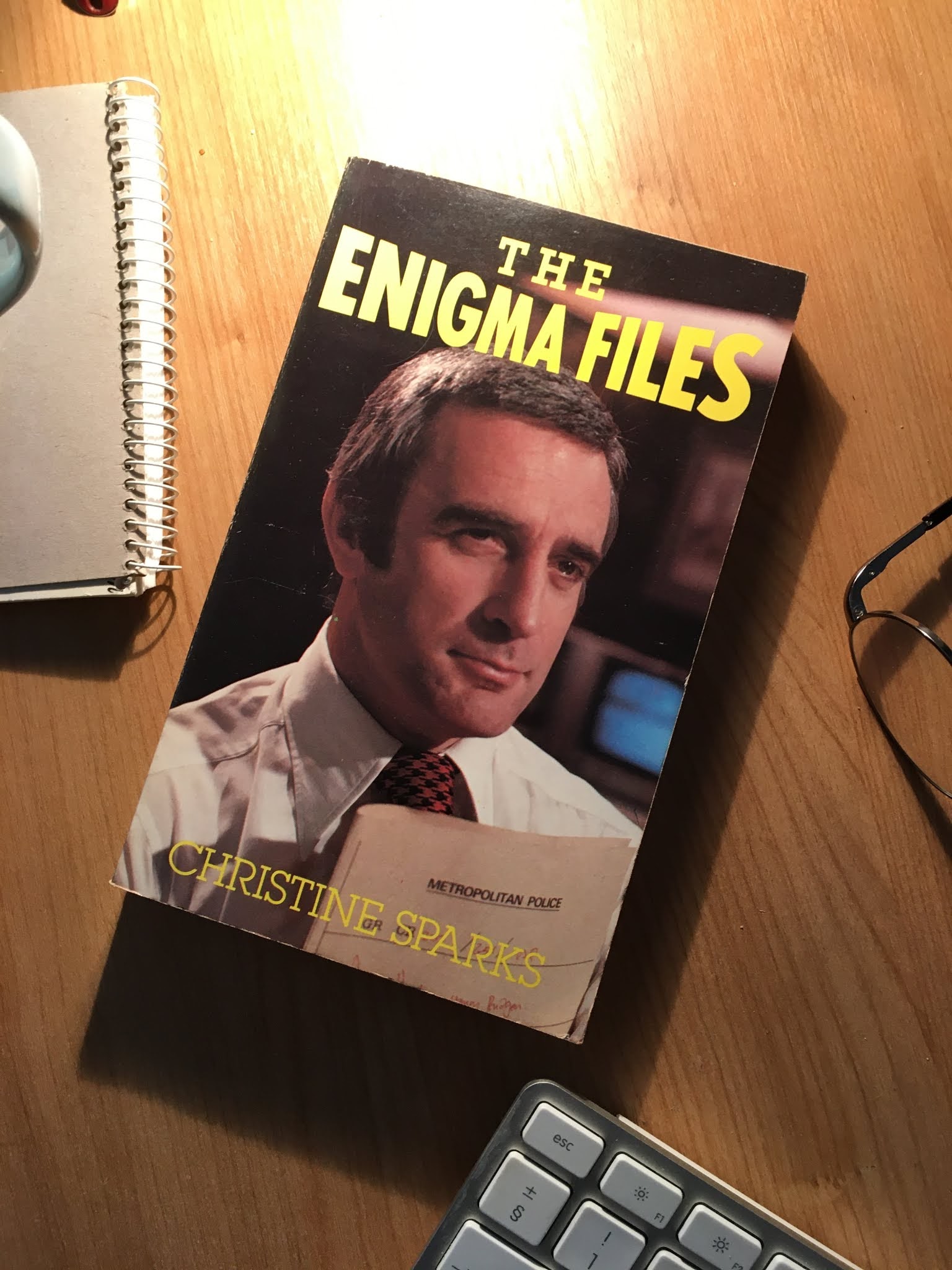
 Revisiting The Enigma Files


I think I have one of ‘those faces’: you know the type. There’s something naggingly familiar that reminds you of someone you’ve seen on TV. At work and elsewhere, people often used to tell me I looked like such-and-such off the telly. Not all of them good, either. But the first of these ‘not quite lookalikes’ is the one I always remember: Tom Adams.

He may have been 42 to my 20-something, but, around the early 1980s there was a certain, and occasionally-remarked upon similarity between myself and the stage and screen actor who, at the time, was perhaps best known for fronting a long-running series of commercials for furniture warehouse DFS. Much later, I learned that our dates of birth were merely two days apart (and some 23 years...) but I don’t think astrology has much to do with physiognomy. Maybe it was on account of this slight resemblance that I was prepared to cut old Tom rather more than the usual amount of slack when it came to his appearances on the small screen.

A capable actor and a familiar face on television and film during the 1960s, there was, nevertheless, a certain quality about Tom Adams that made him an ideal candidate when the DFS gig came up. Remember Patrick Allen buzzing around in his helicopter whilst extolling the virtues of Barratt Homes? Yes, that quality... avuncular yet assertive: the tone is warm and reassuringly confident, but there’s no mistaking the call to sit up straight and pay attention. Admittedly, nobody did it quite like Patrick Allen (still much imitated long after his demise), but Adams came pretty close. Over the years, he clocked up guest appearances in the likes of The Avengers, Maigret, Dr. Who and even The Great Escape, as well as ongoing character roles in The Onedin Line and Emergency – Ward 10, although he remained under my own personal radar until the spring of 1980 when the BBC smuggled onto the schedules a low-budget crime drama series called The Engima Files.

The Enigma Files was possibly the first example on television of what would now be called a ‘cold case’ drama. Adams played an ex-Detective Inspector placed in charge of a warehouse of ‘open case’ files: investigations that have been left unconcluded but are no longer being pursued. It was original enough to grab my attention in an era when new, British detective type drama series were surprisingly thin on the ground, and accordingly, I tuned into BBC2 at 9.30pm on Tuesday, April 15, 1980.

Let’s just look again at that last sentence: BBC2, Tuesday, 9.30pm, April 15... this was clearly not a series of which the BBC entertained great expectations. With a start date of mid-April, the 15-part series would end in late July, a traditional television graveyard. A start date in January would have given it more of a chance, and as to the channel placement: well, I’m not sure to what extent if at all BBC2 commissioned its own drama series or whether this was a case of a show considered a dud being quietly hidden away in an inconspicuous slot. And slots don’t come much more inconspicuous than 9.30pm on a Tuesday, on BBC2. Even One Man and His Dog managed better...

So what was all the lack of hoo-hah in aid of? Thanks to the miracle that is YouTube, we can now find out, as some public-spirited user has uploaded what may very well be the entire 15-part series. The Enigma Files wasn’t just buried on release, it’s stayed that way ever since, without so much as a half-baked VHS to its name. I’m not sure if it found its way onto satellite, but if so, it eluded me (not that I was looking out for it). You might say, it became its own cold case...

Watching it again after over thirty years, it has acquired a quality it most certainly did not possess at the time: nostalgia. The street scenes, populated by dirty, unappealing cars (not to mention citizens) are strongly redolent of the late 70s (with good reason), and the grim November/December weather merely adds piquancy to that whole ‘winter of discontent’ vibe. Contasting this, the VT scenes look, to quote a comment from the TV forum Roobarb’s, ‘beige’: an excellent description which can be applied to a whole raft of videotaped drama and comedy from the same era.

The opening episode, The Sweeper, sees Detective Inspector Nick Lewis shunted out of the force, apparently on account of his maverick tendencies. The way his superior officer is going on, you’d think he was dealing with Jack Regan, not cosy Mr. DFS sofas. But heigh-ho... Nick takes up his new job in a very beige late 70s office where Sharon Maughan is doing a screen test for the Nescafé commercials that would make her a household face later in the decade (she is, honestly, stirring a cup of coffee when we first meet her). Sharon plays Kate Burton, a civil servant in charge of the administrative backwater in which Nick has been dumped. The only other member of the ‘team’ we get to meet is Phil Strong, a slightly chubby guy with a bad sweater and an even worse haircut, played by comic actor Duggie Brown (and, surprise, surprise, Phil is the series’ token ‘comic turn’).

Rather than spending all day filing dusty old Eastlight box files, DI Lewis, egged on by a daughter old enough to be his wife, decides to look into some of the unsolved cases, and starts with the murder of a petty criminal in the grounds of the mansion of a wealthy crime boss, portrayed by that doyen of Talking Pictures TV, Sydney Tafler. In the course of the investigation, Nick narrowly avoids being blown up by a car bomb and blown away by a sawn-off shotgun, all of which sounds like ripping adventure on paper and must have helped sell the series to whoever signed off on it. But the Enigma Files is no Sweeney. Sure, it had aspirations in that general direction: but Tom Adams is just too likeable to be a rival to Jack Regan, and despite some half-hearted efforts on the part of series writer Derek Ingrey (nope, me neither), the hoped-for bristling relationship between Nick and Kate doesn’t really catch fire... at least not in this first episode.

The music doesn’t help: back in the late 70s, it was written into the statute book that every crime or detective drama series must feature slightly funky incidental music with wah-wah guitar. That box was ticked with due diligence, but the result sounds more suited to accompany the exploits of PC Penrose than a hard-nosed detective on the mean, rainy streets of North London.

The drama proceeds at a reasonable pace, with a few talky interludes punctuated by some action sequences that feel more like an obligation than a natural part of the storyline; and, if you check it out, don’t expect much from the ending. But do check it out, because The Enigma Files had its heart in the right place, and is warmly nostalgic in all the right ways. It’s easy to see why the BBC clearly thought so little of it in its day, but the series did spawn the obligatory paperback novelisation, which suggests it might have done rather better business than Auntie anticipated. And, as a 19-year-old viewer, I stuck with it for pretty well the entire run, so it must have had something... apart from a lookalike lead actor, of course.

And now, having said all that, I’d like to take this opportunity to sell you a three-piece suite... 

https://youtu.be/nWx95k37tvM