Wednesday, 30 September 2020

'Jolly good show, old boy'... Thunderbirds turns 55


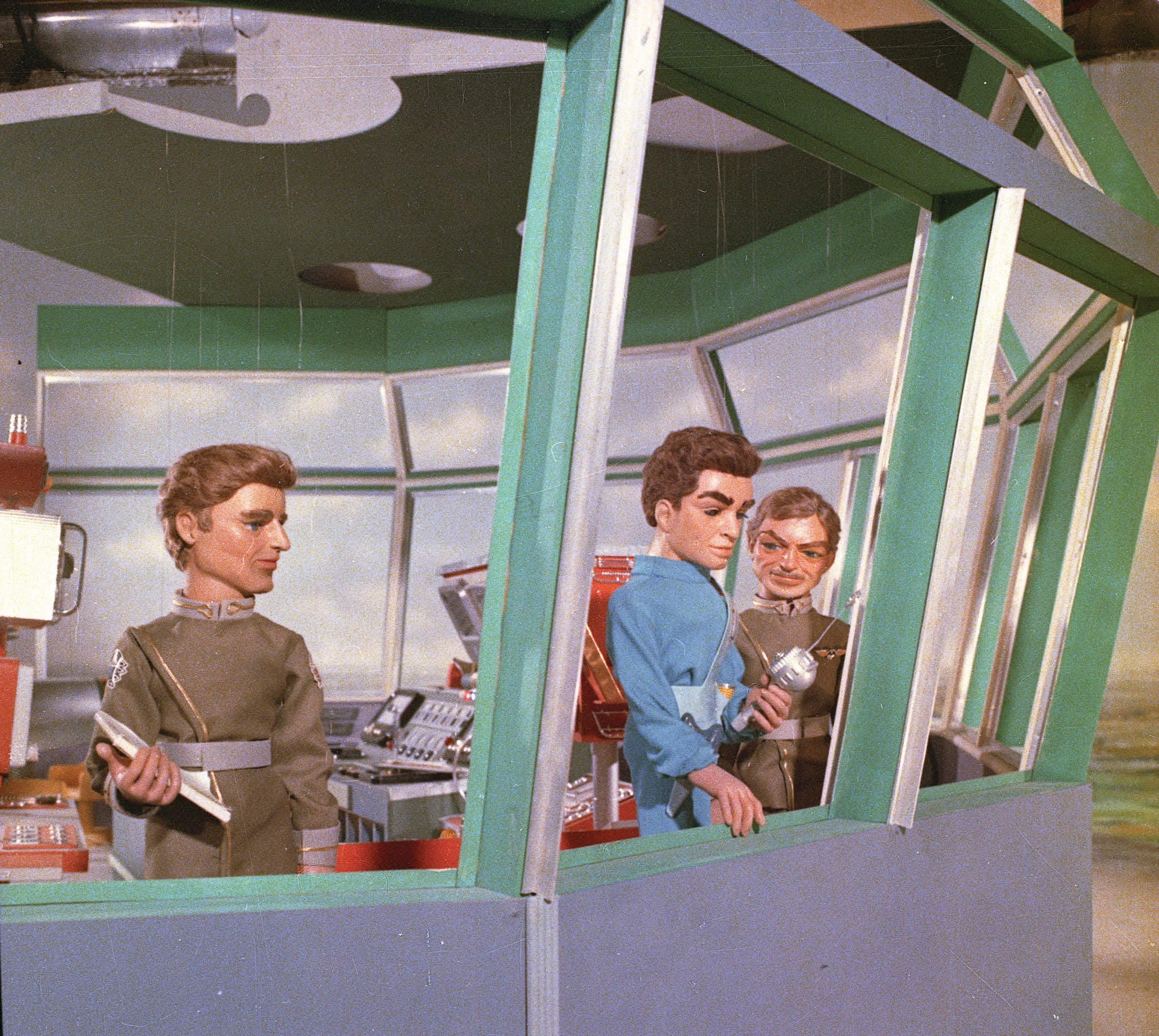
Sobering as it is to report, I shall do so anyway: Thunderbirds, the iconic puppet series that many of us grew up watching, reaches its 55th anniversary today, September 30th. Meaning that if you can remember those first broadcasts, you’ll be around the 60 mark, if not older.

Five and half decades is a long time, and over the years, Thunderbirds has become so much a part of the morass of popular culture that it’s hard to conceive of a time before it existed, or even remember how it felt to encounter the series as something unseen and unknown. If I try hard enough, I can just about remember...

Even by 1965 standards, the build-up to Thunderbirds, in the weeks approaching its debut, was fairly heavy duty. The readership of TV Century 21 comic (of which I was not yet a member) had been seeing sneak previews of the series for months, with early issues featuring cover photographs of hardware such as Fireflash and the Sidewinder. No actual Thunderbird machines were shown as yet – that would have been too much of a spoiler – but Lady Penelope had stolen a march on her International Rescue colleagues with a whole pre-Thunderbirds raft of escapades, illustrated by ex-Dan Dare collaborator Eric Eden.

I didn’t start getting TV21 on a regular basis until the autumn of 1967, but it was still Lady Penelope who served as my entree to Thunderbirds. A short time before the series came to television, her ladyship was ‘interviewed’ on ATV Today, the regional nightly news magazine seen by viewers in the ITV Midlands region. Pieces of this film resurfaced within the past few years, but even before they emerged, I retained very strong memories of this first look at Thunderbirds. I also recall a feeling of mild dread when Lady P,  asked to sum up the new series, described it as ‘Stingray, Fireball and Supercar all rolled into one’. Fireball and Stingray were both favourites of mine, but I had unpleasant memories of Supercar, mostly on account of its goggle-eyed, caricatured villain, Masterspy. Would this baldy nemesis be a part of the new series, I wondered? I even advised our mum that we should ‘turn over after Tingha and Tucker’ (anticipating a 4.55 screening time) just to be on the safe side. Was Masterspy really that bad? Was it worth missing out on a whole new series just because of one bad bald guy?

Any such qualms were set aside minutes later when the interview paused to give us our first look at this brand-new series. The launch sequence for Thunderbird 2 was one of the clips chosen, and damned exciting it looked too... like a super-duper version of the slide in our local playground, with the added bonus of terminating in the futuristic control cabin of an extraodinary, gadget-laden machine. This begged any number of questions: who was the guy going down the slide, and what was the machine? A second clip, culled from The Perils of Penelope, showed us FAB 1 in action – and any car equipped with armaments was just asking to be delivered to our local toy shop in time for Christmas...

Such was the pervasive influence of Thunderbirds across the UK media that word of the series even reached households not in possession of a television set. I know this to be a fact, because one of my friends from down the street, a lad a couple of years older than myself, came up to our house to watch Thunderbirds because his parents (both teachers) didn’t own a television. I can clearly remember us sitting down in front of our old GEC 405-line receiver, at 7pm on Thursday 30 September 1965... yes, seven pm. This was a novelty in itself. Supermarionation series were usually placed in the 5.25 slot preceding the ITN News, although I could dimly remember seeing Fireball XL5 in this mid-evening slot a few years earlier. It all served to add to the excitement – Thunderbirds must be good if it was being shown at seven o’clock...

Even today, the opening countdown, with its fast pull-back on the hero craft still evokes a memory of seeing it all for the first time... those chords... the dramatic voice (Jeff Tracy, as we would soon discover)... and those vehicles. Then, before you could take it all in properly, came the genius moment: the fast-cut preview of tonight’s episode. I’d never seen this done before, and in all probability it hadn’t been attempted, certainly not in such a driving, dynamic fashion. Seeing all that action condensed into just twenty seconds of screen time, you couldn’t possibly turn off or turn over: you were hooked.

And right there, amongst the first shots in that opening sequence, was the bald villain I’d been half dreading – only this time, his eyes lit up! Curiously, this didn’t bother me at all, and although the Hood was the first character we met in that episode, I instantly dismissed any reservations I’d had about Masterspy being part of the new series. In retrospect, an exotic temple in the middle of the jungle seems a strange place for Thunderbirds to start, but this establishing scene was almost certainly part of the extra 25 minutes that had been added to the original, short-form pilot at the behest of Lew Grade. None of which mattered at the time, if it even does now. What mattered was that we were getting a whole hour of futuristic puppet action where before we’d had just twenty-five minutes.

My first really clear recollection of that original broadcast is the establishing shot of Fireflash on the tarmac at London airport. I was already a big fan of aeroplanes: I’d never seen a real one, but there were several in the toybox, and now here was the most exciting plane I’d ever seen. I’m not sure that it didn’t even eclipse the Thunderbird machines: it’s probably the best designed vehicle in the whole series.

Even before that first episode was over, I was hooked on Thunderbirds... the music, the hardware, the characters, everything. Lady Penelope had been almost right – it really was all the preceding series bundled up together, but with one important difference – it was much better. We didn't know it at the time, but Gerry Anderson had peaked. This was simply the most extraordinary thing I’d ever seen on television. One might even echo the words of London Airport Commander Norman when he congratulates Scott on International Rescue’s first successful operation: ‘Jolly good show, old boy.’

* * *

Before the end of Thunderbirds’ first run on television, in March 1966, our dad set up his reel-to-reel tape recorder to capture part of a soundtrack on audio tape. A whole episode would have used up more tape than we had available, so he chose to record the first five or ten minutes of the episode, plus the closing credits: this would mean that, if nothing else, we would have recordings of the music (although by this time I already owned the Century 21 Mini-Album Thunderbird One, bought as a gift at my fifth birthday a few weeks earlier). The episode selected for the recording was the last in the series – Security Hazard – and the recording, which survives to this day, offers up a couple of surprises.

Firstly, the opening credits. On its first broadcast, on Thursday 31 March 1966, Security Hazard cut straight from the episode preview sequence into the episode itself – there was no Thunderbirds theme (the recording of which was half the point of my dad’s endeavours). The tape ran right through with no pauses or edits, and the surviving audio proves the point. The tape was stopped after around five minutes’ worth of the episode, just before the first ‘flashback’ sequence, but our dad started it up again right at the end, hoping to capture the famous theme. But again, disappointment – the programme was unceremoniously faded out on the second credit, and went straight into a commercial with no annoucements or continuity of any kind. For those who think the phenomenon of ‘messing with the end credits’ is a recent invention, here is evidence that broadcasters were doing similar things as far back as the mid-1960s.

The series may have ended, but as a cultural phenomenon, Thunderbirds was only just beginning. In part 2 of this article, I’ll look back to some of the merchandise I and many other fans enjoyed during the series’ first year on air.

Wednesday, 2 September 2020

1999 @ 45


Part Two: ‘Brian Blessed’s Fizzy Drinks Machine’


By early 1976, reports were reaching the newspapers that a new series of Space:1999 was in the pipeline, or perhaps under the lunar surface, for change was, apparently, afoot. The first thing I knew of this second series was that Main Mission, the hub of activities on Moonbase Alpha, was being relocated underground. I’d found the expansive Main Mission set one of the visual attractions of series one, a far cry from the somewhat cramped conditions on board the starship Enterprise, and a world away from the cosy control rooms of UFO. It looked big, impressive, cinematic. But it was all going to change. The other major, and unwelcome change was the loss from the cast of Barry Morse, whose portrayal of Professor Bergman had wrung some genuine warmth and humanity from scripts where characterisation of any kind was always thin on the ground.

Perhaps the most unusual aspect of the series 2 announcement was that it happened at all – no former Gerry Anderson production had run to a bona fide second series: only Thunderbirds had endured beyond its original production run, spawning two feature films and a handful of extra episodes. Given what happened on Space:1999, it was perhaps just as well. Aside from the core characters, and the Eagle spaceships, series 2 was as unlike series one as series one had been to UFO (indeed, Space:1999 series one evolved out of a proposed second series of UFO).

When series 2 eventually rolled around, on Saturday 4 September 1976 (exactly a year to the day since its predecessor had gone to air), I was able to see the extent of the changes. Until this point, I’d had only a vague idea of the differences that were in store, but now it was all too apparent. No Bergman, no Kano, no Paul Morrow... a gloomy, clausatrophobic control room in place of the airy Main Mission... Eagles with bits stuck on the sides... pointless new coloured jackets... and did I mention the music? No, and with good reason. It was all different. And not in a good way.

For some people – especially the unimaginative execs in charge of ITC New York who apparently demanded most of these creative changes – different means better. Not in the case of Space:1999. For all its faults, series one had achieved a cool, futuristic aesthetic, clearly influenced by 2001, but managing to step clear of its shadow. The sometimes unorthodox scripts were more like ‘proper’ (ie literary) science fiction than anything Gerry Anderson had produced up to that point, and despite a tendency to dabble in the realm of psychedelic fantasy as opposed to actual science, had managed to keep on the right side of the line that divides quality sci-fi from trash, and there were some thoughtful moments of philosophy that almost came up to the level of Star Trek season one.

Even Star Trek had succumbed to the gravitational influence of populism, and its second and third seasons found room for some ill-judged attempts at either comedy or basic pulp science fiction, two elements which Space:1999 embraced far too thoroughly in its second series. It failed to impress even my 15-year-old self, with my diary entry for episode one referring to the Alphans blowing up ‘Brian Blessed’s fizzy drinks machine.’ Suddenly, a series that had been dark, ominous and chilly had become brash, colourful and cartoon-like. Never mind that a shape-shifting alien had joined the crew... and wasn’t that the bloke out of The Protectors playing... er... the bloke out of The Protectors in outer space? Most of the blame for this catalogue of crap can be laid squarely at the doorstep of Fred Freiberger, who had wrought the same populist makeover when he was brought in as producer on Star Trek’s third season. Freiberger, writing under a pseudonym (who wouldn’t) also managed to turn in the worst episode of this dire season in the form of The Rules of Luton. Yes, Luton, yes, the town in Bedfordshire, with the football team once beloved of Eric Morecambe. Apparently, Frieberger had seen the sign on the M1 and thought it sounded a bit like an alien world. Which it may well be, but I’d like to bet it doesn’t run to talking trees... 


'Sorry, wrong series...' some of the Space:1999 publications that appeared alongside series 2 had a distinctly series one flavour to the contents...
The second year’s Space:1999 annual had arrived somewhat sooner than its predecessor, and my diary records that I acquired a copy during a trip to Birmingham on Tuesday 17 August 1976. ‘Is good’, the diary reads (many of my diary entries appear to have been written by Manuel out of Fawlty Towers...) Despite its publication date, mere weeks ahead of series two, the second annual remained firmly in series one territory. It was also something of an improvement on the first, which showed signs of having been put together in a bit of a hurry, and the artwork was better (albeit not by much). Also arriving in booksellers at the same time (and bought on the same shopping trip) were some further novelisations, Alien Seed and Android Planet, two original novelisations based on the series one format. Within weeks, a completely new set of series 2 novelisations would begin to appear, with dire cover designs that completely ignored the series graphics in favour of a ‘generic 1970s paperback’ approach.

By mid autumn of 1976, Space:1999 had become, even in my barely-formed opinion, mostly worthless trash. ATV clearly thought so too: the new series was rolled out initally on Saturday teatimes where it failed to compete against Dr. Who (in my own TV universe, the obverse happened, and it was the clash of Space... and Who that finally brought an end to my six years as a loyal viewer of the good Doctor). Late in October, Space:1999 was kicked firmly into kids’ TV land, with a 4.50 slot on Thursday evenings, commencing with, surprise, surprise, The Rules of Luton. This meant that viewers in the midlands got two episodes of Space:1999 in the space of a week, where one was more than sufficient... ATV didn’t even bother to complete its first run, with a handful of episodes held over until late summer of 1977, where they went out at a slightly more grown-up hour.

Before that, we got what I took to be a sneak preview of a new Gerry Anderson series. Indeed, if memory serves, it had been flagged up thus in press mentions sometime earlier in the year. The series (so I believed), was apparently to be titled The Day After Tomorrow, and took its format more or less wholesale from Irwin Allen’s Lost in Space: two families on board a spaceship pass through a black hole, presumably en route to Space:1999-style escapades on the other side. What set this production apart from every other Anderson endeavour was the fact that it had been bought by the BBC. The full background to Into Infinity is well documented elsewhere, so I won’t dwell on it here, other than to say that, back in 1976, I took it to be first glimpse of a work in progress, and was fully expecting a series to appear further down the line. Whatever the circumstances of its production, or its production values – it looks like a 1999 knock-off thrown together during a lunch break on the former production – I refuse to believe that Gerry Anderson ever pointed a film camera at a subject, especially an outer space subject, without expecting to get a series out of it. For my money, Into Infinity was meant as a series pilot.

Even today, I find it hard to articulate my disappointment at Space:1999 series two. Not only was it a travesty as a piece of self-styled space opera, it brought an end to a near unbroken run of TV success for Gerry Anderson and his team, and instead of exiting on a high, they went out on a stinker. The 1999 crew dispersed at the end of production on series two, and when Gerry finally returned to television in the early 80s, it would be with the disappointing, lazily-conceived Thunderbirds/Captain Scarlet mash-up, Terrahawks. Puppets were back, but instead of full-body marionettes they were, uh, ‘super macromation’… that’s Muppets to you, squire...

Perhaps a lesson had been learned: if you’re going to do risible adventures in outer space, do them with puppets – it’s cheaper.


Wednesday, 26 August 2020

1999 @ 45


Part One: A Stylish Weirdness

Forty-five years ago, at the end of August 1975, I was getting a bit excited about something new on television. I’d known about it for months, and as far back as March of that year, I’d bought the first in a series of paperback novelisations, published prematurely to tie-in with an anticipated broadcast date that never materialised. The programme in question was, of course, Gerry Anderson’s Space:1999 and there was just cause for excitement, if not celebration, given that it was all of five years since we’d last seen a new Anderson sci-fi production on our screens, in the form of UFO.

Viewers might have been forgiven for thinking that the Andersons’ run on television had come to an end. I remember my disappointment with The Protectors when the series appeared in 1972. A vapid, watered-down clone of a standard ITC action/adventure template, this glossy cosmopolitan trash wasn’t what anyone had come to expect from Gerry and Sylvia Anderson. For me, The Protectors – slick, soulless, formulaic junk – was the death knell for the futuristic schtick that had been the Andersons’ stock in trade. But I would be proven wrong.

News of nascent film and television endeavours was hard to come by in that era, with few if any magazines or informed sources available to consult. Latterly, and, I have to say, regrettably, far too many putative Anderson productions were flagged up across the media, with barely a single one actually making it into production. I saw the man himself, at a convention in Birmingham some time during the 1990s, outlining the format of a new science-fiction series he had in development. He spent a long time describing it, and to my certain knowledge, a former acquaintance of mine was already helping to develop the script. I think it may have been called Eternity... appropriately enough, since it never arrived. Back in the 70s, it would have been quietly set aside and nobody would have been any the wiser (viz. the Anderson’s puppet/live action pilot The Investigator, filmed and shelved circa 1973).

Unless one was a regular subscriber to British entertainment trade papers, no advance notice was given of any TV series until it was well into production and at a stage where stills could be released to the likes of the TVTimes. And it was, indeed, in the TVTimes, some time during 1974, that I first learned of a new Gerry Anderson endeavour called, so the piece told me, Space 99. Cool title, I thought. Cooler, in fact, than the somewhat clumsy title it ended up with. There wasn’t much to go on at this stage: a black and white photograph (reproduced above, in colour) of Martin Landau and Barbara Bain (neither of whom was familiar to me) was accompanied by a single, short paragraph referring to the new series. The uniforms and the Main Mission control panel backdrop hinted at another sci-fi production, if the text didn’t make it explicit. And in any case, the name Gerry Anderson was synonymous with science fiction.

I’m fairly sure this small promotional piece appeared quite early in 1974, and I awaited further developments, expecting to see the new series on air in the autumn. What I did see, on Monday 23 December 1974, and in the context of a BBC Horizon film about the movie special effects industry, was a brief clip from the pilot episode Breakaway. The clip showed an Eagle, being flown by remote control, making a crash-landing on the moon, but it was devoid of context: no mention of the series; no sign of any of the cast members; even the ship itself was referred to simply as a ‘moon bus.’

Fast forward to Saturday March 8, 1975, when on a trip to the nearest branch of WH Smiths, I discovered the first two Space:1999 novelisations; ‘Breakaway’ and ‘Moon Odyssey’. The cover designs were somewhat simplistic (and I should know, having designed many covers for Space:1999 DVDs and blu-rays), but back then all one wanted from a TV tie-in paperback was a decent rendering of the logo, and some colour photos, and the Orbit paperbacks offered all that. In fact, I had no idea whether the cover treatment of the logo was accurate or not, but it looked like the kind of thing one might expect to see. Notably, there was no ‘Gerry Anderson’ credit either – something which the man himself took me to task over after I omitted it from a Fireball XL5 DVD. In fact, the Anderson name did not appear anywhere in either publication; the back cover blurb referred only to ‘ATV’s space spectacular’, and the authorial biographies referred only to the writing credentials of authors E.C. Tubb and John Rankine.

You might imagine that, as a Gerry Anderson fanatic, I took these books home and immediately read them from cover to cover. But you’d be wrong. I held fire on reading my Space:1999 books for the time being, happy to wait for the real thing to turn up on television. The books’ appearance was a sure sign that the series must be about to appear on television any day, and a spring 75 debut was, I believe, the original plan. How or why it got deferred until the autumn, I have no idea, although autumn was the traditional time at which the television companies rolled out their big new productions.

My diary doesn’t mention Space:1999 again until Saturday 30 August 1975, when a trail for ITV’s ‘Big Season’ included excerpts from the forthcoming Anderson space opera... and also, oddly, enough, the third season of Batman which was finally coming to viewers in the midlands... a mere eight years after its US broadcasts. By this time, I already knew that Space:1999 would begin its run the following Thursday, 4 September, at 7.00pm. It seemed an unusually early hour for such a big budget, adult sci-fi series. After all, UFO had aired at 8pm, with some of its more controversial episodes deferred until even later hours; and over on the BBC, Star Trek had long since settled into a comfortable 8.10pm slot. Perhaps ATV’s programme planners were thinking back to the 1960s, when series like Thunderbirds, deemed to have ‘family appeal’ were shown at this same hour, drawing in both the target audience of children and their parents as well.

I counted down the days and, in anticipation, began reading the ‘Breakaway’ novel (itself somewhat different from the TV episode, having been derived from the original 90-minute pilot script). Thursday 4 September was also the first day of the new school year and, as mentioned above, the evening schedule also saw the return of Batman – which I was able to see in colour for the first time. The caped crusader, however, paled into insignificance next to Space:1999 which was literally the most extraordinary thing I’d seen on television up to that time.

It was also the last time that I’d get the frisson of excitement at the unknown that always came with any new Gerry Anderson series (well, most of them anyway, we’ll exclude The Secret Service). The first sight of the opening titles (with their fast-cut montage of tonight’s episode which took me right back to Thunderbirds); the first hearing of the music; working out the characters and their roles; marvelling at the hardware, sets and special effects. All this had been part of the first run experience of every Gerry Anderson production going back to Thunderbirds, and in this respect, Space:1999 did not disappoint.

I was more than satisfied with what I’d seen on that September evening, and looked forward to more of the same as the autumn wore on into winter. However, it seemed my opinion was not widely shared. The next day at school, friends were complaining about the ‘cardboard characters’ (they’d probably been reading some of the less than complimentary newspaper reviews) and the strange low-key ‘whispery’ speech of leading characters like Koenig and Russell (I hardly noticed it at the time, but today I find it somewhat irritating...)

Within a week or so of this first broadcast, I’d begun creating my own Space:1999 comic, unhindered by the fact that I had only scant photographic or illustrative references. Look-In comic had featured the series on its cover, graced with a typically dynamic, scumbled illustration by noted movie poster artist Arnaldo Putzu. The comic strip inside was less appealing, drawn in a hectic, jagged fashion by either John M Burns or Martin Asbury. Whoever was responsible, I didn’t like it, and this was the only Look-In of the era that I took the trouble to acquire.


How not to design a Space: 1999 Annual... wrong font (Data 70), flipped pic of Barbara Bain. Orbit books did better with their 'as seen on screen' title treatment... well, almost.           

The first Space:1999 annual arrived on Tuesday 23 September (I know annuals are meant for Christmas, but I wasn’t about to wait that long). A friend ordered copies for us through his mum’s mail-order catalogue. Now, at last, I had a few more photographs to refer to, although the artwork was dreadful – as were the scripts. As the autumn wore on, a few more paperbacks began to appear, which I dutifully collected, but did not bother to read – nothing, after all, could top the experience of watching the series itself.

At the age of 14, my ability to judge any television or film production was fairly limited, if not non existent. As long as it fulfilled various criteria – space, or spy, or comedy, and preferably made in the UK (I made an exception for Star Trek), then it was good to go. Never mind how good, bad, indifferent or frankly rubbish the script, acting or direction were. Direction? I barely knew such a thing existed... Thus, Space:1999 didn’t have to do very much to meet with my approval. It was set in space, made by Gerry Anderson, featured a lot of explosions and had good, solid special effects. I couldn’t ask for much more. Yet even I had to acknowledge that certain episodes fell some way below the standard set by others.

Second to air was Force of Life, an episode whose direction (by Prisoner and UFO stalwart David Tombin) gave it a stylish weirdness that compensated for a script where odd things happened but were not properly explained. I liked it a lot, without realising that this would become something of a template for the series – show a lot but explain almost nothing. Some episodes dabbled in metaphysics, whilst others were simply obscure for obscurity’s sake. The best stories were those whose plots were developed and resolved with acceptable logic, no matter how bizarre the events they depicted: Voyager’s Return and The Last Sunset were probably the outstanding examples. My diary records that I found Dragon’s Domain ‘one of the best yet’, an opinion I’ve had cause to revise over the years, but even now, I’ll still concede that it looks great, even if it doesn’t make a whole lot of sense.


The real ‘stinkers’ from series one were, for my money, The Full Circle (caveman stories begin and end for me with The Flintstones), End of Eternity (Peter Bowles looks wrong in every conceivable way), Ring Around the Moon (just boring) and, worst by a long margin, Missing Link (dreary, pretentious, tenuous tosh not even alleviated by the presence of Peter Cushing). I’m even less forgiving of the series today, but back in 1975-6 these episodes struck me as lacking a certain something.

As to how well the series was doing on television, I had no idea. As long as it remained on ITV, on Thursday nights, all was well. It meant I missed out on six months’ worth of Top of the Pops, but there wasn’t a great deal to see there as 1975 shaded into ‘76. But the new year would bring changes on Moonbase Alpha, not all of them good.

To be precise, not any of them good... as we’ll explore in part 2.


Tuesday, 2 June 2020

Ponderings from a Parallel Universe


'Bad Spock' and... bad Kirk? Or is it good Kirk in bad Kirk's clothes? Star Trek enters the arena of the parallel universe with Mirror, Mirror

In a recent post, I touched on the fictional conceit of the parallel universe: fifty years ago, one of the great British examples was being played out on television in the form of the Dr. Who serial Inferno. And, later that same year, viewers in the UK would be introduced to another, more celebrated example, Star Trek’s season two episode Mirror, Mirror. These two stories have distinct similarities in that each posits an alternate version of the world as we know it, populated by fascist döppelgangers of familiar figures. The very word döppelganger also suggests another example of the same plot device, cooked up by Gerry and Sylvia Anderson for their 1969 film of the same name. So what is it with these parallel universes? Where did they get started? Are we, in fact, living in one right now? Looking around at 2020, I’d say it meets most of the requirements: populations living under strangely altered circumstances, bad guys in power, killer virus at large. Perhaps the question for us today is not ‘are we living in a parallel universe?’ but how do we get back from it?

Wikipedia has a lot to say on the subject of parallel universes, alternate realities, call them what you will, but their article is muddled and lacks focus, allowing far too much material under the ‘parallel earth’ umbrella. I would argue that the ‘classic’ parallel universe of speculative fiction – and, indeed, quantum physics – is not merely ‘another world’ or a strange, new country such as are visited in the likes of the Narnia series and Gulliver’s Travels (both of which find their way into Wikipedia's very muddled discussion). It is a fictional world whose characters and settings duplicate an existing fictional world in a way that allows the author to engage in often complex moral debate about the actual world we inhabit. That, after all, was the original purpose of science fiction.

Looking back at the aforementioned Dr. Who serial, Inferno, I reckoned that this was probably the first time I’d come across the idea of a parallel world, inhabited by a cast of döppelgangers, and I was almost right; but not quite. The very first example I saw was in the Fireball XL5 Annual published in 1964, in which series writer Alan Fennell penned a comic strip adventure called Solar System II. In this six-page story, the crew of Fireball XL5 are pulled across the universe by a time-travel beam invented in the distant future by their counterparts on a parallel version of Earth, ‘with people and things the same as the Earth we know,’ as Steve Zodiac explains (to his parallel self). The only difference is that the new Earth is one hundred years ahead of the one they’ve left behind.

The parallel Earth visited in Dr. Who’s Inferno serial added the intriguing notion of the duplicate world being a fascist dictatorship, with the implicit notion (never stated as such) of the Nazis having won the Second World War. Back in 1970, this was still a relatively novel idea. Star Trek had already been there, albeit on a different planet (with ‘parallel development’) in the 1967 episode Patterns of Force (screened in the UK in 1970). Of all the many parallel world fictions, the ‘what if Hitler won the war’ has become the most widely explored – to the point, I would argue, of tedium. Examples are too numerous to list, but the idea seems to have first taken root with Philip K Dick’s 1962 novel The Man in the High Castle, and has been doing the rounds ever since. Stephen Fry turned the whiskery concept on its head with his novel Making History, which speculates on the consequences of Adolf Hitler’s removal from history. Needless to say, it doesn’t end well...

Pulp sci-fi writer Murray Leinster’s Sidewise in Time is widely cited as being one of the first instances of the parallel universe in fiction, although H.G. Wells had toyed with the idea of alternate worlds running along parallel but altered lines to our own in novels such as Men Like Gods. But it seems that Star Trek’s Mirror Mirror was the first example in this emerging sub-genre to use the conceit of ‘evil döppelgangers’ as part of the alternate reality set-up.

The döppelganger is, of course, a fictional trope of its own, with examples including the 1970 thriller film The Man Who Haunted Himself, based on the 1940 short story (later expanded into a novel) The Strange Case of Mr. Pelham. Star Trek was only a few episodes into production when the series offered up its own take on the idea in the ‘good Kirk v. bad Kirk’ episode The Enemy Within. But these ‘evil doubles’ operate in our own world rather than being a manifestation of an entirely altered reality. Gerry and Sylvia Anderson fused the idea of döppelgangers and alternate realities in their 1969 feature film Döppelganger (aka Journey to the Far Side of the Sun) where the alternate reality is identical to our own, but a mirror image. There is no good/evil dichotomy, which leaves the script floundering somewhat. One of the fictional rules of any alternate reality is that you’re supposed to use it to advance moral/philosophical arguments about the world we inhabit... not merely as an excuse for a lot of special effects and explosions. The big problem with Döppelganger the movie is that it thinks it’s working on this deeper level... there are moments when it thinks it’s 2001 instead of what it really is – a very long episode of UFO.

Star Trek’s Mirror Mirror episode is itself embedded in a kind of alternate reality, as least as regards its first roadcast by the BBC. According to the Radio Times database (BBG Genome), this was on Monday 15 June, 1970, a date I cited in my earlier blog where I noted the close coincidence of this broadcast and the transmission dates of Dr. Who’s ‘parallel parallel universe’ (if you will), Inferno. Only, it didn’t happen that way. Despite being scheduled on the said date, Mirror Mirror did not in fact air on 15 June 1970, its first UK brodcast being deferred until Wednesday 11 November of the same year. Genome lists both dates, but only the November date is right. So what happened on Monday 15 June 1970 to cause this Star Trek episode to drift into an alternate reality? Simple: Britain got knocked out of the World Cup tournament, losing in the quarter finals to West Germany in a match played in the closing hours of June 14. The programme schedule for the evening of Monday 15 was evidently altered to offer a retrospective of Britain’s World Cup journey, and the World Cup Grandstand that had been scheduled to run from 18.00 to 19.20 that evening was clearly extended – kicking Star Trek into touch. But it gets better... Britain’s World Cup failure was widely interpreted as being a factor in the defeat, just three days later, of Harold Wilson’s government in a General Election that returned the Tories to power. The events that branch off from this single moment in history are myriad and complex. Somewhere, there may exist a parallel England where Britain, if not winning the 1970 World Cup, at least made it past the quarter finals, and Harold Wilson remained in number 10...

All of which suggests that there could be more to this whole parallel universe idea than a few science-fiction escapades. As recently as March of this year, scientists were excitedly discussing the concept as the ‘only possible explanation’ of a strange particle that did not behave as predicted and seemed to hint at a parallel universe where time runs backwards, an idea previously advanced by Stephen Hawking and others. As far back as 1954, Hugh Everett III conceived of what is now known as the ‘many worlds theory’, a branch of quantum physics which argues for the existence of parallel timelines occurring endlessly and infinitely through a process of ‘branching off’. Put in the most simple terms, the theory posits that for every event at the level of quantum physics, there is an infinity of alternate outcomes, all of which result in parallel but discrete realities. More than sixty years later, the existence of these parallel universes is still hotly debated by physicists, but most of the advocates of the theory are in agreement that there can be no travel between the realities. They are coincident, but self-contained. Unless, of course, you happen to be in possession of the console from the TARDIS... or a red Audi A4.

I once conceived my own humorous conceit regarding parallel worlds, partly to explain my own experience of reality which has, over the decades, seemed to oscillate between discrete and unconnected timelines. I’ve had, as it were, various different lives, often involving different protagonists who, typically, never interact with those from the ‘other’ realities. I decided there had to be a mechanism for these ‘transitions’, and found it in the form of Radio 4’s late-night shipping forecast. The shipping forecast had once prefaced the news at midday and 6pm, but for some years, on FM radio at any rate, it has been relegated to 12.45am where is always prefaced by an ‘iconic’ piece of music called Sailing By. I decided that this would be my ‘gateway’ between realities and that the transitions occured at those times when I was away from home and heard Sailing By on the radio, usually in the car. This, as I say, is merely a fictional conceit, not a genuine belief, before you summon medical assistance... Then, just a few months ago, when the present ‘lockdown’ situation had not quite kicked off, Radio 4’s PM programme saw fit to play this piece of music as a ‘soothing’ theme at the end of an edition in late March. I heard it in the car. ‘This isn’t good,’ I thought, invoking my own fictional conceit...

And, as if in acknowledgment of the fact that there really might be ‘something weird going on’, as I sat writing this piece, with the radio on in the kitchen, DJ Ken Bruce uttered the words ‘parallel universe’. Which, if nothing else, serves to illustrate how this once elegant science-fiction/moral philosophical construct is now a part of everyday speech. At least it is in this version of reality.

Whichever reality you inhabit, good luck in getting back from there. Beam me up, Scotty...

Wednesday, 13 May 2020

Survival Code

Doomwatch at 50: a timely reminder


The 'shocking' climax of Survival Code, summarised on this Radio Times cover from December 1970

Britain is reeling... how will a shocked viewing public come to terms with the bombshell that BBC1 has just (almost literally) delivered? Here in 2020, the words ‘Survival Code’ could be taken to signify yet another set of self-contradictory governmental instructions, but in 1970 they were significant for a much more trivial reason: as the title of the final episode of the BBC’s new eco-thriller Doomwatch, which had ended explosively on Monday 11th May. The episode was controversial, and its aftermath saw a record number of shocked viewers complaining in the only way they knew how: by writing indignant and possibly tear-stained letters to the Radio Times. The reason for this avalanche of mail? The unexpected demise of Doomwatch heart-throb Toby Wren, portrayed by future Jesus of Nazareth superstar Robert Powell.

At this point in Powell’s career arc, resurrection was definitely not on the table. He had signed up for just one series of Doomwatch, with no commitment to continue, and the production team clearly decided to use the situation to their advantage by building up a popular character who could then be shockingly written out of the format. From the outset, Powell’s character, an idealistic and trendily-attired young scientist, had been brought to the fore as one of the series’ star turns. So when, in the series’ finale, Survival Code, Toby was set to work disarming a nuclear device that had (somewhat implausibly) become lodged beneath a seaside pier, viewers must have been expecting the brilliant young boffin to save the day yet again. Which he did... in as much as his work helped avert a nuclear explosion... he just failed to save himself: having disarmed the nuclear stage of the warhead, Toby was blown to bits by the conventional explosive that served as the trigger for the device. His relief was palpable as he cried, in triumph: ‘I’ve done it!’ believing the disarming procedure to be complete. Then, seconds later, his expression altered dramatically as he found another wire, still leading to the detonator. Calmly, the RAF officer watching from above, issued his instructions: ‘Don’t pull it... follow it back to the terminal.’ Seconds later, the pier amusement arcade was consumed in a fireball. As dramatic televisual events go, it was unprecedented at the time: no one, but no one killed off their most popular character... and it would take a genius worthy of Conan Doyle to bring back Toby Wren, who was most definitely gone for good.

With the departure in flames of Toby Wren, and a second series of Doomwatch set to air from December 1970, a new young hopeful was called for, and into the breach stepped actor John Nolan, whose character Geoff Hardcastle was pretty much Toby-again-but-not-as-interesting. John Barron, always a reliable hand at bristling officialdom, returned in his ministerial role from The Plastic Eaters as a regular foil for department head Quist (John Paul), offering the writers a chance to take pot-shots at governmental laxity and incompetence. Plus ça change...

The first series had rightly been criticised for its sexism and the absence of any credible female leads, a failing which the production team addressed by introducing the mostly ineffectual character of Dr. Fay Chantry (Doctor, you’ll note, not Mrs or Miss or Ms) and the downright dull Dr. Anne Tarrant, the latter intended principally as a kind of love interest for Quist (implausible though the idea might sound). By mid series two, there were simply too many main characters, and some of the leads were absent for whole episodes at a time. The absence of arch chauvinist Dr. John Ridge (Simon Oates), whose shirts alone always made him worth watching, was a guarantee of this week’s episode being a stinker, and sadly many of them were.

By the time series three rolled around, Ridge was going off his chump, ahead of being effectively sidelined, and the storylines were moving away from the more hard-nosed ‘not quite sci-fi’ of series one towards more conventional political thrillers. Most of series three is missing, but I think we can live with that: the couple of surviving episodes only serve to illustrate how far the rot had set in. Back in 1970, Doomwatch was considered unmissable, but in 1972, nobody seemed to care any more. It still made the cover of Radio Times, but the summertime transmission slot was indicative of the BBC’s attitude towards this former flagship drama. It didn’t matter any more. Would Ridge destroy the world, as the Radio Times cover warned? Frankly, nobody really cared.

His shirts have sent him insane: Ridge poses with phials of anthrax on a Radio Times cover promoting Doomwatch's dodgy third series

I was too young to be tuned in to Doomwatch in 1970, so I missed my one and only chance of seeing many classic episodes, now sadly junked. Ironically, Survival Code itself did not survive, aside from the closing few minutes, retained for a teaser scene at the commencement of the second series. The rest of the episode is currently missing, with scant hope of its ever being recovered. Back in 1970, I was entirely unaware of the whole 'you killed Toby Wren' controversy surrounding Survival Code. I had, however, seen plenty of trails for earlier episodes, most notably the first episode The Plastic Eaters, whose preview ended on an image of the cover of that week’s Radio Times (showing a half-melted aircraft model kit inside an opened attaché case). From the little I saw of Doomwatch, in these early evening previews, it looked pretty damn exciting to me, but with a transmission time of 9.10pm, it was well beyond my bedtime at the tender age of nine.

Aside from these small clips, I remember Doomwatch principally as a series that seemed to stir up controversy in its day. Adults spoke about it, and the title was quickly picked up by the mass media as a convenient journalistic shorthand for any story related to environmental pollution (and despite what today’s youth may think, such issues did matter back then). Doomwatch returned for two further series, in 1970-71 and 1972: I had ample opportunity to see the final series, most of which aired during the school summer holidays (a ‘graveyard’ slot in the TV schedules), and I certainly remember seeing a trail for the episode Flood (along with a related Nationwide feature), and the series’ finale The Killer Dolphins. I may even have watched the episodes themselves for ten minutes or so, but sadly, they didn’t leave much of an impression. Thereafter, I forgot about Doomwatch almost completely. A year or so later, I came across a paperback novel by the series writers Kit Pedler and Gerry Davis, which reused the old Radio Times cover shot of the plastic plane: sadly, the book was not a novelisation of Doomwatch, and even as a standalone thriller, it was pretty woeful as a piece of writing – albeit nowhere near as bad as their follow-up novel, whose scarily realistic depiction of a nuclear meltdown is negated by a lot of feeble Bond-by-numbers stuff and a lead character utterly devoid of interest or personality. It does, however, chime rather unsettlingly with modern life, in that the storyline concerned the spread amongst the population of an incurable virus affecting the brain...

The poor characterisation in the novels serves to illustrates one of the principal problems with Doomwatch itself, which only came across to me when I finally got to see the surviving episodes many years later. The characters were either cardboard, or offensive, or both, certainly in terms of how they were written. It took the acting skills of series leads John Paul and Simon Oates to breathe some life into what were essentially scriptwriters’ clichés. Not only that, but the series is riddled with the kind of casual sexism that passed without comment in much television and film of the same era: much of it courtesy of Dr. John Ridge, a strange and not entirely believable hybrid of boffin and international playboy, like Jason King with a phD. Ridge would have been insufferable had it not been for the innate charm and sly humour of Simon Oates, who managed to make him the most watchable thing in the series. On the plus side, the first series contained some great ideas – not all of which made for great drama – and a few manipulative moments such as the rodent-paranoia story Tomorrow the Rat, which was taken surprisingly seriously despite including a scene in which Robert Powell attempts to remove a stuffed rat from his trouser leg by walloping it with a frying pan...

It took an article in archive television magazine Timescreen to rekindle my interest in Doomwatch, and convince me how good it must have been when it was at its height. The BBC’s mid-80s Sunday lunchtime archival show Windmill had dug up The Plastic Eaters and screened the opening few minutes during one episode, which gave me my first glimpse of Doomwatch in over a decade. I later acquired some very fuzzy multiple-generation VHS dupes of various episodes, which would have to suffice until an official release. This finally arrived in the form of two BBC ‘best of’ compilation tapes, but there would be no more to come for over twenty years, when Simply Media finally brought out a DVD box set of the surviving material. This in itself was slightly disappointing, because the company for whom I work, Network, had been in negotation to release Doomwatch, and would have made a much better job of it. Still, it was better than nothing at all...

So here we are, fifty years on from Survival Code, with survival right there on the agenda of everyday life. We’ve gone from watching Doomwatch to actually living through it. And, dare I say it, I suspect that Quist, Ridge, Toby et al would have made a better job of handling the current crisis than any of those currently in charge, who show every sign of attaining the same level of ministerial competence as John Barron.

Risible though it now appears in certain aspects, Doomwatch was an important step towards raising the public’s awareness of environmental issues and the many institutional failures that had allowed pollution to continue unchecked. Its message is even more starkly relevant now than it was fifty years ago: wake up to reality or face the consequences. And it proves that environmental activism does not begin and end with a Swedish schoolgirl. As the world struggles to cope with a disaster beyond even the imaginations of Kit Pedler and Gerry Davis, we should all take a moment to reflect on Doomwatch and our own new codes for survival...

As Donald Fagen once said, 'the keyword is survival on the new frontier...'

Tuesday, 14 April 2020

'Steve Zodiac's number is not in the phone book...'

Obsessing over Fireball XL5: 1963-1970
'Lieutenant Ninety, have you seen this week's TV Times?'


Amongst my earliest memories is a recollection of being brought downstairs to see Fireball XL5 on television. It was early in 1963, some time after 7pm, which, at barely two years of age, was past my bedtime. Nevertheless, I was brought downstairs just so that I could see Fireball XL5. It might have been the first episode: a logical assumption, I suppose. I can imagine my parents watching it and thinking it might appeal to me, despite it being shown at such an unusually late hour. In fact, from Fireball XL5 through to Thunderbirds, Gerry Anderson’s series tended to get their first run in this prime family viewing slot, courtesy of parent company ATV who had stumped up the money to pay for the series in the first place, and weren't about to let it get hidden away amongst the likes of Fred Barker and Ollie Beak during children's hour...

I have no idea how much of Fireball XL5 I was allowed to see on that or any other night during its first run; it didn’t matter a great deal, for the series would return for a repeat run the following year at the child-friendly hour of 5.25. Between then (mid-1964) and the summer of 1966, Fireball XL5 was rarely off the air, and was soon sharing the schedules with new arrivals Stingray and Thunderbirds (Supercar, Gerry Anderson’s earlier effort, had by this time gone missing in action). By the autumn of 1965, all three series could be seen in the space of a single week, and while Thunderbirds had debuted in the 7.00pm slot, three Supermarionation series in the space of five days’ of children’s programming must have seemed rather a lot. Not to me, of course. Given the chance, I’d have cleared the schedules to make room for more. But it had been noticed by the decision-makers at ITV.

I have it on good authority that ATV were told in no uncertain terms that the constant, heavy rotation of the Supermarionation series had to stop. With more in the pipeline, the schedules were in danger of becoming a live-action free zone, and ATV were simply enjoying too big a slice of the children’s programming cake (which was no doubt shaped like Thunderbird 2...) None of this would matter to me, except that, in a strange way, it does. I’d grown accustomed to seeing my favourite series on a regular basis, Fireball XL5 especially; but sometime during 1966, the endless repeats of Fireball came to an end. I can actually remember seeing the very last episode, after noticing it listed in that day’s edition of the Daily Sketch. It might even have been a one-off. Either way, the episode was Space Magnet: despite having been the fourth to be filmed, this instalment was habitually shown last of all, and its tag scene of Steve Zodiac and Venus gazing up at a full moon probably felt like a nice way to wrap up the series. The image remained in my mind – it was to be my last encounter with Fireball XL5 for a surprisingly long time.

The late 1960s became a Fireball-free zone. Up to now, despite enjoying the series, I probably hadn’t given it that much thought. It always seemed to be on television, and I was too young to notice that it was the just same episodes turning up time and again. I’d been bought some toys and books based on the series, and the books – a series of four annuals published between 1963 and 1966 – provided a Fireball fix during the brief interludes when the series not being broadcast. The first of these annuals was already looking the worse for wear, having lost its covers and a few inner pages within about a year of its arrival. This would become a key factor in what happened next...

By 1967 or 68, I was starting to notice the absence of Fireball XL5 on television, and began turning more often to the old annuals. I had a dim recollection of the missing covers for the first edition; then, at a school summer fete, I chanced upon a copy on the second hand book stall. I’d have had it like a shot, but our mum didn’t like the idea of bringing second hand books into the house. I mean, it could have been anywhere, might be harbouring unthinkable diseases, bookworms, mites. I had to let it pass: then, within half an hour or so, I saw the same volume being carried around by another child whose parents were less fussy than mine.

That did it... something snapped. For the next three years or more, I would become increasingly fixated on Fireball XL5. It was my first nostalgia trip, and by no means the last. At the age of six or seven, I could barely remember the programmes themselves, and no amount of poring over the annuals could make up for the experience of actually watching an episode: the music, the voices, the lighting. I later deduced that it was not so much the programme per se that I had responded to, but its aesthetic: a kind of noirish, low-lit version of outer space, with visuals steeped in the look of the 1960s. The space ship itself, though relatively conventional, always impressed me as a design, and I liked Steve Zodiac’s uniform so much that I managed to convince my mum to run me up an outfit using the red material from an old anorak. Penance, if you will, for what had happened at the school fete. Like the Gerry Anderson equivalent of sewing mailbags...

Quite early on, I’d been sort of convinced that Fireball XL5 was all going to happen for real. Of course, I knew it was just puppets, but there seemed no earthly reason why there shouldn’t be a real Steve Zodiac flying the actual Fireball XL5 from a real-life Space City. By the year 2062, anything was possible (I conveniently overlooked the fact that I’d be 101 years old by that time – anyway, we’d probably all live forever in the future...) Now, I knew Steve Zodiac was not a real person, but I was interested to know if there was actually anybody with the surname Zodiac, which even as a child I found a little far-fetched. If he was going to exist in the future, his ancestors would be around today. And, honestly, I looked in the Birmingham telephone directory under Z. Because Steve Zodiac’s ancestors must have been Brummies, mustn’t they? There weren’t many entries... but there was a Zodiac: Zodiac Toys, a listing for a shop (this was in the days before the Yellow Pages). Now, I wasn’t daft enough to imagine that Steve Zodiac’s great grandfather could be running a toy shop, but I’d looked into the matter and made a minor discovery: there was a Zodiac in the phone book. But it was probably best not to ring up and ask for a ride in Fireball XL5...

The mania for Fireball was well set in by 1970: photographs from that year’s holiday reveal that I had taken my plastic toy Fireball along with me. But salvation was just around the corner, for in the autumn came the news I’d been waiting for. Opening the TV Times for the week of 12-18 September revealed that Fireball was set to return, the day after the debut of Gerry Anderson’s latest offering, the new, live-action UFO. Somebody at ATV probably felt that Anderson’s earlier space effort might make a good companion piece. Either that, or they were being sarcastic. It didn’t matter: Fireball was back, along with a brand-new series to enjoy. I’m not sure if this set a dangerous precedent for a nine-year-old child: wish hard enough for something and it will turn up in the end. Either way, it worked. And it wouldn’t be the last time, either...


Tuesday, 24 March 2020

'From the Craters of Outer Space...'


This advert appeared in British comics during March 1970, utilising the same artwork that appeared on the backs of promotional packets

Fifty years ago, a minor alien invasion was under way across the UK. No, it wasn’t the Autons, or even the Silurians, both of whom were being dealt with over on the BBC by Dr. Who and the forces of UNIT... these invaders were small, brightly coloured, and had concealed themselves inside innocent-looking packets of breakfast cereal – Kellogg’s Sugar Smacks, to be precise. The invaders styled themselves Crater Critters and had already taken America and Australia by storm...

These colourful, comical creations were the work of Australian plastics manufacturer Rosenhain and Lipmann (R&L) who had specialised in cereal premiums since the late 1950s. One of their innovations had been small, snap-together plastic kits, requiring no glue, but their range of solid, moulded comical characters was to prove even more popular. Many such series were produced over the years, each of which typically comprised a set of six or eight different characters, occasionally derived from film or television copyrights, but often entirely original. If the internet is anything to go by, the most popular of all these creations, by a very long way, were the Crater Critters.

There were eight Crater Critters in all, and in their British issue, they came in a variety of colours: lime green, pale blue, orange, purple and magenta (not brown, as one website claims). The designs were both charming and completely original – but while the internet is very good at collating imagery and basic information on the characters, there is no record of who designed them.

In their original 1968 American/Australian issue, the Critters’ individual names were alliterative: Curly Critter, Cranky Critter, etc. In Britain, they were re-christened, somewhat randomly, with a variety of wacky or space-related names. The whole range was illustrated on the backs of the Sugar Smacks packets in which they were to be found, with the same artwork also featuring in colour advertising which began to appear in British comics and magazines around the beginning of March, 1970, with the above example appearing on the back cover of TV21 & Joe 90 dated March 14.

Despite the advertising, it's just as likely that I found out about Crater Critters from the cereal boxes themselves. Late in 1969, Star Trek’s Mr. Spock had usurped Joe 90 as the cover star on the packaging of Kellogg’s Sugar Smacks (as can be seen from the inset at the top of the ad), and I’d been collecting a range of Star Trek badges that had been offered over the past few months. Unusually, there were only five badges in the range (previous sets had run to six), and the promotion lasted long enough to enable me to collect all five examples. Even with the full set completed, there was no reason to stop eating Sugar Smacks (apart from the obvious), and in due course, a packet must have arrived blazoned with the new promotion. Should any doubt have remained, the colourful advertising would have been more than enough to convince me to stick with (and, indeed, to) Sugar Smacks for the forseeable future.

The first Crater Critter to come into my possession was a friendly-looking creature called Glubber. He was shaped like an inverted comma, with thin, bendy arms, and appeared to be standing on one foot. If anyone had told me I’d still own this tiny plastic creation half a century later, I might not have believed them – although I’d probably have derived a kind of comforting glow from such foreknowledge. My own personal Glubber was moulded in orange plastic, and as the weeks wore on, it soon became apparent that orange was the most popular colour for Crater Critters. Next to arrive was either Gloob (two arms sprouting, tree-like from the top of his head) or the endearingly daffy Upsy-Downsy, whose face was the wrong way up for his body. Upsy also sported a black plastic boater which could (wow!) actually be detached from the character. Excessive detachment and re-attachment eventually caused the plastic connecting tip to snap off, at which point the hat became a permanent, glued-on fixture. It must have been very good glue, because it’s still firmly stuck there, fifty years later.

Collecting Crater Critters became, it’s fair to say, something of an obsesssion during the spring of 1970, and to this day, my memories of the time are suffused with the honey-sweet scent of freshly-opened Sugar Smacks. There were eight Critters to collect, and only limited time in which to do so. All my friends from school had jumped on the bandwagon, and new acquisitions were proudly shown off in the playground. It soon became apparent that not all Critters were created equal, with some examples turning up in much greater quantities than others: the worst offender in the ‘swappit’ stakes was Lunartic, whose simpler mould probably made him easier and cheaper to produce than more complex creations like Buggsy Backbone and, holy grail of the entire range, King Crater.

Buggsy was immensely difficult to find: he never showed up in our Sugar Smacks and in the end, I had to make do with one I was given by a friend. His right arm had dropped off and been flimsily re-attached with glue (Buggsy, not the school friend), but like his fellow beings, he remains in my possession to this day (albeit the broken arm has long since vanished).

King Crater, however, acquired a near-mythical status. No one I knew had even seen one (although the same friend who gifted me Buggsy often claimed to have done so). I’m sure I even heard stories at the time, suggesting that King C had been the victim of some manufacturing accident or otherwise prevented from going into circulation. Whatever the reason, King Crater eluded me, but I pursued him to the last.

By the end of May 1970, when the promotion was winding up, I had amassed an otherwise complete set of Critters: Gloob, Glubber, Upsy-Downsy, Lunartic (all in orange); Miss Venus (purple), Jodrell Jim and Buggsy Backbone (pale blue). Of the other colours shown on the box artwork, I had never encountered any examples and would not do so for some forty years.

The Critters finally went the way of all good cereal promotions – pushed aside to make way for the next offer (disappointingly, this took the form of a ‘send in the packet tops’ promotion, which was rolled out across all Kelloggs’ cereals in spring 1970). But, in the best Spanish Inquisition style there was to be one last chance (and only one). I remember the day with unusual clarity... warm, hazy sunshine... it was the late spring bank holiday, and we’d walked into Mere Green, a villagey collection of shops about a mile from where we lived. For some reason, on our way back, we called into a smallish grocery store which we didn’t normally visit, and it was here that I discovered a scant few packets of Sugar Smacks which still carried the Crater Critters promotion. A packet was duly acquired and, on arriving home, opened up to reveal the identity of its inhabitant...

I couldn’t believe it. Inside the small cellophane wrapper was nothing less than a ... third... THIRD! example of the ubiquitous Lunartic. Whereas his previous incarnations had both been of the orange plastic variety, this final Critter came in a brilliant shade of magenta that I hadn’t previously seen. Naturally, I had hoped against hope for King Crater, and this had been the last chance to find him... but the King had slipped through the net. It would take a different kind of net to finally snare this Critter...

My collection found a home in one of my dad’s used Embassy Cigarette packets, which I carefully marked up with the warning: ‘Crater Critters! Do not junk in bin!’ (my use of ‘junk’ as a verb pre-dating its adoption by TV archivists a couple of decades later). There they remained for, well, the forseeable future. Decades, in fact.

It was a similar craze of the late 2000s that reminded me of my Critter collection – kids were going mad for a set of tiny, stylised monsters whose appearance strongly suggested the R&L originals. Spurred by the sight of them, I retrieved the Critters from the drawer in my former bedroom that had been their home since 1970, and duly began to wonder whether I might still complete the collection. By this time, ebay had arrived, and had already proved its worth as a resource for finding lost or previously unobtainable items from childhood. How about Crater Critters? A quick search revealed a small number for sale, mostly in the United States, and mostly deriving from a much later production run originating in Mexico where a set of original moulds was still being used to crank out copies in garish acid colours. The colours aside, the most obvious way of identifying these imposters was by their lack of headgear – Upsy-Downsy had no hat, and King Crater, no crown.

The King finally rejoins his loyal subjects...

Indeed, it was during these online searches that I was afforded my first sighting of King Crater as anything other than an illustration; but I needed something more than a downloaded image. I had to own an actual example. Setting aside considerations of the number of points on his crown (collectors obsess over such nuances), I finally bit the bullet and shelled out something like 25 dollars for an original example from America (there were none to be found in Britain, suggesting that there really had been a shortage). The King took a couple of weeks to come, and finally arrived, wrapped in cotton wool, in a neat little cardboard box of the kind in which small geological gems are often sold. His crown had only one point remaining, but I didn’t care – a door that had been left open for forty years was finally closed; and in a nice bit of symmetry, the King was orange – the same colour as my first Critter of all those years ago.

In the years that followed, I gathered a few more examples of the Critters from ebay auctions, finally clocking up examples of the colours that had eluded me all those years ago – lilac and lime green. The internet had not only completed my collection, but provided some background to the Critters – I learned of their Australian lineage, and also saw pictures of a Japanese set, which omitted two of the originals but added a pair of oriental-styled replacements. What I also learned was that I was not alone in my fascination for these ephemeral plastic beings – they’d been popular with kids around the world, so much so that Kelloggs had issued them in numerous territories (in America they even had a second wind, with a reissue series appearing in 1972). All of which is somewhat extraordinary when you consider their purpose – a short-lived promotion intended to shift packets of sugary breakfast cereal. There was no Crater Critters film, TV series, comic, or indeed any other form of merchandising – and yet, in their own small way, they had conquered the world... without leaving the breakfast table.