Thursday, 9 February 2023

On Again! On Again!


Discovering (and rediscovering) Jake Thackray

That’s Life! was regular viewing in our household. We’d been tuning in since its inception in 1973, so when a new series began on Sunday 2 January 1977, we were in front of the set at 10pm. 

The programme remains in my memory for a very specific reason, as it provided my first ever glimpse of an entertainer who had been established on television for almost a decade without ever impinging onto my consciousness. Jake Thackray, often misleadingly labelled as the ‘Yorkshire Nöel Coward’, had been a regular fixture on Braden’s Week from 1968-1972, a popular late-night entertainment which, like That’s Life!, had focused on consumer issues, alongside topical songs and sketches. In 1972, however, Braden had given the BBC pause for thought by appearing in a margarine commercial. The corporation deemed this unacceptable for a champion of consumer rights, and whilst Braden wasn’t directly sacked, his show was revamped to allow his co-presenter Esther Rantzen to take centre stage in his place. The rest is television history, as was Braden himself when That’s Life! launched without him in the early summer of 1973.

Esther Rantzen had been personally responsible for Thackray getting the gig on the Braden show in 1968, so it’s somewhat surprising he didn’t transfer to the new series. Like Braden’s WeekThat’s Life! still featured a topical ‘song of the week’, but it would be nearly four years before the self-styled chansonnier was restored to his erstwhile position on the series. Now, two days into the new year of 1977, here he was at last, performing the title track of his new album, On Again! On Again!, his first release in five years.

I was immediately taken with this charismatic newcomer, but more than anything else, I liked the sound he created. Thackray was backed by a double bass player, Alan Williams, and session guitarist Ike Isaacs (who had previously accompanied him on Braden’s Week), and together they created a laid-back, jazzy sound reminiscent of the 1950s. The song itself was somewhat risqué, its opening line a paen to the hindquarters of the female anatomy. Let’s not bandy words: I love a good bum on a woman, it makes my day’ he sang. In the next line, he used this observation as the basis for an extremely erudite bit of wordplay which I only fully understood many decades later: ‘to me it is palpable proof of God’s existence a posteriori’. The song was well-received, and although its sentiments were hardly in tune with the world view of a naive, uncynical 15-year-old like myself, I was instantly hooked. I began to note down Thackray’s appearances (and even non-appearances) in my diary. Fortunately for his fans, this series of That’s Life! remains intact in the BBC’s archives, and Jake’s performances were recently extracted for inclusion on a definitive DVD collection compiling all known surviving clips of the man during his BBC career, spanning the years 1968-1985. For fans, it is a revelation, for me, remarkable to see those old That’s Life! appearances again for the first time in 47 years.

Thackray was an intriguing, enimatic figure. Self-taught in both singing and guitar playing, and strongly influenced by the French chanson tradtion (as exemplified by Jacques Brel and, more pertinently, Georges Brassens), he had begun his career whilst working as a secondary school teacher in Leeds in the mid-1960s. Gravitating to local radio, his cause was championed by a BBC producer whose influence led to his being picked up on the national network and – almost unbelievably for an artist with no professional engagements to his credit – acquiring a recording contract with EMI. His first LP, The Last Will and Testament of Jake Thackray, was recorded at Abbey Road in 1967 while the Beatles were busy in the adjoining studio working on the soundtrack of their TV film Magical Mystery Tour. The fab four quickly picked up on Thackray’s quirky, humorous songs, and it’s reported that John Lennon took a tape of them with him to Rishikesh in 1968.

Thackray’s style of songwriting actually had more in common with the observational songs of Ray Davies, but it’s safe to say his approach was entirely his own. His primary influence was Georges Brassens, a major figure in his homeland of France but vitually unknown in the UK, and it was Brassens’s style of performance, accompanying himself on a nylon-string guitar, that Jake adopted, ending up with a unique hybrid of bluff northern gallic. Lyrically, his abilities outshone his contemporaries and remain unmatched to this day. A graduate in English language and literature, Thackray’s vocabulary went way beyond that of any other popular songwriter, and his ability to dovetail words together in perfect rhyme and metre remains unsurpassed. Stylistically, he was an acquired taste, with a curious singing voice that veered between bass/baritone in one line and a light near falsetto tenor the next. Words were often spat out or bitten off, in a half-singing-half-talking manner. He was not, technically, a great singer, but he had immense warmth and humanity, his pitching was always accurate and his style sounded like no one else on earth. Bernard Braden, in his sleeve notes for Jake’s second LP, reports that his initial appearances on the show led to a significant number of letters requesting his removal. Viewer reaction soon turned around, however, and within a matter of months, Jake Thackray was a household name. Just not in our household.

1977 was something of a career renaissance for Jake, with the That’s Life! spots cannily lined up ahead of a new record release. After three studio albums and a live collection for EMI, Jake’s career had turned back to performance in the early 70s, although even in this arena, he was a reluctant star, who would baulk at the idea of appearing at a 500-seater venue, preferring the intimacy of small folk clubs and pubs. I soon located the new LP in record shops, along with a couple of others from his rapidly disappearing back catalogue. At my birthday in March ‘77, I was bought the new album, and with birthday money purchased EMI’s Very Best of Jake Thackray compilation, which afforded a useful overview of his career to date. Or, to put it another way, his career in full – very nearly.

During the 1977 run of That’s Life!, Jake appeared more than a dozen times, singing carefully chosen numbers from the new album (not all were suitable for broadcast), alongside some old favourites. Although his songs were frequently intended to amuse, I seldom found them laugh out loud funny (some of the humour went way over my head at the time), but his storytelling was unmatched, and his compositions could just as easily be lyrical and melancholic. I found I liked these songs as much as (if not better) than the more overtly comic numbers. Another aspect of Thackray’s performance that interested me was his guitar technique, a simplified variation of the standard folkie ‘clawhammer’ style, focusing heavily on bass notes. I began to practise playing in this manner, and learned some of his songs. My diary for 31 December 1977 includes the entry: ‘did Jake Thackray impression at party’. At a month or so shy of 17 I was far too young to have carried this off convincingly, and my voice nowhere near deep enough to have been as accurate as it sounded in my head, but I’d discovered a new influence. Over forty years later, the voice is still there, but has matured: I open my mouth, and out comes Thackray. It’s a little unnerving…

Back in 1978 I’m sure I fully expected Jake to be back in harness when That’s Life! returned for a new series on 14 May, but I was disappointed. He would not return to television for another three years when the BBC finally gave him his own short-lived series, Jake Thackray and Songs. It was not for want of asking. Television may have made him a star, but Jake detested appearing on the ‘flickering rectangle’, denouncing TV production types on his final album sleeve as being characterised by headphones, cheesecloth and ‘frig’, qualities which, he was happy to report, had not been present during the filming of this low-key series, shot in the intimate atmosphere of a small club.

I could have seen Jake Thackray perform live many times during the coming decade, but never did: I often spotted his name in the listings for folk clubs not far from where I was living. But by this time in his career, seeing Jake’s name on a concert bill was no guarantee of seeing the man himself, and he was beginning to acquire a reputation as a no-show. Two agents washed their hands of him, tired of the endless (if imaginative) excuses with which he explained his all too frequent non-appearances. His career was self-destructing. The recently published biography ‘Beware of the Bull’ makes for quite harrowing reading in its latter stages. A staunch Catholic, Thackray seems to have been troubled by the idea of taking pride in himself and his work, and since his Jesuit schooldays had signed off all written work with the initials ‘AMDG’: ‘Ad maiorem Dei Gloriam’ (to the Glory of God). Towards the end of his life, when approached by fans enthusing about his work, he insisted that many of his songs were, in his opinion, worthless, citing some particular concert favourites as examples. He was also a committed socialist, and his lyrics often took devastating aim at those in society who lord it over others through entitlement and privilege. His late classic song ‘the Bull’ reads almost like his manifesto as it undermines those who set themselves up in authority only to use their privileged positions to drop ‘bullshite’ on the poor ‘bleeders below’.

Jake’s final years were spent in a council flat in Monmouth, estranged from his wife, suffering from alcoholism and surviving on hand-outs from friends and well-wishers. The last photographs of him, taken close to the end of his life in 2002, depict a man unrecognisable as the chisel-featured Byronic figure of the late 60s and early 70s. In a late flowering of enthusiasm, he had been fired up with the idea of a musical production based on his works when it was put to him late the same year. Tragically, he was found dead in his flat on Christmas Eve, aged only 64.

Since then, his legacy has been kept alive by a dedicated fan network whose efforts culimated last year in the release of the aforementioned DVD. Although TV rarely showed Jake at his best (his nervousness is quite obvious at times), this is a superb overview of his career, beginning with his very first TV spot (Beryl Reid Says Good Evening, 1968) and taking in all known surviving clips from the BBC’s archive until his disappearance from the medium in the mid 1980s.

There are few artists in the world of popular music who are genuine one-offs, but Jake Thackray is one of them. He was nothing less than a genius, extradorinarily original and utterly unrepeatable. 


Thursday, 19 January 2023

The Last Snow of Childhood


Snow in the garden, Lichfield, circa 1964


It’s a sentiment one occasionally hears from persons of a certain age: the notion that the winters of our childhood were snowier than those of today. Certainly most winters would include at least one significant fall of snow, often around January or February, but much depended upon where one was living. In the midlands, where our family lived, snowfall was probably close to average. The memorably snowy winter of 1962-63 lies just beyond the limits of my recollection, but there were some heavy snowfalls during the next few years, one of them captured in a photograph.

As a child, one hoped for two things whenever it snowed: firstly, that the snow would settle deeply enough to allow one to play out in it, and secondly that it would lie on the ground for a few days. I judged a snowfall to have been a good one when it completely covered the lawn, so that not so much as the merest tip of a grass stalk was visible. Timing was also critical: if the snow fell during the week, there would be fewer opportunities to get out and play other than in the school playground, where snowball fights were discouraged.

An ideal snowfall would occur on a Friday, allowing the whole weekend for snow-based fun in the garden. There were no hills where we lived, so sledging was never an option: accordingly, I never owned one, and have no ‘Rosebud’ memories to look back on. Even so, a heavy snowfall was always cause for celebration. My earliest diary entry that mentions snow is from Friday 7 January 1972: ‘Today it has snowed heavily and settled very thick. Am hoping to play in it tomorrow.’ And play in it I most certainly did. The timing was propitious, this being the last weekend of the Christmas and New Year break (we did not return to school until Monday 10 January). The diary records no further falls of snow that winter, and judging from weather records, the months of November and December 1972 offered nothing like the kind of snowfall we’d seen in January. The next mention of snow comes in my diary for 1973, exactly fifty years ago this weekend, and once again, the timing was perfect.


On the afternoon of Saturday 20 January 1973, we had been shopping in the local town, and on returning to the car, snow was starting to fall. It came down in the kind of thick, cloying flakes that accumulate quickly and easily, and continued on into the evening, finally petering out around 8pm. I’d been dividing my time between reading comics – as the diary shows, I’d been bought no fewer than three different titles that day – and watching television. Dr. Who’s serial The Three Doctors had reached its fourth and final part, but the item that remains most clearly in my memory is the evening’s feature film, part of BBC1’s ‘High Adventure’ strand.

Invasion was a 1965 sci-fi thriller with a curiously intense, claustrophobic atmosphere. It had much of the feel of a Jon Pertwee Doctor Who, unsurprisingly, considering that the storyline came from DW contributor Robert Holmes (who reused some aspects in his 1970 serial Spearhead from Space). The plot concerns the arrival on earth of a group of alien visitors, the Lystrans, who take over a cottage hospital, enclosing it within a force field, which causes the temperature within the field to rise rapidly (the aliens were played by oriental actors, which reminded me of Gerry Anderson’s UFO). But it was the ‘extreme heat’ aspect of the plot that really fit in with the actual events of the evening. With the snow falling outside, our central heating was running at its usual ‘semi-tropical’ setting, but I was more concerned about the temperature outside. I’d seen the snow accumulating in the garden, but was worried as to whether it would last the night. When the film was over, I crept into the darkened back room and peered out between thick curtains at the snow-covered garden, pale and mysterious in the reflected light of the lying snow. I could hear water dripping from the guttering, and the snow in front of the french windows was dotted with small spots where the drips had been falling. This was not a good sign. Our mum, having heard the dripping, said she thought it was thawing already. This would be a calamity! There was more than enough snow out there to allow for the building of snowmen, but this was not an activity that could be undertaken in the dark. There followed an anxious night during which I hoped against hope that the snow might still be there in the morning. I was right to be worried: the met office report for January 1973 refers specifically to extensive falls of snow between the 19th and 21st, but also records that ‘it was too warm for snow to accumulate to any great depth or to lie for very long’.

My fears proved unfounded, for the next morning, the snow still lay to a depth of two or three inches in the back garden: more than enough for what I planned to do. The day was bright and sunny, as is often the case after a heavy snowfall, and we headed out into the garden right after breakfast, where we made not one, but two snowmen, one of them, apparently, a ‘snow soldier’. Exactly what it was about him that signified his military status, I can’t remember, but what is significant is that I built two snowmen, as though aware that I had to make the most of an opportunity which might not come again. The diary also records that I made an igloo, although this structure was clearly scaled to fit the Action Man-sized Man from UNCLE figures I’d taken out into the snow. The idea of building an igloo was one I’d had for some time, and I was determined to try it out. It was not easy, as the mounds of snow had a tendency to collapse once hollowed out. Maybe I knew this was to be my last chance.

The snow was still with us on Monday but this was a school day, and the diary records that, by Wednesday, it was all gone. I didn’t realise it, but those snowmen were the last I would ever build, and that snowy weekend was the very last time I played in the snow as a child. The winter of ‘73-’74 contained no notable falls of snow, and in March 1974 I became that dreaded phenomenon, the teenager. By the time of the next snowy winter (1976-77) I was too old for making snowmen and igloos in the back garden…

Looking back, I can still recall my anxiety that the snow of January 1973 would last long enough to allow us to play out in it. It’s almost as if, somehow, I knew this was to be my last chance. One thing I do know now is the answer to that legendary poetic question posed in the 16th Century by François Villon: ‘Ou sont les neiges d’antan?’ Answer: in my 1973 diary.


Friday, 13 January 2023

The Lost World of the Magazine Rack


It was a funny looking thing, all white wire and red plastic feet, a classic piece of ‘atom age’ design that my parents must have acquired when setting up home together in the late 1950s. I neither noticed nor appreciated its retro asethetic: it was just part of the living room furniture, like the tall ashtray in red enamel and chrome where our dad stubbed out his cigarettes. But, over time, the magazine rack acquired a strange fascination. It became, in effect, a Sargasso Sea of print; for any item deposited therein was destined to remain there seemingly forever, escaping our mum’s weekly purges of printed ephemera: newspapers, magazines and comics were routinely left out for the dustmen (no one had heard of reycling back then). Being consigned to the magazine rack seemed to confer a special status on whatever was left there. Rather than the daily newspapers, or weekly periodicals like the TV and Radio Times, it became a repository of items that, I presumed, my parents wished to retain for slightly longer. Whether that was so, or whether the contents accrued there by random chance I never discovered.

The magazine rack tended to find its way into overlooked corners of the living room, such as the recess between a faux leather armchair and the 1950s coffee table on which stood our dad’s Bang & Olufsen hi-fi. On dull days, typically in school holidays or wet weekends, I would occasionally turn my attention to its contents.

I can still name some of that neglected ephemera in specific detail. There was usually an Embassy Cigarettes Gift Catalogue (our dad smoked the brand and collected the coupons which could be exchanged for household goods); a home-making magazine such as the ubiquitous Family Circle; an overlooked Readers’ Digest from several autumns gone by; perhaps a motoring magazine, and the ever-present Christmas edition of Punch.

Alongside this random selection one might find a few instruction manuals for hi-fi or tape recorders, but rarely anything recent. Only the Embassy Catalogue ever seemed to change, as each new edition was mailed out.

There’s one item that I haven’t yet mentioned, and it was the reason why I returned, with increasing frequency, to the magazine rack. Tucked away amongst the magazine survivors was a curious book printed ‘the wrong way round’ (ie. in landscape format), and with a single word daubed in white across a corner of the cover: GILES. This was my first ever sighting of the famous cartoon albums that had been an annual event since 1944, and which would continue onwards to the present day (depite the fact that Giles himself died in 1995). The book belonged to our dad, who had received it as a gift from his parents at Christmas 1967. From conversations I had with him later, I learned that the Giles Annual had been a yearly tradition, and that he’d been given every one since their first appearance. This was amazing! Where were they now? (By this time, I’d taken to collecting Giles in a big way). Unfortunately, they’d gone the way of all such perceived ‘ephemeral’ items. Before he left home, they’d been in his old bedroom, but had long since been thrown out. As for the others, a decade’s worth spanning the years 1957-66, our mum had taken care of them. As Basil Fawlty once said, lucky old bin.

The survivor dated from 1967 – our first year in our second home – and its cover depicted a croquet match taking place on the lawn of a lovingly-depicted manor house. The players are all reacting to the arrival of a fizzing bomb that has been hurled onto the lawn: the drawing continues onto the back cover where we can see the culprits: a band of football-scarf-wearing and rattle-toting young tearaways in the typical Giles manner. The front-to-back gag was a running feature of every Giles album, with some layed out in the manner of our example, whilst others offered ‘before and after’ versions of a comic scenario.

Giles annuals tended to end up in doctors’ and dentists’ waiting rooms, a fact acknowledged in at least one of his cartoons by Giles himself, so clearly we were not alone in considering them ‘disposable’, but how the 1967 edition survived whilst others did not is something I never quite fathomed. No further editions appeared at subsequent Christmases, and none of the earlier albums had survived the move from our former home in Lichfield. When I first came across the book, I had no idea that it was one in a series that went back over thirty years: it was simply a random cartoon album that belonged to our dad. But the fact that it contained cartoons lent it a special fascination.

At first, I was more than a little wary of looking inside. A few cursory glances had revealed the characters to be, for the most part, grotesques, and initially I didn’t much care for Giles’ take on the human race. He didn’t balk at depictions of nudity, either – one cartoon showed a naked Adam and Eve romping through the undergrowth while a knowing schoolboy observed them with a sly grin as his teacher looked on disapprovingly. I noted that each cartoon was dated, and also that many of them included references to topical events, some of which I could still dimly remember. The year 1966-7 included references to Soviet Premier Kosygin, the Aberfan and Torrey Canyon disasters, and, closest to home for me, Batman.

The more I returned to the annual, the more I began to appreciate the quality of Giles’ draftsmanship. These were not the crudely sketched cartoons one found in newspaper columns or the humour sections in TV21 Annual. These were nothing less than mini masterpieces. Giles’ draftsmanship outclassed all of his contemporaries and has never been bettered. His compositions were often audacious in their use of ‘empty’ space: some panels might consist principally of sky, a featureless expanse of wall, or virgin snow (Giles was arguably the best artist since Breughel at depicting snow scenes). Characters were often dwarfed by their surroundings: perhaps this was his way of showing how human lives are overwhelmed by the worlds we inhabit. One aspect of his work that I particularly admired was his ability to suggest depth in two dimensional space. Intriguingly, Giles was blind in one eye following a motorcycle accident early in his career: so was his gift a form of compensation for his inability to perceive depth, or did his monocular vision make it easier to render the world as he saw it himself, in two dimensions? Either way, his abilities went beyond any definition of the word genius.

By the autumn of 1973, I had become hooked on Giles, and in early January I used some ‘Christmas money’ to purchase that year’s annual, whose cover depicted the Giles family picnicing in the woods whilst, on the back cover, Grandma is entertained to tea (and beer) by the Mad Hatter. As yet, it had not occurred to me to seek out earlier editions of the books, and when I first discovered them, in a local second hand bookshop, it was more by accident than design. In doing so, I set myself a task that may never be completed, given that Giles collections continue to be published every year to this day. I now own copies of every annual up to around the year 2000, and random examples thereafter. Some of the earlier editions are facsimile reprints – curiously, Number 5 is rarer than Number 1 on account of many copies having been lost in a warehouse fire – but for the most part, they are the originals, sourced over many years from countless bookshops and book fairs.

It was at one of the latter that I saw my first Giles original. The size of it staggered me: fully four times larger than it appeared in the annual. The distinctive areas of grey dot-matrix tone that were such a feature of Giles in print were indicated on the original by a pale blue wash. This would disappear when photographed for the printing plate, whilst another artist applied the tone areas on an overlay, using the blue as a guide – I once met one of them and he attested to the fact that it was no easy task.
Our dad’s old Giles annual survives to this day, but the magazine rack is long gone. Its place was taken, some time in the 1980s, by a varnished wooden example, utterly lacking in the retro charm of the original. Nevertheless, it had the same effect on anything placed inside it… as, indeed, does the anonymous example I own myself. Perhaps all magazine racks are the same, jealously holding onto anything given into their custody.

In preparation for this piece, I did a Google image search for 1950s Magazine Racks and turned up a pristine example of the exact piece our parents had owned, for sale on Etsy... you can see it above, loaded with some typical vintage content: the aforementioned Giles annual, a November 1967 edition of Woman magazine, an October 1974 Exchange and Mart, an April 1978 Warwickshire & Worcestershire Life (a midlands lifestyle magazine), and two old hi-fi leaflets.


Friday, 23 December 2022

Christmas Minus Fifty: Part Two


BBC and ITV square up to win the ratings battle for Christmas Day... fifty years ago.


Last time, we visited the TV schedules from fifty years ago, and found both ITV and BBC in reasonably traditional form. Films, stage spectacles and musical items dominated on both networks, while the only offering that would endure to the modern era was one of the most traditional: a ghost story. Not a single sitcom was in evidence, and soap opera had still to make its undesirable entry to the BBC schedules. On both networks, the big days for populist festive fare were Christmas Day and Boxing Day. Although television was already firmly established in most British homes, it’s interesting to reflect that, for many people, family activities were probably still favoured over the television at the festive season. By 1974, in that year’s edition of The Likely Lads, Bob Ferris reflects that on ‘Christmas night, full of food’, all he wanted to do was to ‘sit down and watch the box’. Times were changing, and Christmas TV would become an increasingly dominant part of the whole festive experience during the 1970s and onwards to the present day.

On BBC1, Christmas Day 1972 got started at 9.30am with an item called This is Christmas Morning, about which the Radio Times compiler waxed lyrical without actually telling us very much. At 10.00 Mr. Benn popped up (he did, after all, live in Festive Road), followed by a news summary. A Christmas Service and Christmas Appeal were followed at 11.30 by A Stocking Full of Stars, a comedy and cartoon compilation for children, co-hosted by avuncular favourites Roy Castle and Michael Aspel, and broadcast from the National Children's Home at Harpenden. Nothing so far in the schedule to offend modern sensibilities… but not so fast, because at 1.30pm came the unaccountably popular Black and White Minstrel Show. Now as then, we’ll skip very quickly on to the next item, Top of the Pops 72, but we can’t linger long here either. By this time established as a Christmas tradition, TOTP would always feature a round-up of the year’s hits during the festive season, most often on Christmas Day afternoon. Unfortunately, one of the two presenters is even more unwelcome in the modern era than the George Mitchell Minstrels…

At 3.00pm came the traditional Christmas broadcast by the Queen, a broadcasting tradition that was then in its fortieth year, having started on radio in 1932 before television took up the baton in 1957. I was never specially interested in the Royal Family or the Queen (other than as a piece of philatelic iconography), but our mum always liked to watch the Queen’s Speech, so I’m sure we left the TV on after Top of the Pops. It was almost certainly turned off or turned over before the next item, Billy Smart’s Christmas Circus. I wouldn’t have been tempted back for the next item either, a televised version of the pantomime Dick Whittington, recorded at the Wimbledon Theatre and starring the unlikely combination of Dick Emery and Peter Noone… to say nothing of Stratford Johns. The news at 5.45 was followed by a new Christmas Day TV tradition in the form of Bruce Forsyth and the Generation Game. By this time on Christmas Day, our mum was usually poised to unveil a huge cold collation that would see us through the evening. I well recall filling up plates at the table and taking them into the front room to eat in front of the telly.

If the stars of comedy and variety had been notable by their absence up to now, then the next item on the schedule would make up for it. Christmas Night With the Stars was a well established TV tradition, dating back to 1958, and this year’s instalment, hosted by the Two Ronnies, featured specially recorded festive snippets from current comedies including The Goodies, The Liver Birds and Dad’s ArmyIt was to be the last such compilation until the tradition was briefly revived in 1994. The big draw of the day was undoubtedly The Morecambe and Wise Christmas Show at 8.15.

A big movie was, of course, inevitable, and this year’s offering was neil Simon’s comedy, Barefoot in the Park, in its 1967 adaptation for the screen starring Robert Redford and Jane Fonda. This ran until 11pm when tradition reared its resistible head with a festive edition of old-time music hall nostalgia in the form of The Good Old Days. Finally, to round off the day’s viewing, Z Cars and Kelloggs Special ‘K’ stalwart John Slater told viewers A Christmas Story (the Radio Times offers no clue as to what it might have been).

Over on BBC2, the Christmas Day schedules found room for  Play School, kicking off broadcasts at 11.00am, before a cartoon film with music, narrated by Dustin Hoffman, The Point. Other items during the day included the documentary film strand Look, Stranger, and a retrospective of the year’s golfing action which had been dominated by names including Tony Jacklin and Lee Trevino. The Queen at 3.00 was followed by Laurence Olivier’s 1944 Technicolor production of Shakespeare’s Henry V. Going into the evening, we find an edition of Call My Bluff and a wordless film, The Stallion, relating the adventures of an escaped horse on Dartmoor, before the mid-evening schedule settled into full-on BBC2 mode with La Sylphide, a film from French television of a romantic ballet.

Arguably the best item on offer across all three channels this Christmas was another ghost story, albeit one dressed up in modern garb. Nigel Kneale’s The Stone Tape would go on to acquire legendary status, and provided a notable TV role for Michael Bryant who had just guest starred in a memorable episode of Colditz (see my earlier blog for more detail). Athough to modern viewers the story is marred by mysogyny and stereotypical characterisations, the core idea of traumatic happenings being somehow ‘recorded’ in their immediate environment still has resonance today and is often revisited by similarly paranormal productions.

The schedule was rounded off by a repeat of yesterday’s America, and a special edition of The Dick Cavett Show featuring legendary song-and-dance man Fred Astaire.

Meanwhile, over on the commercial channel, Christmas Day had got started with a concert of carols from the Royal Festival Hall, followed by a festive edition of the long forgotten cut-out cartoon series The Enchanted House. At 9.30, viewers were treated to the sight of ‘Leslie Crowther in a children’s ward’ (as referenced in the 1974 Christmas edition of The Likely Lads). ‘A Merry Morning’ was something of an ITV tradition, and this year’s programme came from the King Edward VII Orthopadeic Hospital, Sheffield, where ukulele man Alan Randall added to the festive fun. A Christmas edition of film magazine Clapperboard was followed by a Christmas Morning Service, taking programmes up to twelve noon, when the 1939 cartoon film Gulliver’s Travels was given an airing.

There was to be no escape from circuses, with ITV offering The Big Top at 1.15, with Billy Smart’s big rivals, Chipperfields, providing the acts under the ringmastership of David ‘Diddy’ Hamilton. A wildlife film, The Flight of the Snow Geese, straddled the hour from 2.00pm till 3.00pm when the Queen’s Speech also appeared. Afternoon entertainment was provided by the Morecambe and Wise 1966 cinema vehicle That Riviera Touch, which I remember being promoted quite heavily (ITV would finally bring the duo up to date when they decamped to Thames later in the decade). We certainly watched this before bailing out at 4.50 when Opportunity Knocks presented a 45-minute Christmas special. Hughie Green on top of turkey and christmas pudding was really too much to stomach.

Things took a turn for the better after the ITN News at 5.35, with ITV presenting its own comedic line up, with the All-Star Comedy Carnival. Scheduled deliberately to clash with the BBC alternative, viewers could watch one or the other, or perhaps shuttle between the two (this was, of course, before the days of the remote control). At 7.30 came the one and only soap opera in the Christmas schedules, in the form of Coronation Street, of which the TVTimes listing says: ‘at last the 1940’s (sic) show’. I’ve no idea what that might have been, but it sounds a far cry from the life-and-death-drama and shout-fests that the soaps currently insist on dishing up on Christmas Day. A festive Comedians followed at 8.00 before the evening’s big film, 1966’s Khartoum starring Charlton Heston, Laurence Olivier and Ralph Richardson. The ITN News cut into it at 10.15, while the evening was rounded off with The Love Goddesses, a film documentary about some of the iconic females of cinema.

It’s interesting to reflect that, of all the festive offerings on television this year, very few have endured into the modern era. The most often repeated (albeit mostly in truncated or clip form) must be The Morecambe and Wise Show, whilst the two comedy carnivals have, miraculously survived. The BBC edition was rebroadcast in recent years, whilst ITV’s is available on DVD. Other years are much less well represented in the archive. The compilations were never repeated, and seem to have been considered as disposable items, good for one year only, perhaps explaining how so many of them came to be junked. Back in 1972, full-length festive episodes of contemporary comedy series were much harder to find, and it’s notable to see no such examples on repeat as would increasingly become the case in later years. One should also reflect that, despite the preponderance of colour movies in the schedules, many (including ourselves) were still viewing in monochrome. The cost of a colour set in 1972 was £225, equivalent to over £3,000 today, and such expensive luxuries were well outside the budget of many families.

Those old schedules also tell us that Christmas television was a long way from being set in stone, and both networks were still very much feeling their way into the future, propping up their festive line-ups with reliable entertainment staples like films, circuses and variety. I would argue, though, that despite the huge array of channels available to modern viewers, there is less choice and diversity of content, and far too many formats and programmes look to have come to stay, seemingly forever. Could the BBC conceive of Christmas today without the obligatory staples of Strictly Come Dancing, EastEnders, Call the Midwife, Michael McIntyre et al? I doubt it. Programmes like these have become the schedulers’ crutch and will likely endure for however long ‘real time’ broadcast television has left to live. Personally, I’ll give it less than ten years. Who knows what we’ll be watching by then… or even how.

Next time, we’ll move onto 1972’s Boxing Day highlights.


Christmas Minus Fifty


A look back at the pop cultural highlights of Christmas 1972


As we clock up yet another Christmas, it’s interesting to reflect on how many of the old chestnuts still roasting on the open fire of popular culture weren’t around this time half a century ago. Oft-repeated Christmas episodes of The Likely Lads, Porridge, The Good Life, Some Mothers Do ‘Ave ‘Em and even Steptoe and Son had not yet been produced. On the radio, Christmas music lay as thinly on the ground as powdered snow: no Slade, Wizzard, Wham, Band Aid, Jona Lewie, Macca, Greg Lake, Pretenders: absolutely nothing existed from what has since become the default pop soundtrack to Christmas. So what, then, were we watching, and listening to on that long ago Christmas of 1972?

Let’s start with Christmas Eve, on BBC1, where broadcasting did not begin until 10am. Programmes kicked off in traditional festive flavour with a Christmas Eve mass from, of all places, Kings’ Heath, Birmingham. This was followed by a cartoon rendition of Dickens’ A Christmas Carol (illustrated, according to the Radio Times, ‘in the style of the original … by “Phiz”’. So far, so festive. 

Next up was a travelogue to Jerusalem (try finding anything like that in this year’s schedule), followed by a concert by the Vienna Boys’ Choir. So far, the day’s television could easily have hailed from several decades earlier, as did the next offering, Robert Youngson’s silent movie compilation, The Golden Age of Comedy. Unfortunately, my 1972 diary had fizzled out during the summer holidays, so I have no record of whether we sat down to watch this, but I suspect we probably did. We may have left the set on for Mary, Mungo and Midge: at eleven years old, I was rather too old for such nursery fare, but I adored Johnny Pearson’s theme music. At the time, I imagined it to have been written specially for the series: only much later did I discover that all the music cues were selections from the KPM library.

We certainly didn’t stay around for the next offering, Disney’s Davy Crockett, King of the Wild Frontier. The BBC always tended to include Disney items in their Christmas schedules, but they bored me rigid. I can well remember a subsequent year’s Christmas Eve television including Disney’s The Great Locomotive Chase, which was promoted so heavily you’d have thought it was a Hollywood blockbuster. As if this wasn’t enough, there was still more Disney to come at 5.20, in the form of Disney Time. I found this kind of clip compilation somewhat more digestible, but history has not dealt kindly with its antipodean presenter. Between these two festive wedges of Disney was sandwiched another travelogue item, Around the World in Eighty Minutes, described in the Radio Times as ‘a Guided Tour of our Spectacular Planet with Joyce Grenfell, Kenneth Allsop, David Attenborough and Tony Soper’. 

The news at five past six was followed by a twenty-minute film about children with muscular dystrophy. Again, it’s hard to imagine anything like this featuring on prime time Christmas BBC1 these days, where the likes of EastEnders and the merit-free Mrs. Brown hold sway. A respectful mood was maintained across the next two items, namely ‘the story of Jesus told in pictures’ and the obligatory Carols with Kings’ College Choir (almost the only item on offer that can be found in this year’s schedules).

Having done its festive public service duty, the BBC then kicked back and devoted the bulk of the evening’s viewing to a broadcast of the 1961 movie West Side Story, almost certainly its first outing on British television. The main news summary at 9.50pm was followed by an Omnibus profile of Judy Garland before what was for me the highlight of the evening, A Ghost Story for Christmas. Lawrence Gordon Clarke’s film of A Warning to the Curious was only the second in what would become a recurring strand of festive adapatations derived mostly from the works of M.R. James. I definitely stayed up to watch this, having seen the very atmospheric promotional trailer for it which had been aired several times in the run up to broadcast. This demonic offering was offset by the Midnight Eucharist, followed by closedown.

So much for Christmas Eve on BBC1. But what did the other two channels have to offer as alternatives? On BBC2, programmes didn’t start until 4.30pm, with an hour long film, Money at Work: The Poverty of Nations, examining how British aid money was being spent in under-developed countries. Other items during the evening included a festive quiz, Christmas! What’s It All About?, an episode from Alastair Cooke’s ongoing series America, the panel show Face the Music, a play, a Spike Milligan offering, and best of all by a very long way, Alan Bennett’s film A Day Out. This elegaic offering focused on a cycling club outing on a summer Sunday before the First World War, and featured fine performances from a cast of established and up-and-coming character actors. A very young Anthony Andrews appeared briefly, in a cast that included James Cossins, Brian Glover, Fred Feast and Philip Locke.

Christmas on ITV was, inevitably, a much more populist affair: one has only to glance at the cover of the double issue of TVTimes to get a flavour of what was in store. Christmas Eve started traditionally enough, with a Service of Lessons and Carols at 9.30am, followed incongruously by a repeat of Captain Scarlet and the Mysterons. I was never one to miss an episode, so I can say with certainty that I saw this. I’m not sure if we hung around for the festive edition of pop show Lift Off that followed at 11.00, but if we did, then the next offering was a definite cue to switch off the set: Stars at Christmas With Songs at Christmas featured an eclectic line-up of mostly venerable performers including Frank Ifield, The Beverley Sisters, Bob Monkhouse, and someone called Leila Khalil Utshant (who was neither a terrorist nor a song by the Teardrop Explodes). The archives were raided for the next item on the bill, the 1952 feature film Ivanhoe, which in spite of its age, boasted a production in Technicolor. 

Christmas Eve being a Sunday, ITV’s generic football offering, Star Soccer, filled its customary slot at 2.15, ahead of a song and dance revue, Christmas Company, with a bill that managed to find room for the Mike Sammes Singers, Jack Parnell and his Orchestra (ubiquitous TV performers of the era), and current pop chart one-hit wonders, Lieutenant Pigeon, whose hit 'Mouldy Old Dough' had been roosting at number one during October and November. Sunday also meant The Golden Shot, which by this point in its run was being compered by comedian Norman Vaughan, whose inept handling of contestants has to be seen to be believed. This was followed by Sleeping Beauty On Ice (whose TVTimes listing mysteriously includes Police 5 presenter Shaw Taylor!). Further spectacle followed with a staging of Joseph and the Amazing Technicolor Dreamcoat. I’ve always hated musicals, especially those with Biblical storylines, so I think it’s safe to say that we were either tuned to BBC1 or, more likely, visiting relatives, since I distinctly remember seeing part of the evening’s big feature film, Gigi (1958), on our aunt and uncle’s colour television. Elsewhere in the schedule, ITV’s evening line-up found room for a children’s carol competition (hosted by Alan Partridge inspiration Fred Dineage), a musical special presided over by comic entertainer and pianist Victor Borge, and an Aquarius looking at the Christmas story. In common with BBC1, ITV also featured a midnight mass as an end to the day’s programmes.

What’s remarkable about the line-up on both channels is the lack of festive specials from the big comedy and entertainment names of the era, which both channels were keeping in reserve until the following day. And contrasting today’s schedules, where brand-new drama and comedy tend to dominate prime time on Christmas Eve, both ITV and BBC1 took the ‘easy’ option of filling their mid evening schedules with feature films. Of the two networks, it’s BBC’s offerings that have fared best down the years, with A Warning to the Curious having been broadcast in relatively recent years, as well as featuring on a DVD collection; Alan Bennett’s A Day Out would also enjoy several repeat broadcasts and is still available to view as part of a DVD collection. Of ITV’s schedule, pretty well the only items one could select to watch today are Captain ScarletIvanhoe and Gigi.

Next time, we’ll consider what Christmas Day had to offer.


Tweedledum at Fifty


It was Colditz's best episode: could it be the best episode of any series?


In all the pantheon of television, spanning over eight decades, can there possibly be a ‘best ever episode of everything?’ If there is, then it must be a matter of personal choice and, inevitably, selection. No one can have seen every episode of every series ever produced. For me, though, there has long since been a clear candidate, an outstanding example of hour-long drama that beats pretty well anything else I can put up against it. It’s an episode of the BBC’s Colditz, and it turns fifty this week. After half a century, it is still staggeringly impressive.

Tweedledum was episode ten in an initial series of fifteen, and was first broadcast at 9.25pm on Thursday, 21 December 1972. It tells the story of an RAF officer’s attempt to escape from the infamous POW camp by achieving repatriation. In order to do so, he decides to feign insanity. John Brason’s script was based on genuine (and successful) attempts to do the same thing by actual POWs in the real Oflag IVC, better known as Colditz. The story relates how Wing Commander George Marsh (Michael Bryant) uses his student experience working in an asylum as the raw material for an audacious and dangerous escape attempt. With only the British medic (Geoffrey Palmer) and a select few fellow inmates in on the secret, Marsh duly sets out to present himself as a paranoid schizophrenic, knowing that once he embarks on his deception, he will have to live the role twenty four hours a day, convincing not only his German captors, but his fellow prisoners.

Suspecting that Marsh may be faking, Security Officer Ullman (Hans Meyer) details one of his men with personal experience of insanity to keep close watch on Marsh as his mental state unravels.

The episode also finds room to depict another genuine escape attempt, by a French officer who audaciously ‘leap-frogged’ over the wire in the exercise compound, scoring a ‘home run’ (a feat achieved in real life by Captain Pierre Mairesse-Lebrun). But it’s Marsh’s feigned insanity that is the heart of the story, and Bryant’s BAFTA-nominated performance in the role that make this such an outstanding episode. Tweedledum is arguably the finest piece of acting Bryant ever gave on screen; he ends up convincing not only the Germans and his fellow officers, but the audience. I’d stick my neck out and say that if there has ever been a better piece of acting anywhere in the history of television, then I’ve yet to see it.

As the German officer detailed to keep watch on Marsh, Bernard Kay is almost equally impressive: his character, Hartwig, has a brother in an asylum, and at first he is convinced Marsh is faking. His conversion from scepticism to total empathy provides a moving contrast to Bryant’s study in psychosis. Kay, whose own father died in an asylum, must have felt a special resonance with the storyline.

Despite having only a handful of lines of dialogue, Bryant walks away with the show, stealing it wholesale from the series’ nominal stars Robert Wagner and David McCallum. As McCallum’s character Simon observes, Marsh saves ‘the best for last’: for when he is finally accepted for repatriation, he stages an emotional last stand, refusing to leave the castle which he now insists is his home. This is perhaps the strongest scene in the entire 50 minutes.

A recurring musical motif crops up throughout the episode, as Marsh persistently plays a 78rpm record of JS Bach’s Chromatic Fantasia and Fugue in D Minor, an elaborate, intricate piece of harpsichord virtuosity that memorably symbolises his inner turmoil. It also serves to illustrate the manic, obsessive quality of Marsh’s ‘illness’ as he repeatedly plays the record over and over, to the annoyance of his fellow inmates.

I came a few weeks late to the Colditz series – having been recommended to it by a school friend with an abiding interest in World War II – and Tweedledum was amongst the first episodes I saw on that original broadcast. It was also one of just six episodes from Colditz’ first series to be given a repeat broadcast, six months later. Curiously, whilst the entire second series was repeated in 1975, it was not until the 1990s that the first series would be repeated in full, on UK Gold. In 2010, the series finally made it onto DVD. During that first run, Colditz quickly became a must-see, and I even went so far as to read Pat Reid’s original books, republished to tie in with the broadcasts. They were, in fact, the first ‘grown up’ paperbacks I ever owned.

Tweedledum would eventually come to stand apart from the rest of Colditz: in 1981, it was chosen for a one-off repeat broadcast in a midweek slot that was given over to random repeats of unrelated hour long dramas (other examples included Softly Softly: Task Force and The Man from UNCLE), and it came up for an unprecedented fourth broadcast during a retrospective season of archive television in 1986. I’d managed to record the 1981 screening, and for many years, Tweedledum was the only example of Colditz I had available to watch. Accordingly, I have probably now seen it more than ten times, yet for all those repeats, it never loses its power.

Michael Bryant would become a favourite actor of mine, albeit a face rarely seen on the small screen, and perhaps more at home in the theatre. He can be glimpsed in the latter context in an uncredited appearance in the film The Deadly Affair, a 1967 adaptation of John Le Carre’s Call For the Dead. But after Tweedledum, my personal favourite Bryant performance was in the BBC’s A Ghost Story for Christmas of 1974, The Treasure of Abbot Thomas, which cast him as a curious academic delving unwisely into the tale of a reputed alchemist. Just this year, viewers had a rare chance to see Bryant starring in the BBC adaptation of Jean Paul Sartre’s Roads to Freedom, a series that had been unbroadcast since the mid-70s. In the central role of troubled existentialist lecturer Mathieu, Bryant is coolly impressive; but Wing Commander Marsh remains a career best performance, for me at any rate.

I wonder how much of today’s desperate-to-impress, big budget series will similarly stand the test of time? There aren’t many other episodes of television that I’ve lived with for half a century, and none in all that time that has had the lasting impact of this single example. On that basis, I rest my case. For me, there is no better episode of a television series, and there probably never will be.


Friday, 2 September 2022

A Radio Times at Random


16-22 May 1970

Any vintage edition of the Radio Times or TVTimes is an intriguing snapshot of the era in which it appeared – not merely for what it tells us about the televisual content of the week in question, but the wider context provided by advertising, editorial and the inevitable letters page. This one, featuring the boardroom/oil exploration drama The Troubleshooters on the cover, turned up recently on ebay for a very reasonable £8 (good quality RT copies are usually listed at upwards of £15). So what, if anything, does this random edition reveal about life in Britain in the spring of 1970?

Radio Times had undergone a facelift in the autumn of 1969, replacing its austere block-serif title font with the fancy swash caps that would endure, with modifications, for over thirty years. To modern readers, this 52-year-old example would feel strangely cheap, printed for the most part on newsprint pulp, with only the covers and four internal pages in colour, on a dull, matt coated paper (TVTimes used this superior stock throughout the whole magazine).

The Troubleshooters was the biggest new thing that week on the BBC, and accordingly scores another cover (there had been at least four previous examples during the 1960s). The series was taking over the Monday evening 9.10pm slot from which Doomwatch had exited with a bang (non nuclear) the previous week. In common with most videotaped BBC drama of the period (and a fair amount of comedy), The Troubleshooters is mostly missing from the archive. Taking its lead from ITV’s immensely popular boardroom drama The Power Game, the series played off the management shout-outs against sweaty dramatic action ‘out in the field’. Many episodes sound intriguing from their plotlines, but it’s safe to say that its arctic or desert settings would mostly have been realised in the studio. Like its timeslot predecessor DoomwatchThe Troubleshooters followed the standard BBC drama production formula of filmed sequences inserted into a mostly VT studio-based production, and this 1970 series was its first year in colour. The Troubleshooters endured into 1972 when, along with Doomwatch, it passed into history. Despite having scored the RT cover this week, the series did not make the ‘big colour feature’, usually placed towards the back of the magazine. This week, it was given over to a new ethnographic BBC2 series The Family of Man, contrasting lifestyles in New Guinea and 1970s Britain.

On the reverse of the cover we find an advert for the ‘Baxi Bermuda Plus’, a gas fire with back boiler (a popular combination at the time). Mid-May may seem a strange time to be promoting such a product, although it was clearly aimed at far-sighted householders who would get their central heating systems fitted during the summer months in order to be ready for the autumn and winter (we certainly did in our house). There are only two other colour ads in the magazine, both aimed at the same demographic: the inside back cover promotes Axminster and Wilton carpets (which look pretty much the way you’d expect a carpet to have looked in 1970), while the back cover splashes Sanderson wallpaper, also looking determinedly of its time.


Editorial content includes a feature on the famous Harlem Globetrotters, who were appearing that week at Wembley as part of a world tour. ‘We try to strike a balance between comedy and basketball’ said their manager George Gillette. Quite how that worked out is hard to imagine, although fancy ball-twirling and nifty footwork probably played a part. The team would be turned into a comedy cartoon series by Hanna Barbera, airing from September 1970 in the USA, and debuting on BBC1 a year later.

The following page focuses on Henry Darrow from BBC2’s High Chaparral series, whose interview shares a page with Bery Reid, appearing that week in a production of Sheridan’s The Rivals on BBC1. The mere idea of BBC1 airing an 18th century comedy of manners at prime time on a Sunday night says a lot about where the Corporation saw itself in 1970 and how far it has come (some may say sunk) since then… The same page also provides a tiny boxed-out corner highlighting the week’s pop and jazz music, including appearances from The Move, Fotheringay, The Soft Machine and, er, Sweet Water Canal (of whom the internet has nothing whatever to say…)

Page 10 looks at that week’s edition of The Wednesday Play – another indicator of where the BBC stood on drama at the dawn of the 70s – but somewhat more interesting is a coupon inviting younger viewers to vote in Jackanory’s ‘hit parade’: a chance to nominate favourite tales for a repeat run. The stories and their narrators provide a neat snapshot of the state of play chez Jackanory during this ‘classic’ era. I’m sure I saw all of them. Across the spread, what we must take for a typical 1970 housewife (resembling a less scary Mary Whitehouse) extols the virtues of her ‘Creda Autoclean’, an oven that, no kidding, actually cleans itself. Well, it was the seventies after all…

As I mentioned in the intro, it’s the adverts as much as the TV listings that add period colour to these vintage publications (albeit most of them are in black and white). Page 13 is given over to the ‘McVitie’s Treasure Trail’, with entrants invited to find the shortest way through a graphic maze for the chance to win prizes. Star prize was ‘a car for ten years’. No slouches, McVitie’s. The lucky winner would receive a Ford Capri 1600 GT, fully taxed and insured, and replaced in subsequent years with ‘its equivalent’ (presumably another Capri – the marque endured until 1986). Of course, you needed to eat some biscuits if you wanted to enter: ‘treasure tokens’ were included on special packs of Jaffa Cakes, Chocolate Homewheat, Rich Tea and Digestive (all of them still with us 52 years later). And while you were munching your way through that lot, you could be giving some thought to completing the obligatory slogan ‘McVitie’s Bake a Better Biscuit because’ (in no more than 12 words).

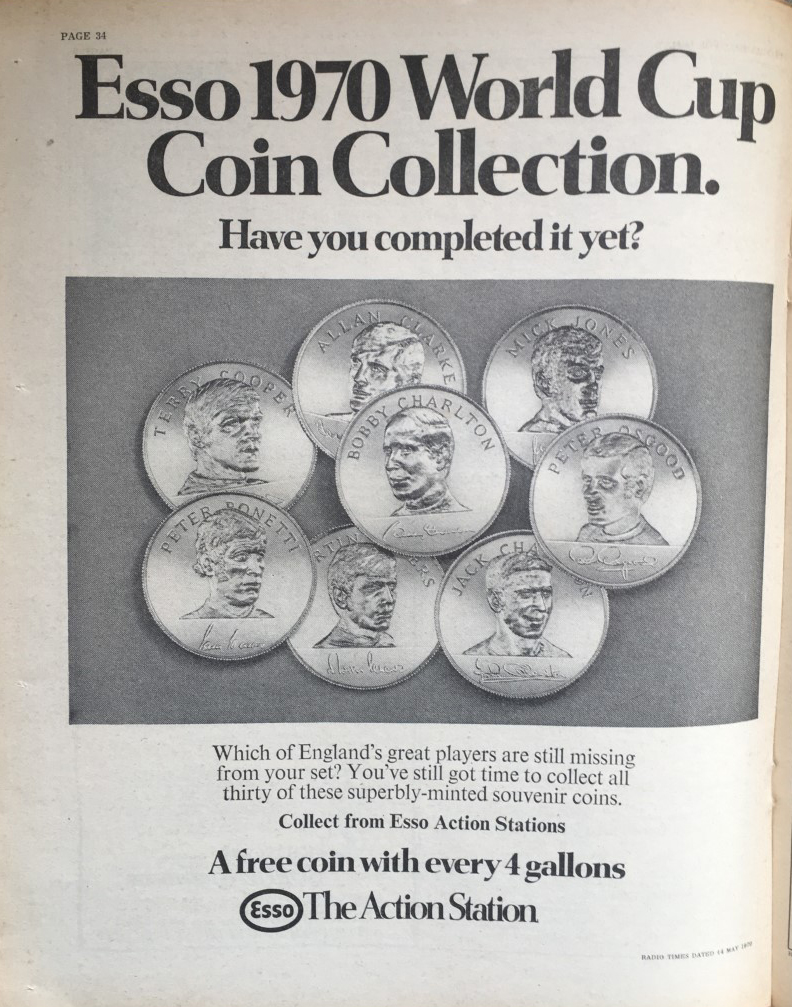
Page 15 features the Kodak Instamatic camera. I always got this confused with the Polaroid Land ‘Instant’ camera, but this was of the conventional point-press-take-the-film-to-Boots variety. The layout of this ad is a classic example of ad agency art directors’ work of the era, and it would be hard to improve on its clean lines today. Other advertisers include Gordon’s Gin, ‘New Calor Gas’ (propane cylinders providing a domestic gas supply), Lurpak butter, Diamond Paints and the nursing profession. Most redolent of the moment, on page 34, is a reminder to collectors of Esso’s ‘World Cup Coins’ that they still had time to complete their collections. These 10p piece-sized items commemorating that year’s England team players were given away at petrol stations at a rate of one coin for every four gallons. In 1970, a gallon of petrol cost six shillings and eightpence, so to qualify for a coin, you had to spend… well, you work it out (just a bit over £2). Adjusted for inflation, that six shillings and eightpence would be equivalent to £4 today, so each of those neat little coins would be setting you back £16. Of course, you also got a Tiger in your tank… but could you find Peter Bonetti?


So much for the commercial world, but what could consumers look forward to watching on the box when they weren’t eating biscuits, decorating their houses or filling up their Ford Capris? BBC television in 1970 consisted, of course, of just two channels, both now broadcasting in colour. Saturday’s programmes began at 9.35am with a raft of language courses lasting until 11.0, when the service closed down again. It was back at 1.10 with Jack Scott providing the weather forecast (almost certainly thunder… it was thunder all the way in May 1970). This led into the inevitable Grandstand, introduced by the inevitable Frank Bough. That took care of the whole afternoon until 5.15 when Dr. Who ushered in the evening’s entertainment with the second episode of Inferno. Evening highlights (I use the term in its loosest sense) included Dad’s Army, an adventure movie (Many Rivers to Cross), A Man Called Ironside and… oh dear. Page 18 reveals a photograph I dare not reproduce, promoting that evening’s edition of The Black and White Minstrel Show. Unbelievably, this dodgy old chestnut still had another eight years to run on air before continuing as a holiday camp entertainment until – gasp – 1989! I positively hated the B&WMS. Not because I was developing a precocious politically correct sensitivity at the tender age of nine: I just detested all that dressing up and poncing about whilst singing ‘Polly Wolly Doodle’… Of course, you could always turn over to BBC2 where Chronicle presented a film entitied ‘One People between the Alps and the Sea!’ followed by The Young Generation. Fortunately, there was good old ITV to fall back on.

Sunday’s big hitters were Paul Temple on BBC1, and the aforementioned The Rivals; whilst BBC2’s line-up included Rowan and Martin (a scheduling fixture at the time), and what sounds like the 1970 equivalent of Coast – Bird’s-Eye View, an aerial tour from Montrose to London. Monday on BBC1 gave us Star Trek – well into its second BBC season, with Wolf in the Fold – along with The Troubleshooters at 9.10 and The Harlem Globetrotters at 10.00. Over on BBC2, the dreaded Pot Black was probably being recorded over last week’s Doomwatch. This isn’t as insane as it sounds: colour videotape was expensive, and routinely re-used after wiping. The entire 1970 series of Steptoe and Son, the first in colour, is known to have been sacrificed to the tedious snooker fest. Elsewhere in the same week, we find Z Cars now in its 2-part ‘soap opera’ era (best ignored), a forgotten spy drama series Codename on BBC2 (almost certainly wiped), medical soap The Doctors, eccelsiastical comedy All Gas and Gaiters, plus such schedule staples as It’s a Knock-OutSportsnight with ColemanMan Alive and Tomorrow’s World. Curiously, a Frank Sinatra concert – which to me seems like a televisual big deal – was tucked away at 9.10pm on Wednesday on BBC2. Wednesday also saw Marius Goring starring in the popular forensic drama The Expert, whilst Friday night’s big 9.10 pm drama was a repeat run of the hugely popular The Forsyte Saga (made in black and white, this would be its last sighting on terrestrial television). In the head-scratching category comes Friday’s mid-evening comedy, The Culture Vultures, a totally forgotten comedy of business manners starring Leslie Phillips. Children were offered the likes of Banana Splits and a repeat run of Belle and Sebastian, alongside the ubiquitous Blue Peter. Occupying the prime slot ahead of the early evening news was Michael Bond’s Herbs spin-off The Adventures of Parsley. Parsley could also be glimpsed in cowboy guise on page 60, in a half-page promo for BBC books for Children. On the evidence, Parsley’s Last Stand looks like a must-have (a fine vintage copy will set you back £18, or six shillings if you own a time machine).


We’re almost done with our random week in May 1970, but there is still the letters page to consider. An attitude seems to prevail here, and it will be familiar to anyone who listens to Radio 4’s Feedback. Programme makers, taken to task over various aspects of content or taste will always defend themselves and explain why their creative or production decision was the only one possible. It’s rare for anyone to hold up their hands and admit to an error of judgement. In this issue, a reader takes Doomwatch to task for scientific inaccuracy in presenting a plastic-eating chemical as a ‘virus’, and for claiming that ‘fear of weightlessness’ (y’what?) is a symptom of paranoia. Series co-creator and scientific advisor Dr. Kit Pedler was having none of it, insisting that the fictitious plastic-eating ‘virus’ had been ‘tailored’ (but it’s still inorganic, so technically not a virus, a point he chose not to address), before going on to defend the other accusation, levelled at the episode Re-Entry Forbidden, whose script he claimed had been verified by ‘a group of psychiatrists’. Well, okay, Dr. Pedler, if you say so.

Sniffiest response of the week goes to the producer of Junior Points of View, answering a complaint that the viewers’ letters on said programme were dealt with so quickly as to be rendered unintelligible. ‘I suppose,’ writes a smug Iain Johnstone, ‘intelligibility can only be assessed subjectively.’ That’s telling you, T.A. Ayre of Bournemouth!

And finally, the award for most laconic reply of the week goes to John Howard Davies, producer of All Gas and Gaiters. ‘Do the ecclesiastics… exist in such a rarefied hierarchical atmosphere that they never encounter a solitary parishioner…?’ asks J.A. Timothy of Flint. ‘Yes,’ says Mr. Howard Davies.