Wednesday, 20 December 2023

Decades of Christmas Past: 1963


Over the next few posts, I’m going to be revisiting festivities from decades past. Beginning sixty years ago...

Do I remember Christmas 1963? Not with any degree of clarity. Aside from fragmentary glimpses, my memories of childhood don’t begin until around 1964. What I do know with reasonable certainty is that my big present of Christmas 1963 was a Triumph Herald pedal car, made by Tri-ang. It was unusual for toy manufacturers to make pedal cars of actual production models, so the fact that they’d chosen to make a child-size version of the selfsame model driven by our dad was felicitous to say the least. I can be seen pedalling it around the back garden in a cine film taken the following summer, which is how I can date the toy’s arrival to Christmas ‘63. Our dad always told the story of how, shortly before Christmas and aged just two and a half, I casually asked one day why there was a Triumph Herald on top of my parents’ wardrobe. I’d been in their bedroom for some reason and, glancing upward, had seen the end of the cardboard carton – curiously, and most likely on account of our dad’s recollection, I can still just about picture that moment. Had I actually read the name Triumph Herald? More likely, there would have been a line drawing of the toy on the side of the box. Either way, I’d caught out Santa – but it didn’t stop me from believing in him.


That Triumph pedal car, as seen in the summer of 1964

The ‘real’ father Christmas was to be found not at the North Pole, but in Lewis’s department store in Birmingham. His grotto contained a posting box for letters to Santa: what more proof did one require? 1963 was very likely the first year in which we made our pilgrimage to Lewis’, to find ourselves in a queue winding up the stairwell to the 5th or 6th floor where the grotto was located. Lewis’s Santa was always more convincing than others. Maybe the beard was real? He certainly had the voice off to a tee – think of James Hayter’s voice-over in the classic ‘Mr. Kipling’ cake commercials and you’ve got it. He sounded as if his cheeks were stuffed with cotton wool, which they very likely were. The grotto was always attractively done out with festive tableaux, of which I can remember next to nothing: these scenic distractions provided something to stare at while we each waited for our audience with Father Christmas. Aside from Santa himself, Lewis’s – in line with other Selfridges’ stores – employed a seasonal ‘minder’ to preside over the grotto and ensure good behaviour on the part of the young visitors. His name was ‘Uncle Holly’, and he was done up in hunting green and a white curly wig and sideburns, giving him the appearance of a kind of festive John Bull, although as a child I thought he looked like Hughie Green. Uncle Holly handed out badges to well-behaved children, who automatically became members of the ‘Uncle Holly Circle’.


Having whispered in Santa’s ear what they wanted for Christmas, each child was allowed a pick from his bran tubs – one for boys, one for girls. The presents were usually a simple boxed game, or plastic toy. Once, memorably, I was given a girl’s present by Santa. This was one of the ‘imposter’ Santas one found in other stores, in this case the long-vanished Co-Op department store in Lichfield. Opening my gift, I found it to be a small plastic kewpie-style doll sitting in a pink bathtub. I can still see it as clear as day: the toy came in a thin cardboard container, with a cellophane window. Our dad found this a source of great hilarity, and the incident of the ‘dolly in the bath’ was often referred to in later years.

Aside from the pedal Trumph Herald, I’m not sure what other presents arrived at Christmas 1963. Our dad, who earned a modest income from his clerical job at GEC, supplemented his earnings by playing drums in dance bands several nights a week – activities which he referred to as ‘earning pennies for toys.’A sizeable chunk of this supplementary income went on providing Christmas presents for my brother and myself, and his generosity knew no bounds. There were certainly plenty of other toys under the tree on that Christmas Day of sixty years ago, but the only items I can identify for certain were a pair of that year’s annuals, some of the first I ever owned.

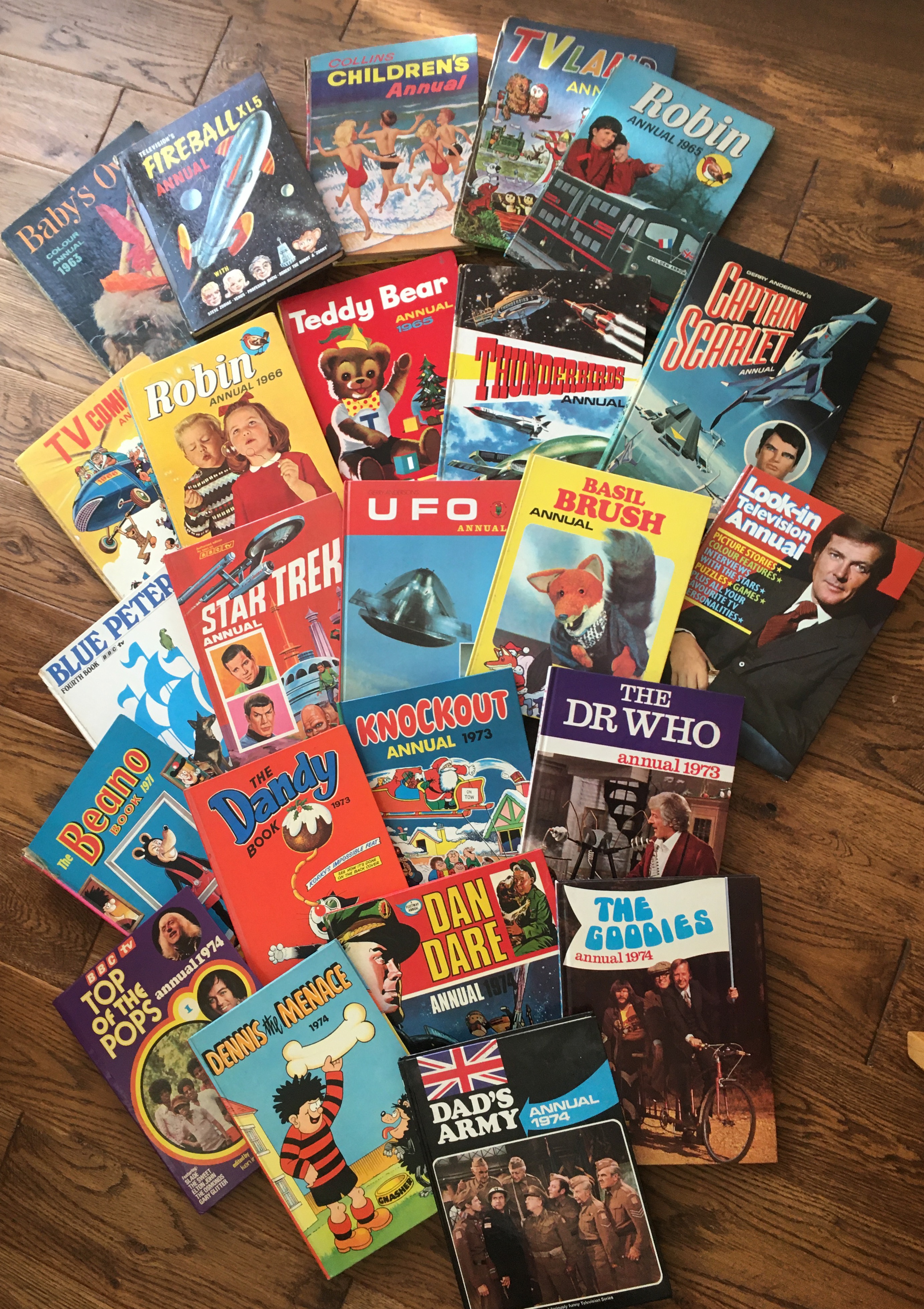
Fireball XL5 Annual was a gift from my grandparents, who would go on to buy me all four editions as a kind of Christmas ritual. This particular volume was certainly well-loved. Within a year or so, its board covers had ‘done a Fireball Junior’ and become detached from the main body of the book, along with the last twelve pages. It remained in this state for years, until I decided to draw the missing pages myself, and stick them back in with sellotape. Today, one could find a copy in seconds on ebay. That annual became as important to me as the TV series itself, if not more so. Fireball was scarcely off the screen during 1963 and 64, but it was only on once a week, while the annual could be enjoyed at any time – including in the bath, which probably took care of those covers!

The other annual I received that year fared much better than Fireball, and was clearly less of a favourite. Indeed, it survives intact to this day, with only some minor damage to the spine to show for its age. Coincidentally or not, the book came from the same publisher as the Fireball annual, W.M. Collins and son, and was an example of their ‘Children’s Annual’. Printed on heavy pulp boards, in the same line and spot colour technique employed in the Fireball volume, this was a collection of mostly text stories, varying between realistic adventure and fairytale whimsy, the kind of book intended to be read aloud (which probably accounts for how it survived in such good condition). All the contributors to this volume were credited in the frontispiece, a rarity in children’s annuals, but none of the names is familiar. Illustrations were in a variety of styles, some imitative of the likes of Arthur Rackham, whilst others had a more contemporary feel. I found some of the drawings a bit unpleasant, and would refrain from looking at them. My personal favourite story, and one which I asked for time and again was called ‘Lost in the Snow’, a heart-warming tale of a little girl who gets lost in a snowstorm on ‘the downs’ while taking lunch to her father, the farmer. The story is credited to E.M. Langford, whilst the line and tone illustrations – in a kind of early 60s knitting pattern style – came from one H.C. Gaffron. The name is unfamiliar, but Google reveals him to have been Horace Gaffron, a reasonably prolific, though obscure illustrator active in the children’s book field at this time.

As to the actual activities of Christmas Day 1963, I’m sure they must have been in line with what we did on subsequent years. Our grandparents would have come for Christmas dinner and tea, and no doubt the television would have been turned on at some point. I was aware of television from a very young age, but a glance at the programme schedules for Christmas 1963 rings no bells. ITV’s programmes began at 10.35 with The Christmas Tree, a party involving Pussy Cat Willum and friends. Christmas Morning Service was followed by the story of the nativity and a half-hour film looking at some of the people who have to work on Christmas Day. Following the news at 1pm, a pre-Crossroads Noele Gordon was the hostess of Christmas Box, an hour-long entertainment. Cliff Richard and the Shadows were top of the bill at 2pm with Christmas Swingtime, which led viewers nicely into the Queen’s message to the commonwealth, at its traditional time of 3pm. The rest of the afternoon was devoted to a movie, The Charge of the Light Brigade (1936). By teatime, a near normal weekday schedule had resumed, with Desmond Morris presenting Zoo Time at 4.50, followed by an episode of William Tell. At 5.45 came a festive edition of the 1960s equivalent of Give Us a Clue – Don’t Say a Word – followed by another news summary at 6.10. A ten-minute address from the Archbishop of Canterbury was followed by Carols, Coffee and Crackers, described as a ‘light-hearted carol sing-song… from the Youth Club of Yardley Parish Church, Birmingham’. Clearly, this one was for Midland viewers only. Regular weekday programmes resumed at 7pm with the quiz Take a Letter, followed at 7.30 by Coronation Street (this being a Wednesday). 8pm brought Christmas Startime, a variety showcase featuring the likes of Bruce Forsyth, David Nixon, Bernard Braden and Barbara Kelly, to say nothing of Mr. Acker Bilk. The news at 8.55 was followed by a reimagining of Charles Dickens’ Pickwick Papers, starring Arthur Lowe. The decidedly un-festive University Challenge followed at 10.40, then at 11.10, a compilation of regional entertainment filled the forty-odd minutes left until the Epilogue and Closedown.

Over on BBC Television, the day’s programmes began in Welsh, before the Queen’s Christmas Message (curiously in sound only) at 9.30. The rest of the day’s programmes included an obligatory visit to a children’s hospital ward, in the company of Frankie Howerd. Tittered they not, I have no doubt. The afternoon was taken up by an hour-long profile of the still living Walt Disney, and a visit to Billy Smart’s Circus. BBC’s film choice wasn’t quite as venerable as ITV’s – Abbott and Costello Meet Captain Kidd was a mere ten years old. Sooty and Sweep invited viewers to their Christmas Party at 5.15, then the evening news was followed by a charity appeal by the Mills family – John, Mary, Juliet, Hayley and Jonathan. It being Christmas Day, viewers weren’t going to escape without a panto, which arrived in the shape of Dick Whittington, starring Terry Scott, Hugh Lloyd and Reg Varney. At 7.15, we had a festive edition of Z Cars, followed by the traditional Christmas Night With the Stars compilation. Curiously, the contents included a segment of Juke Box Jury, and even a visit to Dock Green. Charlie Chaplin’s The Gold Rush followed at 9.25, then after a five-minute news summary, a programme of classical music rounded off the day.

Did I see any of these entertainments? I’m sure the television would have been turned on by the evening, if not in time for the Queen’s speech, but I was probably too engrossed with new toys to pay any attention.

A popular misconception – primarily held by people too young to know better – is that Christmases of the past were often snowy. So did we have snow for Christmas 1963? The Met Office Monthly report summarises the situation: ‘On the evening of the 24th a depression to the west of Ireland deepened rapidly as it moved north, and associated fronts brought rain to most districts that night and for much of Christmas Day.’

As Greg Lake would put it in his hit single of twelve years later, ‘it just kept on raining.’


Tuesday, 19 December 2023

Annuals Revisited – End of an Era


A glance in any bookstore around Christmas time will reveal that Annuals continue to be a festive tradition, with brightly-coloured tomes reflecting the pop cultural obsessions of today’s young generation. Of the titles we had back in the 70s, only a handful remain – Dandy and Beano will both celebrate their centenaries in around fifteen years, and both annuals remain in print even if only one of them is still an actual comic. Rupert is still going, and still in the same yellow check trousers, but there’s not much else out there that a comics or TV fan of the 70s would recognise. Guinness World Records still appears year on year – we got our one and only copy back in 1972 – whilst Ripley’s Believe it Or Not continues to log barely believable facts and figures in a series that Wikipedia reckons started in 2005. Now, I hate to disagree, but I have a copy cover-dated 1974, which was given to my brother at Christmas fifty years ago. It’s a World Distributors effort, compiled from reprints of the American Believe It or Not comic book. Other offerings for 2024 include Pokemon (still popular after all this time?), Peppa Pig, Thomas the Tank Engine, Minecraft (*sigh*) and a bunch of other kids’ TV tie-ins (presumably) that I’ve never heard of.


A design car crash: some of the garishly-coloured covers of this year's annuals.

In an era when children’s entertainment is dominated by social media, I find it rather reassuring (© 1977 Ned Sherrin) to see such publications piled up in Smiths, even if many of them look like they were put together by a team of colour blind AI chimpanzees...

A modern Beano book with its glossy four colour interior is a very different animal from the more austere versions I remember from the 1970s, and I’m not sure that’s necessarily a good thing (although I can’t see today’s kids going a bundle on the old two-colour print jobs). In common with most modern publications, today’s annuals are garish in appearance, with covers that are cluttered, over-coloured and over-designed. The golden turkey for worst offender this year must go to the Match of the Day Annual, whose cover is the worst piece of design I have ever seen on a professional publication. It literally looks as if the designer has dropped all the photo cut-outs and typographic elements he needs into a page template and then just left them where they landed. To think of someone getting paid to do hack work like this while I remain unemployed is galling to say the least: not that I’d go a bundle on designing any kind of football publication. Even the once reliable Rupert is a car crash of colour with its cheap computer rendering. Compared to the subtly toned, hand-painted covers that once graced the Rupert books, this is almost a travesty. Clearly, budget is king and no one will pay for ‘real world’ artwork any more. I wonder if any comic artist still owns a box of paints? Still, if it sells, it sells, so who am I to argue. What would today's kids make of the annuals I had as a child? Not much, I'll wager.

For me, it is now more than twenty years since I last bought an annual – 2002 saw both Captain Scarlet and Thunderbirds back in print from Carlton, tied in to their recent revival on BBC television. Design-wise, they didn’t have a lot going for them: generic ‘high tech’ Photoshop covers, and fonts that just screamed ‘early 21st century’. The only reason I bought them was for the photo-strips they contained, adapted from TV episodes. In an era before frame grabs were easily obtainable, this was a good opportunity to study the characters and hardware. Feature items borrowed material from the 1960s annuals to provide biographies of the characters. At sixty A4 pages each, they were somewhat lightweight compared to the annuals of the 60s, but they were in colour throughout and I’m sure the youngsters of 2001 were more than happy with them. One thing decidedly lacking from these publications is nostalgic value: ignoring the dated Photoshop work and typography, they look barely any different from this year’s crop and could sit alongside them in any bookshop without raising an eyebrow. You couldn’t say that of 1963’s Fireball XL5 Annual, which looks properly of its time.


At the time, these were my first annual purchases in around twenty years. Back in 1983 or 84, I went out and bought myself the first Terrahawks Annual, a World Distributors effort that ticked all the publisher’s usual boxes: heavy on splurgily-painted text stories and artworked from the cheapest possible sources. I no longer own this copy (I detest Terrahawks), but online images reveal the artwork from this and its second incarnation to have been either drearily naive or undisciplined and garish. The programme clearly got the treatment it deserved. This was the very last World Distrubutors annual that I owned. The company would be defunct within a decade, spelling the end of a publishing phenomenon that went all the way back to the early 1950s.

Rather better were the efforts of Howard & Wyndham whose Brown Watson imprint was responsible for a late flowering of TV crime tie-in annuals during the late 70s. Beginning in 1977 with The Sweeney and The New Avengers, the annuals ran for only a year or two. The company’s history is hard to make out: Howard & Wyndham was a theatre-owning and management company that later owned shares in Independent Television, which might explain the publishing tie-ins. However, the company closed eight years before the first of these annuals appeared in bookshops. Brown Watson, meanwhile, continues as a children’s book imprint, based in Leicester, but with a history going back to only 1980.

1977’s first Sweeney Annual was arguably the best of these publications, featuring some terrific comic strip art from Brian Lewis – his style was instantly familiar to me from the work he’d done on the Countdown comic – alongside a few photo-illustrated text stories and features. It wouldn’t surprise me if the designer had worked on Look-in or even the Blue Peter books, as the page layouts are strong and reminiscent of those titles. The second year’s effort saw the standards slip somewhat, with fewer photographs and, for my money, inferior artwork. Brian Lewis was otherwise occupied illustrating that year’s Van Der Valk Annual, turning in some excellent colour pages.

The two New Avengers Annuals followed a similar format, with the second including two very recognisable David Lloyd strips, adapted from TV episodes. One thing that all of these Brown Watson titles had in their favour was fidelity to the on-screen graphic look of the various series, and the covers were all very well done, within the limitations of contemporary print technology.

1978 really was my last year of having annuals bought for me at Christmas, and alongside these creditable publications we find, sadly, the very worst of all the examples I’ve considered in the course of these articles. Return of the Saint Annual, hailing from Knutsford-based publishing house Stafford Pemberton, arrived in the same year as the series itself. The look of this all-colour publication was reminiscent of the Century 21 storybooks of a decade earlier. The only artist I can identify is Malcolm Stokes, who had worked on City Magazines’ annuals and Countdown comic. He was definitely not responsible for the comic strips, which were scrappily drawn and amateurishly lettered. Photographs were in short supply, and rendered quite badly: the colour printing wasn’t helped by the use of inferior paper that soaked up the ink and made for a dull appearance. I remember being very disappointed with this annual when I got it. Okay, it scored points for using the correct TV title sequence logo, but the cover was a design exercise in how not to do it. It's a shame to go out on a low note, but as we've seen, the golden age of annuals was well and truly over. By now, classics like the Rupert books of the 1930s were being faithfully reprinted using techniques and materials that captured the essence of such vintage items. But no one was seriously going to do that for a modern title aimed at a modern audience.

One wonders how long annuals will continue as an end of year tradition. They may be barely recognisable from the thoughfully-crafted publications of my youth, but at least they're still there: and in a world where online is increasingly the name of the game, that should be some small cause for celebration. Just don't get me that Match of the Day annual for Christmas, okay?


Sunday, 17 December 2023

Annuals Revisited – The 1970s


And thus to the 1970s, a decade in which TV spin-offs from World Distributors enjoyed a near monopoly over the festive annual market. D.C. Thompson continued to keep the Dundee flag flying with its regular publications, of which we received the Beano, Dandy, Beezer and Topper at various times over the next few years. Both my brother and myself had outgrown nursery papers like Teddy Bear and Pippin, and the yearly crop of annuals began to feature more grown-up fare. By 1975 I was no longer content to wait until Christmas and would make sure of getting a copy of something like the Space:1999 Annual as soon as it appeared. In this case, my friend’s mum ordered a couple of copies from a catalogue for us.

1970

UFO Annual – Polystyle, publishers of TV Comic certainly hit the ground running with this sumptuously illustrated book that reached the shelves in time for Christmas, a mere three months after UFO had made its TV debut. The absence of comic strips in any annual is always a clear indication of a short lead time, and the reliance on photos illustrating text stories and features meant that this would have been a comparatively easy item to produce. For me, the exclusive use of photos gave this annual an edge over the typical World Distributors efforts, which relied far too heavily on artwork that often looked rushed. The UFO Annual was clearly designed by someone who’d studied the series and its iconography: the Eurostile font employed on the main titles is used throughout. Purists might bemoan the absence of comic strips, but for me, their absence adds quality – there being no rubbishy artwork to spoil the clean page layouts. Of all the Gerry Anderson tie-in annuals, UFO is up there with the best of them.

The Beano Book/ The Beezer Book – Strange as it may sound, these were the first of the classic D.C. Thompson annuals to arrive in our house, and they owed their appearance to a summer holiday ferry trip to the Republic of Ireland when my brother and myself had been bought copies of the Beano and Beezer to keep us entertained on the voyage. Of incidental interest is the fact that the copies for sale on the ferry were several weeks out of synch with what you’d have found in any newsagent. After the holiday, we started getting both comics on a regular basis, so the year’s annuals seemed like a safe bet. I still think Colonel Blink is the single funniest creation ever to emerge from D.C. Thompson, but it’s probably not okay any more to use myopia as a source of humour. Oddly, we see a distinct difference in production values between these two sibling annuals – The Beezer had a lower page count, but was printed in colour throughout (likewise the Topper), whilst the Beano book was longer, but printed in black line with a variety of spot colours, a format also adopted by the Dandy.

TV21 Annual – After the bumper crop of TV21 spin-off annuals that had taken pride of place over the last three years, 1970 saw the wheels come off the operation. TV21 had been thoughtlessly amalgamated with Joe 90 the previous year, losing most of the remaining Gerry Anderson strips in the process. Unbelievably, Tarzan and The Saint, both of them renegades from TV Tornado following its merger into TV21, were still on the roster for this year’s annual. But the golden turkey here was Land of the Giants, a survivor from the Joe 90 comic, whose author had clearly seen the series but never read a single piece of promotional literature, for he insisted on referring to the little people’s spaceship as the ‘Spendthrift’ (it was really the ‘Spindrift’). A clear case of Chinese whispers, I think. If one had to sum up this annual in a single word, I think ‘rubbish’ would suffice.

Thunderbirds Annual – A curiosity, this. For, despite the title, the contents look very much like what we might have expected from this year’s TV21 Annual – or perhaps last year's.The featured series was to be found in just four stories and features, whilst the remaineder of the contents comprised titles from the 1969 TV21 weekly – Department S, Captain Scarlet, Secret Agent 21 and Zero-X – plus Joe 90. It certainly did not reflect the state of TV21 circa 1970. Pages were printed in the customary ‘cheap colour overlay’ process familiar from the last few years’ annuals from City Magazines, alongside red and green duotones. Artwork was of the very cheapest: functional journeyman stuff with neither the commitment nor flair of the genre’s greatest exponents.

TV Comic Annual – The last edition to find its way into our house had arrived at Christmas 1965, but 1970 would be the first of several years in which either myself or my brother was given this annual at Christmas. Of the 1966 strip line-up, TV Terrors and Mighty Moth were still present and correct, alongside Dr. Who and Popeye, although the rest of the contents had been updated to keep in line with what was currently popular on the box. To say that the two Dr. Who strips were not quite like the TV series is something of an understatement: both the Doctor and the Brigadier were present, but beyond that, continuity went out of the window. One strip saw the Doctor experimenting with levitation and thus capturing a fleeing spy whilst the other saw him using his trusty recorder (shurely shome mishtake? - Ed) to communicate with some dolphins.


Star Trek
 – I would continue to receive these Star Trek Annuals as a Christmas tradition right the way through to 1975, and they have all survived in mint condition. I was and still am a fan of the original series, but I never thought much of its comic strip incarnations, and publishers World Distributors relied on US comic book content for their Star Trek annuals for as long as the title remained in publication. As a footnote, I didn’t mind TV21’s take on the series: by 1970, Mike Noble’s strip was the only decent thing left in the comic, although he clearly did not possess a colour television set as he insisted on depicting Captain Kirk in a red shirt...


1971

Look-in Annual/ Countdown Annual – 1971 wasn’t a bad year for comic launches, with the two best offerings arriving hot on each others’ heels early in the year. The early start meant there was ample time to have an annual ready in time for the Christmas market, and both Look-In and Countdown weighed in with a couple of quite respectable efforts. Of the two, Look-In felt somewhat superior, with a classic laminated board cover, although the pages were falling out from day one. Countdown found room for artwork from comic contributors John M Burns, John Cooper and Jon Davis – although I have to confess I have never liked the work of the latter pair. Former Dan Dare assistant Don Harley turned in a fine if rather routine take on Thunderbirds, distinguished by some excellent likenesses of the characters. The strip, Terror at Toreba featured a kind of giant roast chicken from space crash landing on a Pacific island. Elsewhere, the annual followed the comic’s format with features about space travel and UFOs, the latter including some highly dubious photographs...


Barrier Reef Annual
– 
Yet another World Distributors TV tie-in, and one that you can’t give away today on ebay. Try finding anyone who remembers the series! I watched it and had this annual bought for me this Christmas, but I doubt I’ve ever given it more than a cursory glance. The series never had much of an impact, and one wonders why World even bothered with an annual, unless the title came as part of a BBC licensing package deal. I’d have preferred an Ace of Wands annual myself, but sadly no such publication ever appeared. Incidentally, I can still hum the ‘feem toon’ from Barrier Reef, if anyone’s interested? Thought not...


Laurel and Hardy Bumper Book
– 
Arriving before Christmas and hailing, if memory serves, from what must have been my last ever trip to Santa’s grotto, this gift book follows the World Distributors model of reproducing material from comic books. A couple of photo articles, one of them illustrated with a picture of Morecambe and Wise, belied the book’s British origins – although like a good many such efforts, it was printed overseas. The characters are not quite the Laurel and Hardy of the Hal Roach films, but a ‘reimagining’ by cartoon producer Larry Harmon, based on his TV films. Having said that, I couldn’t really tell the difference aged ten, and enjoyed reading this book in the run-up to Christmas, several of the stories having a festive or autumnal flavour.


Tom & Jerry Annual – I’m not sure how many of these were produced, but we got given a couple of examples this year and next. Like Laurel and Hardy, these were definitely not the Tom & Jerry of the original cinema cartoons, as both of them spoke (it would have been hard for them not to do so in the comic strip format), although their appearance was unaltered. The artwork, reproduced from American comic books, was slick and excellent.

TV Comic Annual – Another excellent effort from Polystyle, maintaining the production format familiar from our old 1966 example, blending full colour strips (of which there seemed more this year) alongside red or green duotone. Popeye remained a perennial favourite, as did Mighty Moth and TV Terrors, but this year saw new original characters in the form of Nelly and her Telly (she daydreamed herself into the programmes she was watching) and Texas Ted, a stetson-hatted braggart who came across like a charmless Desperate Dan. Tom and Jerry were the cover stars during this era and are featured prominently, alongside Roadrunner, Pink Panther and Bugs Bunny. Other licensed TV material included Animal Magic, Basil Brush, Dad’s Army (nicely drawn by TV Comic regular Bill Titcombe), Skippy, Titch and Quackers, Whacko! and, somewhat surprisingly, The Avengers. Dr. Who had by this time been regenerated into the new Countdown comic which was perhaps for the best...

Also weighing in this year were annuals from The Beano and The Dandy, alongside the Beezer and Topper.

1972

The Persuaders Annual – If I’d had the task of designing this annual, I doubt I’d have done any different, as the cover follows the same rules I applied when designing the DVD releases of the series, using the same colour palette and, critically the same font as the TV title sequence. A slim volume, like others from the Polystyle stable, this was nevertheless a decent effort, with artwork of a quality comparable to that seen in the Countdown and TV Action comics, and a few decent colour photographs. The strips were provided by Frank Langford, a regular on the Countdown comic, and Martin Asbury, whose energetic style fairly leaps off the page.

Countdown Annual – By the end of 1972, Countdown had long since been revamped into TV Action, but this year's annual – subtitle notwithstanding – still reflected the comic's original line-up of strips and features, with The Persuaders! included albeit only as a text story. The artwork was still noticeably superior to anything seen in the TV21 series of annuals, with extensive four colour printing and a decent array of photographs.

Dr. Who Annual – I’d only picked up on Doctor Who with the beginning of the Jon Pertwee era, since which time there had been only one annual published, in 1970. Why World Distributors missed a year is unknown, but they returned to the fray with this example, boasting a nice colour photographic cover. Inside, artwork ruled the roost, not all of it of a particularly inspiring quality. Nevertheless, I was happy to have it, and would continue to receive the Dr. Who annuals every Christmas until the end of the Pertwee era. During the 70s, I also managed to obtain copies of the two annuals hailing from the William Hartnell era (published in 1965 and 66), and one of the three Patrick Troughton editions, featuring a Cyberman cover painting. These latter must have had considerably smaller print runs than the Hartnells, as they never turned up in the second hand shops and jumble sales from which such old items were usually acquired.

TV Comic Annual – Hard to tell this one apart from the previous year’s edition, with most of the same content still present and correct. Catweazle replaced The Avengers, but otherwise it was the mixture as before.


The Aeronauts Annual
– 
This French TV series had been shown during childen’s viewing hours by BBC1 – although in its home country it was a prime-time mid evening series aimed at adults. Quite what the BBC was thinking was anybody’s guess. The series being based on a comic strip, this was an easy assignment for World Distributors, who simply commissioned a painted cover (nicely depicting the TV series actors), pairing it with a couple of the French comic adventures, translated by Charles Pemberton. Given that the series was based on the comic rather than the other way round, the characters in the strips bore scant resemblance to the TV actors; although the artwork was excellent, especially in its depictions of the various fighter jets.

Knockout Annual – The Knockout title, which had been around in my Dad’s day, was revived with all-new content by IPC in the spring of 1971, which didn’t allow for the publication of an annual that year. The comic was quickly revamped, shifting Bash Street knock-offs The Super Seven from the cover to the inside pages, with a gimmick strip The Full House taking their place. Both are present here, although The Full House (a cutaway with panels showing the events in different rooms of the titular dwelling) didn’t translate well to the narrower page format. All the regulars were present, including Fuss Pot (probably the title’s most successful creation), Joker, The Toffs and the Toughs and Pete’s Pockets. Two strips featuring The Group, appear to have been reprinted from another IPC title, but I’ve no idea of their origin.

Once again, the Beano, Dandy and possibly Beezer annuals found their way into Santa’s sack this year, along with another Tom & Jerry and The Flintstones.

1973

Dr Who – ‘...your 2003 Christmas present is likely to be something like a miniature pocket computer.’ So spoke 1973’s Dr. Who Annual in a feature entitled ‘A Space Age Christmas’ imagining the festivities of thirty years hence. The same article warned young readers that ‘if pollution and the effects of the population explosion go on … there will probably be very few trees left in the world’ (lest anyone was still in any doubt that environmental awareness existed before the Thunberg generation.) Elsewhere, this year’s annual was the expected mix of text stories, perfunctorily illustrated with what look like designer’s roughs. Better artwork was on show in the two strip stories (one of them in full colour), courtesy of one Steve Livesey.

Dad’s Army – It might surprise you to know that no fewer than five Dad’s Army annuals were produced by World Distributors, published every year from 1972 to 1976. This edition was the only one I ever owned, and looks to be typical. The contents were analogous to those of the Dr. Who annuals, heavy on the text stories, with two comic strips and a mix of features, in this case focusing on wartime and military history. The artwork in this edition was a shade better than this year’s Dr. Who, and the artists are all familiar from other World Distributors titles. A nicely designed colour photographic cover added value – subsequent editions would feature artworked covers.

Top of the Pops – The weekly pop show was about to celebrate its tenth anniversary, which probably accounts for the appearance of this debut publication, the first of many: a TOTP annual was still appearing as late as 1991, although the original run (from, you’ve guessed it, World Distributors) ran out of steam in 1984. Edited by Ken Irwin, this first edition began with a brief overview of the programme’s history – not too much, mind, we don’t want to alienate the teenyboppers of 1973! The teenies were well catered for with the rest of the content, spotlighting current hit artists including Gilbert O’Sullivan, the Jacksons and of course, Slade. Three of the programme’s most popular presenters – including a certain Mr. Savile – each got to pen a short autobiographical piece; and there was, of course, a short feature focusing on the inevitable Pan’s People. Much of the content was in black and white, with a few colour portraits thrown in to justify the 75p price point (standard across all World Distributors titles this year). The preponderance of monochrome pages seems ironic in light of the fact that most of 1973’s TOTP shows that survive exist only as black and white kinescopes!

The Goodies Annual – The Cricklewood trio were well established as TV comedy favourites by 1973, and must have looked like a cert to shift a few thousand annuals when World Distributors signed them up for this one-off publication. Monty Python had already published their first tie-in ‘Big Red Book’, aimed squarely at a mature audience, and alongside such sophistication, The Goodies Annual seems to justify John Cleese’s taunt ‘kids’ programme’ at the end of 1973’s festive special, The Goodies and the Beanstalk. World Distributors knew a winning formula when they saw it: essentially, this is just another Dr. Who Annual with the Goodies taking the place of the Timelord. Comic strips took up more of the content than usual, alongside a couple of text stories, games and a number of photo features, one illustrating the trio in the recording studio (more than a year before The Funky Gibbon), whilst the other looked at the show’s innovative special effects. Some cartoon contributions from Graeme Garden added a kind of Cricklewood Royal Warrant to the whole endeavour, but the Goodies themselves were left decidedly underwhelmed by their first venture into print. Their dissatisfaction with the end product spurred them on to do something better themselves, and next year saw publication of The Goodies File, which played the Pythons at their own game to excellent effect.


Dan Dare 
Annual
 – I have to confess to knowing next to nothing about Dan Dare at this point in time. The space ace had first appeared more than a decade before I was born, and by the time I was of an age to appreciate his adventures, they had all but come to an end. This welcome volume reprinted two stories from the classic Frank Hampson era – 1951’s The Red Moon Mystery and 1959’s Safari in Space. As an illustration of Hampson’s progress on the strip, the compilers couldn’t have done a better job. Red Moon was brilliantly realised and a cracking adventure that feels like the template for every environmental disaster movie ever filmed; but Safari looked simply stunning. I’d never seen better artwork on the pages of a comic and surely never will. Hampson’s studio system was by this time running like a well-oiled machine, although the wheels were about to come off, and this would be the last of Dan’s adventures that he saw through to the end. Part way into the continuation story, Terra Nova, Frank left the strip under something of a cloud and would never return. I knew none of this back in 1973, and was able to appreciate the annual for what it was – namely, some of the greatest comic strip artwork ever produced. Up to now, my comic heroes had been the stalwarts of TV21 – Noble, Bellamy, Embleton – but Frank Hampson kicked them all into touch.

Dennis the Menace – For many years the star of his own spin-off annual, Dennis’s solo outings were not strictly annuals given that they appeared every two years. A somewhat slimmer volume than the accompanying Beano book, it shared the same spot colour artwork, in this case red (or orange) and black, the better to depict Dennis’s iconic striped jersey. This was the second Dennis annual we got to see, and almost immediately I spotted something a bit odd about some of the comic strips: Dennis looked different. He was thin and spindly-legged, contrasting his squat, bulky early 70s appearance. I wondered whether these strips might be reprints from an earlier era, which indeed proved to be the case. Despite having been well read, this example survives in absolutely mint condition, which must surely be a testament to D.C. Thompson’s robust production values.

With 1973 done and dusted, we've reached the end of what I personally consider to have been the golden age of annuals, but there would be plenty more to come during the 70s, with World Distributors continuing to license any TV property that looked like it could shift a few thousand copies. In the third and final part of this feature, I'll look at some of the last few annuals that ever made it into my hands, and reflect on the slow decline in content and quality that has brought us to where we are today.


Saturday, 16 December 2023

Annuals Revisited


Part One: The 1960s

Back in the 1960s and 70s, no Christmas was complete without annuals. I had them bought for me every year until I was in my mid teens. I still have the very first of them, Baby’s Own, a Fleetway publication printed in 1962. In the days before I’d learned to read, the bright colour illustrations in this book left a huge impression on my developing imagination. By the late 60s, the sight of annuals in the shops was an exciting reminder that Christmas wasn’t too far away. I can clearly recall seeing 1967’s Captain Scarlet Annual piled up in WH Smiths, brand new and still fresh from the printer, with its distinctive new-printed smell.

Every Christmas brought a fresh crop of annuals, some years providing a bumper harvest, and between my brother and myself, we probably got around half a dozen new annuals every year. Most of them are still in my possession, and it occurred to me to make a list of all the ones we had, going right back to 1962. Which were the most popular? Which survived intact? And which was the very last?

As mentioned above, Baby’s Own set the ball rolling back in 1962 when I was a mere eighteen months old. In addition to this, I had earlier been given two of the so called ‘Big Noddy Books’, annual-sized publications that had been published on a semi-regular basis since the early 50s. So, as of Christmas 1962, my collection of annuals stood at three. Now, let’s count off the rest, year by year…


1963

Fireball XL5 Annual – the first of four, from publishers WM Collins and son, and a clear favourite judging by the distressed condition in which it survives to this day. All four in the series followed the same format, with full colour printing at the beginning, middle and end, and single colour/ spot colour on heavy pulp paper elsewhere. Such 1930s production values were on the way out, and would not endure beyond the mid-1960s.

Collins’ Childrens’ Annual – a blend of mostly text stories, ranging from fairytale whimsy to Enid Blytonesque rollicking adventure, the Children’s Annual had been going for years by the time I was given my one and only copy. It survives to this day in very good condition, testament to the fact that I didn’t care much for it, although one particular story – Lost in the Snow – became a childhood favourite. 

Bobby Bear’s Annual
Dean and Son’s Bobby Bear had been a fixture of the Daily Herald newspaper since 1919, making him even older than Rupert, and his annuals went all the way back to the 1920s. The Herald had undergone a change of ownership in 1961 and would be revamped into The Sun just over a year later, so Bobby’s days were numbered. This annual was clearly well-loved, and suffered the same fate as Fireball XL5, losing its board covers and several pages. More recently, I bought myself this mint condition copy off ebay.


1964

Fireball XL5 Annual – the second of the series, this one survived rather better than its predcessor, though I must have given it away in the 1970s as the original is no longer in my possession, having been replaced by a cleaner copy. The stories were written by Alan Fennell, who had contributed about half of the scripts for the TV series, so they were very much in the style of the original. With the TV series only on air once a week, and often absent from the screen altogether, the Fireball Annuals became as important to me as the programme itself.

Robin Annual – Cover-dated 1965, this was another favourite, alongside the following year’s edition. I’m not sure if we were ever bought the Robin comic on anything like a regular basis, and these two annuals were the only examples we ever owned. Our mum gave them away in the 1970s, but I later found replacement copies. Some of the stories from this year’s edition became beloved childhood favourites and just to look at the illustrations is to evoke a rush of nostalgia for winter afternoons in front of the fire. TV characters like Andy Pandy and Bill and Ben rub shoulders here with the likes of Bizzy Beaver, Nutty Squirrel and Richard Lion; but Robin’s most intriguing character was based on Mr Woppit, the teddy bear mascot that accompanied speed demon Donald Campbell in his various Bluebirds (and was rescued from the final tragic wreck on Coniston Water). Originating in the 50s, by 1964 Woppit looked more like a pig than a bear, and was accompanied by his friends Mokey the donkey, and Tiptop, a clown.

TV Land Annual – TV Land was a short-lived comic, launched as a junior companion to TV Comic when the latter revamped its contents to appeal to a slightly older readership. The comic’s original cover star, Pussy Cat Willum, was long gone by the time this annual was published. It was, I believe, bought for my brother, and survives intact to this day. Stories include Noggin the Nog and Ivor the Engine (both with illustrations by Peter Firmin); The Woodentops; and a cartoon elephant called Packi, created by Tony Hart.

Teddy Bear Annual – Teddy Bear was a Fleetway publication, promoted as being ‘the only story paper for mothers with young children written by a mother with young children’, and had been appearing weekly since late 1963. Its title character was a charming little bear who lived with his family in ‘Bear Green’ (clearly inspired by the real life Beare Green in Surrey), and other regulars included a pre-Denis Healey Silly Billy, Nurse Susan and Dr. David and Paddy-Paws the puppy (of which I own several original art boards). Creator/writer Barbara Hayes appears to have been a prolific contributor to Amalgamated Press and Fleetway publications, and in 2010 published a book on ‘How to be a Successful Writer’. So she must have done all right out of it.


1965

Fireball XL5 Annual – Ex-Eagle artist Eric Eden's fine artwork had featured in the first two volumes but this year the comic strips were supplied by another Eagle contributor, Desmond Walduck. His illustrations of Fireball made the ship look as if it had eaten all the pies in Space City. The stories were still excellent stuff, and included a couple of classics. Eden remained on board, providing paintings for the cover and endpapers, but by 1965 had found weekly employment on TV21, illustrating the Lady Penelope strip.

Robin Annual – Although the original was long gone, many years later I chanced upon a copy of this year’s Robin Annual in an antiquarian bookseller in Lichfield. I hadn’t had sight of the contents for over thirty years, and when I opened it up, it was a full-on hit of forgotten childhood. Robin, like its older sibling Eagle, used the best illustrators in the business, and this year’s annual includes some fine work from John M. Burns and Gerry Embleton.

TV Comic Annual – TV Land having ceased publication, my brother was bought this in its place. The line-up of characters seemed designed to put me off as a reader, as it included several series I found hard to take on the television: not only did we have Dr. Who, but Space Patrol and (horrors!) The Telegoons. On the printed page, they were somewhat less disturbing, but I still tried to avoid looking at the colour endpaper photographs of the Space Patrol crew. The original copy has survived to this day. 

Teddy Bear Annual – Author/editor Barbara Hayes was really working her socks off, turning out every week’s edition of the comic (for which she received sole writer credit) and a couple of annuals every year. Artists are hard to identify, except for the prolific Jesus Blasco, better known for his action-oriented strips, but who could turn his hand to fairytale whimsy when the occasion demanded. I own a panel of his artwork from this year's annual, which accompanied the tale of 'Barbara One-Shoe'. I told you she was working her socks off...


1966

Thunderbirds Annual – International Rescue had arrived on the small screen in the autumn of 1965, which was too late for that year’s crop of annuals, so it was another year before Thunderbirds scored its own annual. TV21 publisher City Magazines was responsible, and this was the first of their publications to appear in a new large format. The inclusion of colour photographs added interest, but the contents were for the most part illustrations, rendered in the same cheap line and wash printing technique that City used on all of their annuals. Nevertheless, I was pleased to get it and can remember opening it on Christmas Day when it was still dark outside...

Fireball XL5 Annual – This was to be the last of Collins’ Gerry Anderson tie-ins, and with the series itself fast disappearing from screens, there must have seemed little point in continuing. The covers of the first three had all been provided by Eric Eden, but this year saw him demoted to the endpapers, with TV21’s Fireball artist Mike Noble doing the honours on the cover. Unlike the cobalt blue space backgrounds that appeared in the TV21 comic strip, Noble here bowed to convention and provided a solid black space background, giving the four Fireball annuals a kind of visual continuity. Of the four, this was my least favourite, mostly on account of what I felt was somewhat inferior artwork (I was a hard taskmaster at the age of five).


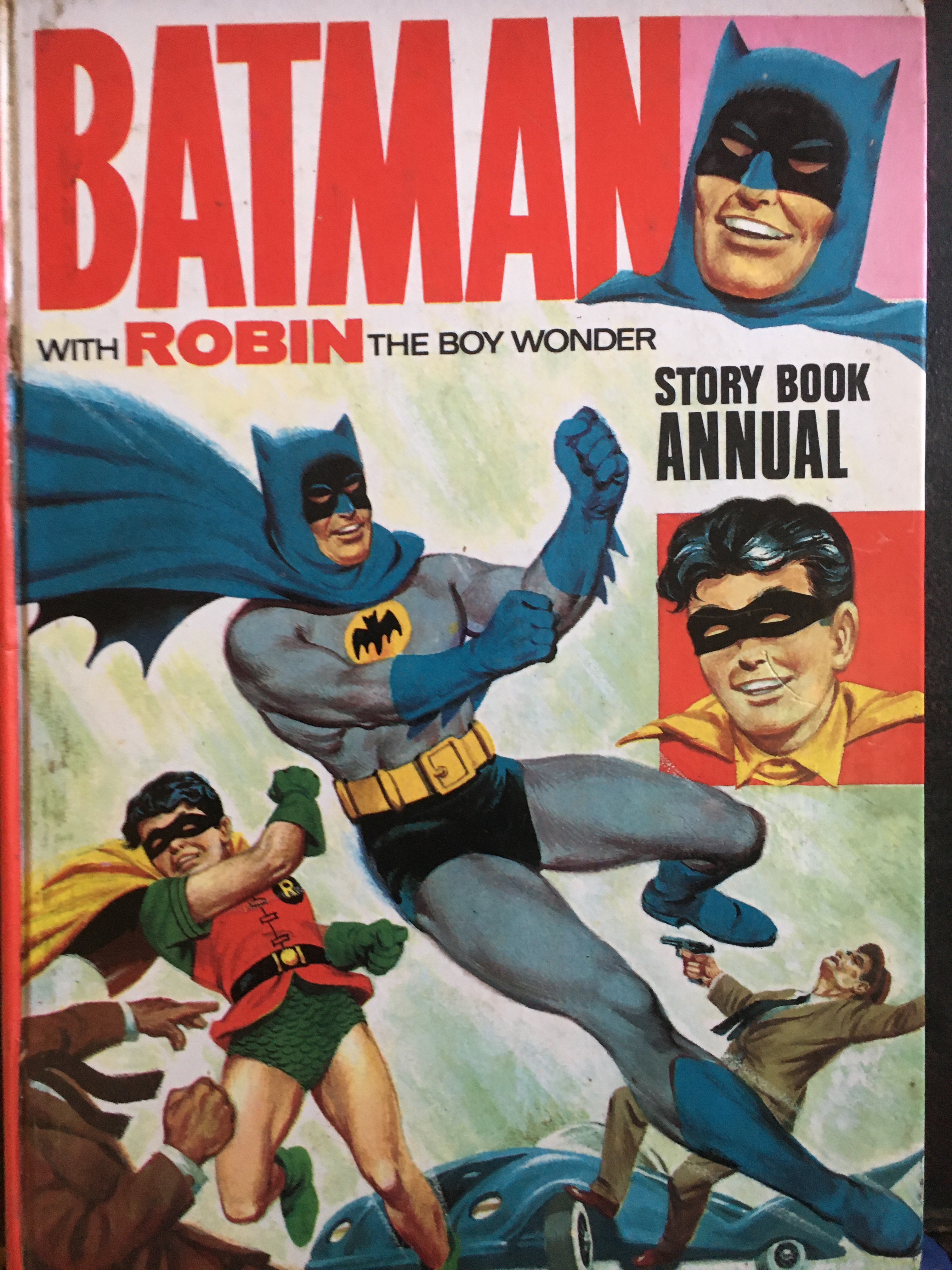
Batman Story Book Annual – The Caped Crusader had been the year’s must-see television event, and by the autumn was spawning merchandising spin-offs including toys, bubble gum cards and this cheap cash-in from Manchester-based publishing house World Distributors. World’s annuals often looked like rush jobs, abd Batman was no exception. Comic strips took time to produce and were expensive to commission, so all too often these publications consisted of nothing but text stories, illustrated in haste by one Walter Howarth – a name revered by Dr. Who fans for his work on that series’ annuals. Howarth could turn out excellent likenesses of key actors, but his technique was rushed – hardly surprising considering his workload – and the cheap Ben Day dot printing process didn’t add much to his slick linework. The cover artist looks to have been under orders to avoid any resemblance to Adam West...


1967 

Blue Peter Book – I’d been watching Blue Peter on television since we’d had a set in the house, but this was the first year I’d had one of the ‘Blue Peter Books’ bought for me. The programme was at a point of transition, with John Noakes having recently joined, and Peter Purves waiting in the wings, so the cover designer played safe by photographing the show’s line-up of pets, arrayed around the Blue Peter emblem. The contents included an illustrated guide to making your own Christmas ‘advent crown’ (coathangers and tinsel), which proves that this kitsch classic had been a staple of the programme since the mid 60s. I would continue to receive the Blue Peter books every christmas for the next four or five years, by which time I’d stopped watching the programme.

These were great annuals for Christmas day reading, with their blend of easy-to-read features (generally reprising material from the TV episodes), puzzles and stories featuring William ‘Tim’ Timmins’ perennial favourites Bengo the boxer pup, and junior space adventurers Bleep and Booster.

Captain Scarlet Annual – The first of only two dedicated Captain Scarlet annuals (though there would be later examples when the series was revived in the 1990s). I can still recall the excitement of seeing this in the shops, only a matter of weeks after the series had started on TV. Annuals like this were a great source of reference material if, like me, you wanted to draw pictures of your TV heroes, as there were plenty of colour photographs available to study (my original copy still bears a palimpsest of scored-in outlines where I’d traced various photographs). Artwork came courtesy of TV21’s ‘B-listers’, Ron Turner and Jim Watson. 

The Pogles Annual – Slim, but handsomely produced, and featuring a photographic cover, this was one of my brother’s annuals at Christmas 1967. The following year brought a further volume.

Sooty Annual – The Daily Mirror had been cranking out Sooty annuals for a good few years, but this was the first of them to make it into our house. I never cared for them very much: Sooty was reinvented in a kind of toytown setting populated with characters who never saw action on the TV series. Harry Corbett, of course, was nowhere to be seen, as the annual Sooty had grown a pair… of legs, that is.

The same year brought a further Teddy Bear Annual – now a gift for my brother – but little else. I’d passed on the second Thunderbirds Annual, having somewhat lost interest in the show in the wake of Captain Scarlet. I would make up the defecit a few years later by acquiring a copy discarded by our cousins.


1968

Joe 90 Annual – I can still remember seeing this in a TV21 half-page advert in the autumn of 1968, a week or so before the series appeared on television. The cover image of Joe in the Big Rat intrigued me: what was it all about? I’m afraid the series, when it arrived, had rather less of an impact. The format followed the look of the Captain Scarlet and Thunderbirds examples. Good colour photographs, cheaply overlaid colour printing on the strips. And those ‘B-listers’ were being kept busy, Ron Turner in particular...

Captain Scarlet Annual – Another fine effort from the TV21 production team, with art editor Jim Watson providing a number of strips. The excellent Ron Turner was also on board, although as a child I found his drawings too stylised, and he was rather less adept at drawing the series’ hardware than he was at making up his own. And he couldn’t draw Captain Scarlet’s hat to save his life!

Thunderbirds Annual – Nice cover design here, placing each of the Thunderbird craft inside its respective number. I’ve long been of the opinion that, when he was asked to design the International Rescue vehicles, Derek Meddings started by drawing the numbers one to five and using them as the basis for their shapes. Thunderbird Four looks just like a figure four, Thunderbird One is clearly a figure one, Thunderbird Three has three nacelles… all of which has no relevance to this year’s annual. Amongst the strip stories was an effort clearly from the pen of TV21’s Scott Goodall, who never missed an opportunity of smashing up the hero craft. In his strip Curse of the Elastos, much of Tracy Island gets pounded into rubble and Thunderbird Three is completely destroyed. I mean, it’s only a comic strip, but you just don’t do that kind of thing!

TV21 Annual – I’d started getting TV21 on a regular basis in late November of 1967, too late to be bothered with that year’s annual, and this one was the first I had bought for me. This year saw a big family gathering at our grandparents’ small semi, and our grandad had gone to the trouble of making a ‘bran tub’ from which we each extracted our presents, mine including this particular annual, which has survived with me to the present day.

Also in the running for this year were The Herbs Annual – a gift for my brother – and yet another of the perennially popular Teddy Bear, alongside another outing for The Pogles. Meanwhile, in the category of ‘I’d have liked it but didn’t get it’ we find TV21’s spin-off Project Sword. Despite being bought several of the toys tied into the concept, we never had the annual, and I wouldn’t have sight of it until I turned up a copy in the late 70s.


1969 

Star Trek Annual – Star Trek had only been on air since July, but World Distributors were quick off the mark, with an annual in the shops in time for Christmas. This one followed their long-established practise of licensing comic strips from the USA and reprinting them alongside a few hastily cobbled together features. For all that, I was glad to have it, and one of those features promised the return of Halley’s Comet in the far distant future of 1986. I could hardly wait.

Joe 90 Annual – Joe got two annuals this year, a series edition and another based on the comic that had been launched under his moniker in January. My brother got the latter whilst I was given the former. It followed the by now standard City Magazines format of strip stories and text stories illustrated with colour photographs. The self-styled ‘Joe 90 Comic Annual’ included the same character line-up as the weekly, which meant appearances from The Champions , Land of the Giants and two sporting Inuits known as Ninepence+Tenpence alongside Joe himself.

Captain Scarlet and Thunderbirds Annual – You couldn’t get the wrapping off this one… oh, as you were, that brown paper and string is part of the cover design. A demotion for two Gerry Anderson properties who were nearing their sell-by date and had clearly not shifted enough copies last year. The contents were the usual TV21 Annual-style artworked strips, alongside text stories illustrated with photos. For me, the artwork in these annuals was getting worse with every passing year. Jim Watson and Ron Turner provided their usual reliable schtick, but alongside them we got the sketchy efforts of Jon Cooper, whose work I have never liked, and an unidentified artist with a dreadful exaggerated style that verged on caricature. Whoever he was, his two stories – The Mind Machine and Secret of the Mummy’s Tomb – were so downright awful that I’ve never bothered to read them!


TV21 Annual – Now in its fifth year, but sporting a rather pedestrian cover design of boxed photos, this would prove to be the last of the really good TV21 publications before the comic and its associated annuals turned bad. The following year’s example was dire. This year we still had the expected comic line-up of Captain Scarlet, Thunderbirds and Secret Agent 21, who also appeared in his revamped format as Mr. Magnet, plus appearances from Fireball XL5 and Stingray, both of which had been absent from the comic for more than a year. The colour photographic endpaper of Fireball XL5 alone makes this edition worth collecting, as the original transparency has long since vanished.


In the next part, I'll consider the many different annuals – mostly TV spin-offs – that arrived in the 1970s.


Wednesday, 13 December 2023

Farewell, Earthling Phil


Around 1971, our dad got made redundant. He’d moved from a steady but undemanding clerical job at the GEC to wallpaper manufacturer Colorall, in a sales position. The job didn’t last long – maybe he didn’t shift enough rolls – but by the spring of 1971 he was out of work again. Fortunately, he had a second career, as a semi-professional drummer, in which capacity he’d been working the dance band and supper club scene in the Midlands for over thirty years. With the day job gone, he fell back on music as his sole source of income. Around this time, he’d been a ‘dep’ (temporary replacement) drummer for Midland bandleader Graham Dalley, whose residency at The Barn nightspot in Solihull provided a semi-regular source of work. Dalley was a multi-instrumentalist – his LP ‘At the Barn’ credits him with piano, vibraphone, trumpet and electric harp. He was also, if the sleeve is anything to go by, a joker with an irreverent sense of humour. Five years earlier, he’d annoyed the BBC with his Parlophone single Landing of the Daleks, a shameless Joe Meek influenced cash-in, that was promoted using the commercially available Scorpion Automotives Dalek Playsuit (the band probably owned more copies of the suit than anyone else). For the purposes of the recording, Dalley’s Barn line-up christened themselves The Earthlings, and it was organist Ray Pritchard who caused the kerfuffle when he added a morse code signal – ‘SOS Daleks have landed’ – to the recording. Auntie was having none of this, and banned the single from airplay on the grounds that the interpolated SOS signal might confuse shipping. More likely it was a case of sour grapes at anyone trying to make money from one of their own commercial properties. Unfortunately, our dad isn’t on that record, as he wouldn’t hook up with Dalley for another few years. But his guitarist – the subject of this article – was.


Phil Nelson was a consummate jazz guitarist, who’d been active on the Midlands circuit for some time. When our dad joined up with the Dalley ensemble they became friends, sharing the same warm philosophical outlook on life. Tragically, Graham Dalley died suddenly in 1970, leaving the Barn ensemble without a bandleader and the band in search of a new residency. Naughty SOS man Pritchard teamed up with Phil and our dad to form a trio, who quickly secured a residency at the Pontins Wall Park holiday camp in Brixham, Devon. During that spring and summer, they lived in digs in Paignton and Brixham, a student-style existence that was occasionally shared by Phil’s wife Jenny and their large poodle Fred (‘You’ve heard of Manfred Mann?’ Phil said; ‘Well, this is Dog Fred Dog’).

There was plenty of room in the accommodation, enough for our mum, my brother and myself to visit on holiday twice during that summer. We got to know Phil quite well: he had a passion for aircraft and science fiction – the digs was littered with pulp paperbacks and copies of Aero Modeller magazine, some of which passed into my hands and are still in my possession. He never mentioned his ‘Earthling’ credentials, which is a shame, as it’s exactly the kind of thing that would have impressed us as kids – especially since the Daleks were about to make a return to Dr. Who. We saw the trio perform at the holiday camp on at least one occasion. I remember wishing to myself that they would play the James Bond theme when they did precisely that. Phil was the first person I ever saw in real life playing a ‘proper’ guitar: in this case, a Gibson Super 400, the same huge single-cutaway jazz guitar beloved of early rock and rollers. Our dad later reported that Phil had painted it blue and turned it into a wall ornament, but I rather hope this wasn’t the case – an unmolested Super 400 would today be worth around £20,000.

The summer season proved to be a one-off, and from the autumn onwards, the trio returned to home turf, gigging around the Midlands. Phil and Jenny visited our house on several occasions: I remember them being impressed by some of my felt-pen drawings of cartoon characters, which were always fetched out when we had visitors. A couple of years later, Phil attempted to teach me the guitar. Our dad had bought me an electric guitar for my 12th birthday, on the agreement that I would take lessons. Phil even advised us on the best instrument available from Birmingham's music shops on a budget of £30. The fact that I am not today a jazz guitarist is entirely my failing, not Phil’s. He did his level best and taught me scales and basic positions: but I was more interested in learning how to play the solo from 10CC’s Rubber Bullets (I had the sheet music, but the solo wasn’t included). After a few months of this tuition, we gave it up as a bad job. Aside from occasional visits to our house, I didn’t see Phil again, and the trio gradually drifted apart.

Decades later, I hooked up with him on facebook, where he still displayed the same warm sense of fun that had appealed to us back in the 70s. Of all my facebook friends, Phil was the most likely to comment on a post, sometimes humorously, but often with a thoughtful, philosophical insight. He never had anything to sell, or sought to promote himself in any way. He was more likely to share a photo of one of his dogs – all of whom were identical clones of the original ‘Dog Fred Dog’. It is to my eternal regret that this rekindled virtual friendship never went beyond the computer, but even in that limited capacity, I was glad to have him as a friend, and facebook won’t be the same without his ‘likes’ and comments. He was a warm and funny man, very much like our dad in outlook. He is survived by his wife Jenny and son and daugher Clark and Philippa.

You can hear Phil and friends warn earth of the imminent Landing of the Daleks here (and note the first two comments from Phil himself):

https://www.youtube.com/watch?v=sFHJonHQbiM


Press clipping promoting the 'controversial' single. Phil is weilding a Framus 12-string guitar.


Saturday, 9 December 2023

Something Nice (will fly by)


It was whilst looking through a 35-year-old diary for something else that I stumbled across the entry for today’s date, December 9. At a glance, it might seem to an outside observer like a relatively ordinary entry. I’d taken the day off work and had gone with my dad on an early shopping trip into Lichfield. This in itself was a relatively unusual event, as I normally went on such trips alone. It may even have been the last time I ever went shopping with our dad (although he would live for another thirteen years). Did I think back to the times he took myself and my brother around the toyshops of Lichfield during the 1960s? Probably not. Of course, if this really was our last ever shopping trip, I had no way of knowing this. It’s the kind of thing that is revealed only when it’s too late to do anything about it. During our tour of the shops in search of gifts, we happened to look in at the small independent record shop that had its premises in Tudor Row, a small passage alongside a genuine Tudor building where we’d been bought sugar mice as children. Browsing through the shop’s rack of recent releases, my eye was caught by the sleeve of a 12” single, featuring an attractive design in the style of the Incas. The record was by an ensemble called Robert Lloyd and the New Four Seasons, of whom I knew precisely nothing. Lloyd was, if I had but known it, something of a local hero, hailing from Birmingham, whose band The Nightingales had been long standing favourites of DJ John Peel. I’d never heard the record, but something about the sleeve intruigued me enough to risk £2.95 on a purchase (the price tag is still attached to the sleeve 35 years later).

Back at home, that lunchtime, I gave it a listen. The song, Something Nice, weighed in at a staggering nine and a half minutes – three times the length of the average pop single. It began with a relentless ‘four on the floor’ drumbeat that didn’t let up for the entire recording. The melody was pretty unimaginative, consisting of just two notes for the verse and another two notes for the chorus. For all that, it was quite listenable, if lacking in dynamics. But what really drew me in were the lyrics – and at nine and half minutes, there were quite a lot of them. The singer seemed to be taking himself to task for his failure to grasp life’s opportunities for fear that ‘something nice would fly by.’ He talks about his responsibilities, his failings, his work and his relationships in a frank and self deprecating manner. And that was what I related to. Like Mr. Lloyd, I wasn’t entirely happy with how my own life was shaping up (shaping down?) at the age of twenty-seven. I too was afraid that ‘something nice might fly by’. Rather than sticking my head above the parapet and risking having it shot off, I’d been keeping my various creative endeavours – primarily of a musical nature – to myself. The single seemed like a warning. It might have been sent by my future self. And yet I failed to act upon it. Thirty-five years later, as far as ambitions go, I’m still where I was that December day back in 1988. The only difference between then and now is that, at the age of 27, I still had some good years ahead, years in which I might conceivably make good on my failure to get anything off the ground. At the age of 62, the Billy Liar-esque notion of somehow becoming a pop singer – or even a writer of scripts for Danny Boon – begins to seem not only unattainable but laughable. The creative industries have never gone a bundle on old people. You’ll have noticed the decided lack of sexagenarians on TikTok.

Something Nice – life, to be precise – has indeed flown by. Finding that diary entry feels akin to Philip Larkin’s reflection on lost youth in his verse Sad Steps (1968). The poet, ‘groping back to bed after a piss’ parts the curtains and is confronted by the startling sight of a full moon in a ‘wind-picked sky’. It serves him not as a romantic symbol, but as ‘a reminder of the strength and pain of being young/ that it can’t come again/ but is for others undiminished somewhere.’ On finding that diary entry, I fetched out my copy of Something Nice – it lay in a cupboard mere inches from where I sat – and, for the first time in many years put it on the turntable. As I did so, the windy overcast of the morning blew aside to let in a low, wintry sun – recreating precisely the same conditions of weather as on that long-lost day in 1988. I’d even venture to suggest that, purely by chance, I’d chosen to play the record at the exact same time of day. A circle had just been squared.

Back in 1988, I played that song to anyone who would listen. It came to feel like a kind of personal soundtrack, a manifesto even; and it accompanied a developing relationship that in time would bring some of Larkin’s ‘strength and pain’. But I was still young. I got over it. 

As for Robert Lloyd, the single, on small indie label InTape Records, did nothing, but it got him noticed, along with his slightly more successful and tuneful pop song Nothing Matters. Within a year or so, he’d been signed to Virgin. Something Nice, now pruned to a radio-friendly four minutes, was re-recorded and reissued. It still did nothing. Lloyd and Virgin soon parted company. Much later, he would revive his new wave combo The Nightingales, whose noisy cacophony was a world away from the smoother sounds he’d been aiming for in the late 80s. As an artist, Lloyd seemed determined not to play the conventional pop star game. When last sighted, he was the subject of a Sky Arts documentary, and came across as an immensely likeable, funny guy with a Midland sense of humour that I got immediately. The kind of chap who could keep you entertained for hours down the pub. His own personal Something Nice has long since flown by, but judging from that film, he seems happy with his lot.

As for me, to subvert a lyric from Doris Day, what will be has been. I can look back thirty-five years but I can’t look that far forward. As a more quotable source has it, ‘nothing will come of nothing.’ And I can’t say I wasn’t warned.

If any of that intrigues you, then the original, full-length Something Nice can be heard here:

https://www.youtube.com/watch?v=FuL4isLD7cc