Monday, 13 March 2017

Daydream… a time detective story

The double album that started it all… as featured on Radio 2 in April 1970.


Saturday, April 25th, 1970


It’s a warm, springlike afternoon, with tulips and daffodils blooming in the flower bed and the laburnum tree in next door’s garden showing signs of life. It’s lunchtime: our mum’s in the kitchen, while in the back room the radio is turned on... a huge, valve-powered 1950s artefact, nearing the end of its working life. I’m pretty sure my dad’s tuned in to hear something specific, but I’ve no idea what. We don’t, as a rule, have the radio on on Saturday lunchtimes, so there has to be a reason. We’re listening to Radio 2, and the programme on air is LP Showcase presented by Brian Matthew: ‘the Top Sellers, the evergreens, and the latest longplayers’, according to the Radio Times. This week, amongst the featured albums is a new double LP collection entitled Easy Listening, a compilation of recordings by various artists. This is perhaps the first time I’ve heard the expression ‘easy listening’. One of the tracks played is a cover version of a song entitled Daydream, released the previous year by progressive pop/classical Belgian ensemble Wallace Collection (not to be confused with the Lovin’ Spoonful’s song of the same title). The song, much sampled in later years, is based around a distinctive descending chord progression, and has been covered by the massively popular (in Germany) Günter Kallman Chorus. (In fact, it will be this cover version, rather than the original, that becomes the source for numerous samplings some twenty five years hence).

The lyrics begin as follows:

Daydream/ I fell asleep amid the flowers/ for a couple of hours/ on a beautiful day.

I’m hearing this as I gaze out into the back garden with its colourful display of spring flowers in the beds. But there’s something else happening. A thunderstorm is brewing. It seems rather early in the day (thunderstorms are most common in the afternoon and early evening). But there’s no doubt about it. The storm is breaking, and it’s quite nearby. Günter Kallman is about to be silenced in mid flight. Our mum comes in from the kitchen to insist that the radio is turned off. Why, I have no idea. Silence reigns... making it all the easier to hear the thunder through the french windows...

I was not keeping a diary in 1970, but I can recreate this scene with precision. How? Partly from memory – the song, interrupted after maybe two verses, will become indelibly imprinted on my mind forever – and partly through a combination of research, and finding associations with the same point in time. For some reason, it became a moment in time that held an odd fascination; forever after, the whole mood could be evoked simply from those few lines of melody and lyric. Much later, it became the focus for an in-depth piece of what one might call ‘time detective’ work. I still had the memory, but I had no clear idea of when it happened. 1968? 1969? For a long time, I couldn’t be sure. I didn’t even know who was singing the song, or what it was called, and I had slightly misheard the lyrics (‘daydream’ sounding to me like the more predictable ‘baby’).

I have to wait until the late 1990s for the first clue: an issue of Mojo magazine dealing with prog/psych bands prints the opening lines of the song. For the first time in all those years, I finally have a title... Daydream... and an artist... Wallace Collection. I’m a step closer to revisiting that mysterious ‘thundery Saturday’. But it proves to be a case of one step forward and another sideways. Wallace Collection’s version is not the one I’m looking for, but it will take a long time before I realise... for the time being, my first goal is to find a copy of the song.

In those pre-ebay days, this proves to be surprisingly easy: rare record specialists the Diskery, on the corner of Bromsgrove Street, Birmingham, have a copy of the Wallace Collection’s album Laughing Cavalier in stock, which contains said recording (I’m pleased to report that the shop is still trading, and claiming to be the ‘oldest record store in England’). It costs me about a tenner, a small price to pay for resurrecting a memory of twenty years vintage.

In all those years, I haven’t heard the song again, yet I can still recall the melody of those opening bars. Playing the album, though, I can tell at once that there’s something not quite right. The melody and lyrics are exactly as I remember them (apart from the misheard opening word) but the production isn’t as smooth as I recollect, and the Belgian-accented singer is not the voice I remember. So far, so good... but I can do better.

A few years later, Daydream resurfaces in a new version, given a contemporary makeover by an artist called I Monster, and retitled Daydream in Blue. This 2001 cover, which will get to No. 20 in the UK album charts, is sampled from the Günter Kallman recording, but omits the song’s mid-section melody, lifted from Tchaikovsky’s Swan Lake. Curiously, back in 1970, the radio was turned off before the Günter Kallman Chorus could reach this section, leaving only the famous bars ‘sampled’ in my own memory. Aside from this, I Monster’s reading includes an unnecessary ‘dirty’ sounding chorus based on the sample’s chord changes, now buried beneath a distorted soundscape.

It is iTunes that finally leads me to the version of Daydream that I remember: looking for it in their store, and imagining I might come across the Wallace Collection version, I find instead the Günter Kallman reading, now considered an essential item in the sampler’s arsenal. Hearing it after some thirty-five years is like finding the missing piece of a jigsaw: the way it sounds matches up exactly with what’s been in my head all this time. But I’m not finished yet, not by a long way.

Some years later, I discover that the Günter Kallman version of the song enjoyed its brief moment of popularity as a result of its inclusion on a ‘popular easy listening record from 1970.’ It takes scant minutes online to identify this album, and locate a copy for sale on ebay. Another tenner changes hands. Now I have the exact artefact that I heard playing on the radio, and a specific year – 1970. Just one piece of the puzzle remains to be solved. When, exactly, did this take place? I know it was late spring, but I can’t be any more precise than that. Not yet, anyway.

Fast forward to 2014. Saturday, April 26th is warm and brilliantly sunny. The flowerbed is blooming with daffodils and vivid red tulips. It’s a different flowerbed in a different garden, but the mood is strangely familiar. Radio 2 is playing in the kitchen... Pick of the Pops. This week’s chart is 1970... All Kinds of Everything by Dana is at number one, a song that holds all manner of associations, from seeing her win Eurovision that year to a contemporaneous craze for ‘Crater Critters’, small plastic space creatures being given away in packets of Kelloggs’ Sugar Smacks. Don’t ask me why: such is the way with memories.

The thought strikes me that it was a day very much like this, back in 1970, when the Günter Kallman/ thunderstorm moment occurred. I’ve long been of the opinion that, if you want to recapture a specific moment in time, then the more orignal artefacts you can put together, the closer you’ll get to actually being back there. It’s as close as you can get to time travel. Today we have the same weather (barring the thunderstorm), 1970’s chart on the radio, and the garden in bloom. Add to that some contemporary copies of TV21 & Joe 90 (complete with ‘Crater Critters’ promotion on the back cover) and the Radio Times, and the trip is almost complete. The Radio Times reveals the identity of the programme we were listening to: LP Showcase was a regular feature at lunchtimes from 1969 into 1970. I put the Easy Listening album onto my dad's old Bang & Olufsen hi-fi… Günter Kallman's version of Daydream issues through the speakers. This is almost time travel. Maybe if I concentrate really hard it will be. All that’s missing now is the exact date.

I’ve got a very strong feeling it was close to today’s date, but I can’t be sure. There’s one way of narrowing down the search: the thunderstorm. The met office website holds monthly weather records going back to the year dot, and while these are for the most part basic summaries rather than detailed local observations, there is sometimes sufficient detail to pin down a notable event like a storm. The record for April 1970 notes the following: ‘Occurrences of thunder were mostly isolated except in Scotland on the 20th and in the Midlands and eastern England on the 25th.’ April 25th 1970 was a Saturday – and the final piece of the historical puzzle is in place.

(For the record, that evening’s television on BBC1 included part 6 of the Dr. Who serial The Ambassadors of Death, The Debbie Reynolds Show, Dad’s Army (wiped out for us by further thunder, if memory serves) and a film, Ride Vaquero!, in the BBC’s High Adventure season. I well remember this proto Spaghetti Western being on the television mid evening that same day.)

Aside from anything else, this story serves to illustrate a phenomenon that I experienced growing up: you weren’t allowed to have the television (nor, seemingly, the radio) switched on during a thunderstorm. Our mum insisted on this. We even had to turn the lights off, which if anything only served to accentuate the oppressive gloom associated with most summer thunderstorms. The earliest example in memory is of an episode of Top of the Pops being interrupted in maybe the summer of 1966, but there were countless others. It drove my dad mad; for some reason he had specially wanted to hear that radio programme in April 1970: I suspect that a record might have been scheduled featuring musicians he had worked with, but that’s something I’ll never know. What I do know is that, one thundery Sunday evening a few years later, in frustration at not being allowed to watch TV, play records or listen to the radio, and being made to turn off the lights, we were all taken out in the car for a drive to ‘nowhere in particular’ (in actual fact, West Bromwich) rather than sit in the dark and silent house.

It also illustrates part of the point of this blog: there is nothing you can’t remember if you try. It’s all still there. Sometimes, it takes a little prompting; but given the right combination of circumstances, information, and the mnemonic qualities of a half-forgotten song, you can damn nearly travel back in time. I’ve been back to a specific moment in April 1970. It took me years to get there. But it works.


Thursday, 23 February 2017

There is nothing wrong with your television set...

… just this programme


A super-evolved David McCallum in the Outer Limits episode The Sixth Finger.
 If he's so smart, he'll know not to waste his time watching it, then...
Friday, 28th March 1980

At the age of 19, stopping up till 12.45am should have been no big deal, but somehow it still felt that way. I’d been up at some ludicrous hour of the morning to catch the first of several trains that would take me to college (I’d stupidly decided to commute from home to Coventry), but the next day was Saturday, so what the hell. The reason for my burning the midnight oil was simple: BBC2 were starting a repeat run of The Outer Limits, the US science fiction/horror anthology TV series from 1963-5. Looking back, it seems extraordinary now to realise that the series was a mere fifteen years old, for it already had the look of an artefact from a much earlier era. What’s fifteen years ago now? 2002. I don’t think any film or TV series made then could possibly look as much of a period piece as The Outer Limits looked in 1980.

To be pedantic for a moment, the BBC2 run wasn’t technically a repeat, as the network had never shown the series before. In fact, its only British airing had been on a limited number of ITV regions in the mid 60s. My first encounter with The Outer Limits came a decade later, when a magazine (possibly the short-lived World of Horror) featured a colour spread of gum cards produced to tie in with the series (albeit in the very loosest sense – the text accompanying the pictures was unrelated to the content of the TV episodes). Shortly afterwards, the series was featured in Starburst magazine, and an episode guide appeared in a publication called Fantastic Television. By this time, I’d seen enough to know that The Outer Limits, with its weekly doses of insane monsters, looked like essential viewing. The gum cards included some memorable entries, such as the ‘Man With Super Sight’ (an unrecognisable Warren Oates with eyes like fried eggs in the episode The Mutant) and David McCallum as a super-evolved human.

At the time these articles appeared, there was no prospect of ever getting to see The Outer Limits; and yet, within five years, here it was on BBC2, albeit in a time slot even later than the usual late night favourite Sergeant Bilko (which I also began watching later that same year – having seemingly discovered a taste for late-night televisual nostalgia).

ITV’s run had been incomplete, and limited to a couple of regional networks. So the late night 1980 broadcasts were to be The Outer Limits’ first (and only) networked run in the UK. The episode order was something else entirely. I already knew (from Fantastic Television) that there had been two seasons of The Outer Limits, beginning in 1963 with the pilot episode Galaxy Being. Yet it was a second season episode, Demon With a Glass Hand, that was chosen for the series’ BBC2 debut. Clearly, someone involved in the scheduling of programmes was a science fiction buff, and Demon... had been chosen as a series opener for its credentials: winner of two major awards, and penned by Harlan Ellison, a name that would be familiar to every Star Trek fan.

As an example of The Outer Limits, Demon With a Glass Hand isn’t exactly typical. There is, for instance, no ‘bear’ (the name given by the production team to the weekly monsters that were a regular feature of the first season), and its claustrophobic setting within the stairwells of Los Angeles’ Bradbury Building (later a location for Blade Runner) gave the episode a unique look and feel that set it apart – quite far apart, in fact – from the rest of the series. The next episode was another series two entry, but much more typical in that it featured a supposedly scary monster. Keeper of the Purple Twilight also – unfortunately – typified the drab, grey interiors seen in much of the series, not to mention some drab, grey acting and writing. For week three, the BBC delved back into series one for the episode Moonstone, notable only for some imaginatively-realised alien beings. It was back to series two and Harlan Ellison again for week four, and the episode Soldier (later, famously, the subject of a law suit between Ellison and Terminator writer/director James Cameron).

I kept note of all these episodes in my diary, giving special mention to any that struck me as particularly noteworthy. I wrote up a brief synopsis for Demon With a Glass Hand, and also noted the fact that week five’s episode The Premonition was a good story (a test pilot and his wife, suspended in a moment of time, have to work out how to save their toddler from being run over by a truck). It’s fair to say that I greeted the return (or arrival) of the series with enthusiasm. But it’s equally true that, by the ninth or tenth week, my loyalty was being sorely tested with stinkers like The Invisibles and Counterweight.

When the Outer Limits was at its best – episodes like The Man With the Power or The Sixth Finger – it could be imaginative, well written and stylishly directed, and there was often a name guest star worth watching (Martin Landau, Robert Culp and David McCallum amongst others). At its worst, it could be dull, pedestrian and badly acted, with a cast of unknowns who looked to have been drafted in from daytime soaps. There was, indeed, more than a hint of soap about episodes like The Mutant and Moonstone, both of which included needless and incredibly dull romantic sub-plots, and came across like Peyton Place in space.

On 27th June, the BBC showed the episode It Crawled Out of the Woodwork, widely acknowledged as perhaps the nadir of The Outer Limits. I certainly thought so: ‘very bad episode’, my diary records, ‘probably the worst yet.’ By 18th of July when the first run of episodes ended, I was describing it as ‘last crappy Outer Limits.’

It was off air for only a month (presumably the person responsible for scheduling it on was on holiday and didn’t want to miss an episode) and when it returned it was with the iconic ‘bugs with human heads’ episode The Zanti Misfits. I’d seen these somewhat risible creations pictured in books and magazines and had long wondered about the episode: but now, presented with the opportunity to see it at last, I passed. I didn’t even tape it (we wouldn’t have a VHS machine in our house until later that same year) but a friend of mine did. He brought the tape round the following week when my diary records that I ‘watched a bit of it.’ Which says it all, frankly. Indeed, I didn’t see the complete episode until many years later when the complete series came out on DVD.

The trouble was, The Outer Limits had cried wolf (or, rather, bear) once too often, and by the time of The Zanti Misfits, I knew enough to realise that, if the stills looked crap, the actual episode wouldn’t be any better. From then on, I made less of an effort to keep up with the repeats, and despite the occasional decent episode such as the comedic Controlled Experiment, I didn’t think I was missing out on the weeks when I chose not to watch.

With a few short breaks, the BBC repeats continued until July 1981, and despite the chaotic running order, every available episode was screened. The late Friday night slot was retained throughout, with episodes typically starting at any time between 11.30pm and midnight. I was often out on Friday nights, and caught the tail end of a handful of episodes when I got in: ZZZZ was a risible story about a queen bee who takes on human form, while Cry of Silence, in which a couple are menaced by tumbleweeds, has to be one of the least worthwhile hours ever committed to celluloid.

Despite its many disappointments, I was prepared to give The Outer Limits a second chance. As mentioned previously, I’d kept no recordings of episodes, aside from a couple of tape to tape dupes, so when the chance came to buy both series on DVD, and at a fairly reasonable price, I caved in. That was over ten years ago. To date, I still haven’t sat through every episode. Now and then I’ll dig out the box set and give it another chance. But every time, I run up against the same old problems: rubbish acting, poorly realised science fiction settings (a typical Outer Limits space survey team look to have been outfitted by the quartermaster from Fort Baxter), muddled scripts (topped and tailed by some heavily moralising and patronising voice-overs) and a surfeit of men in rubber suits pretending to be monsters.

I’m well aware that there are still many hardcore fans of The Outer Limits – mostly, it would appear, of the white American geeky fraternity – but even devotees of the show acknowledge its variability in quality. With Psycho screenwriter Joseph Stefano on board as series one producer, one might have expected something a little better. Part of the problem, I think, lies in the anthology nature of the series: with no ongoing cast members, viewers have to invest their time each week in a new crop of characters, often sketchily realised and indifferently acted. Compare this with Star Trek, which managed to do anthology-style stories within a superbly-cast, solid series format. Actually, don’t. There is no comparison.

As the ‘control voice’ at the start of each week’s episode assured viewers, ‘there is nothing wrong with your television set’. Indeed. Nothing that can't be cured by changing channel...

We now return control of your computer to you…


Saturday, 18 February 2017

Aspirations… Colour TV in Nordic Drift...

Sunday, 5t April, 1970…


Roll neck ahoy… Francis Matthews as Paul Temple.

I can still remember the first television programme I saw in colour. It was a Sunday in April 1970, and the programme was Paul Temple. Francis Durbridge’s character had been a mainstay of BBC radio since the 1930s, but his television incarnation was brand new, one of the first BBC drama series to be produced – and screened – entirely in colour. A 13-part series running from November 1969 to January 1970 was followed quickly by a second, beginning in April of the same year. The first episode went out on Sunday, April 5th… and I was watching.

We didn’t have a colour television in our house, and there was a very good reason for that: cost. A typical set in 1970 would have set you back £300 – the equivalent of around £4,500 today – and with colour broadcasts having only begun on BBC1 and ITV the previous autumn, a colour television was still an expensive luxury, unaffordable to families on an average income. On that day in 1970, we were in a household with an above average income, a good deal of which fell into the category of disposable. My aunt and uncle enjoyed the kind of lifestyle depicted in the Sunday colour supplements – G-plan furniture, groovy wallpaper, a white Jensen Interceptor (boasting the first personalised numberplate I ever saw). He was an estate agent. Clearly, this was the way to afford gracious living…

They'd started their married life in a flat, but since 1968 or 69 had been living in an extraordinary house, designed along Scandinavian lines. Although no more than a modestly-proportioned semi on an estate of identical dwellings, it was unlike any home I’d ever seen. A small side porch opened into a room of impressive proportions, boasting a full height sloping ceiling, open-tread staircase and a floor-to-ceiling window. This room served as a kind of communal central area to the house, intended for use as a dining area, with a small kitchen leading off at the front of the house. The very idea of a kitchen at the front seemed to me like an innovation.

In fact, it was hard to tell which was the front and which the back of this Scandinavian-inspired home: the frontages presented a somewhat drab appearance, lacking in what would now be called ‘kerb appeal’, with a tarmaced yard taking the place of a garden, and the overall impression was akin to that of a service area behind a row of shops. At the back, tiny lawns opened onto a tree-lined communal walkway. It was certainly different, and it was modern, two qualities I had already learned to appreciate.

Scandinavian living… from a Rightmove listing, and reversed, this interior is identical to my uncle and aunt's home of the early 1970s. The side window extended to a sloping ceiling, but all you could see through it was a car parking space and the side of the house next door.

I saw a lot more than just colour television on that bright, spring Sunday. I saw the future. This was the kind of lifestyle I could imagine for myself: the modern, clean-lined furniture, the colour telly, the Scandinavian interior (an aspiration reflected in the the tiny cul-de-sac’s name of Nordic Drift). This, I was sure, must be the shape of things to come.

Meanwhile, there was Paul Temple: I’m not sure if I’d seen this series before, but I was certainly taken with that evening’s episode, which introduced the soon-to-be regular character of Sammy Carson, a rogue with a heart of gold, memorably portrayed by George Sewell. I was also impressed by Paul Temple’s Rolls Royce – the kind of car I could imagine myself driving, as part of my imaginary Nordic/ G-Plan lifestyle. With his roll-neck sweater and slacks, Paul Temple would have felt right at home in Nordic Drift.

Over on ITV, an advert break was in progress: I was interested to see that some of the ads were in colour, while others were still in drab old black and white. In the latter category was the original, pre-robots commercial for Smash instant mashed potato, a simple idea that presented an unpeeled spud as a ‘rival’ for Smash. ‘It’ll never catch on,’ the voice-over assured us...

* * *

I’m fairly certain you can still buy Smash in any supermarket, but as for the rest of the impressions that Sunday left on my nine-year-old imagination, the future has been less than kind. Paul Temple, for instance: junked en masse by the BBC, a mere 16 out of 52 episodes survive in the archive. I’m fairly certain that the episode we would have seen on that Sunday evening is not among them. And what of that lifestyle? It’s fair to say that Nordic Drift left an indelible impression on me, and forever after I’ve been drawn to houses that are in some way quirky or unconventional. But if I imagined that the values of 1970 would survive into my own adult life, I was sadly mistaken. Like so much I saw on TV during those years, my dream of the future was an illusion. Sure, you can still buy retro-styled G-plan chairs in any branch of John Lewis, but the likes of bean bags and lava lamps have acquired a patina of ironic kitsch. Nobody bought such items ironically in 1970. 

The aspirational young people who colonised the bright, new estates of the late 1960s are now reaching the ends of their lives. They’ve moved on, and their values have become those of the so-called ‘metropolitan elite’, none of whom would be seen dead living in a 1960s semi, open tread staircase or not.

Those old estates haven’t aged well. My aunt and uncle wisely moved out in the mid ’70s, exchanging Scandinavian cool for a solid 60s detached on a highly desirable tree-lined avenue. The innovative modern dwellings of Nordic Drift and its surroundings had done their job in attracting the bright, young, Observer colour supplement crowd, but by the mid ’70s the tide of fashion was on the turn. No one wanted radical modernism any more. By 1975, Laura Ashley and Habitat were the new watchwords, and aspirational house hunters were turning their backs on homes that had been in vogue less than five years earlier. You only have to look at any mid-’70s housing development to see the change, bay windows and neo-Georgian stylings replacing the avant-garde brutalism of developments like Nordic Drift. These days, those once-cool Scandinavian houses change hands for around £125,000. In property terms, that’s peanuts: whereas the solid ’60s detached my aunt and uncle bought for £10,000 is now valued at close to a million.

Most of us have moved on. But some of us have minds like cement. My ideas of style, cool, and aspirational living were poured into a mould and set on that day in April 1970. They’ve never changed. But the world they belong to is getting harder and harder to find. I’ll have to face facts: I never will drive that Jensen Interceptor. There was one simple lesson that I failed to take away from that Sunday: if you want a flash lifestyle, get a job that will pay for it.


I should have become an estate agent...  

Tuesday, 31 January 2017

Fifty Years Ago Today...

Tuesday January 31st 1967


On this day in 1967… Trumpton reaches its fifth broadcast episode…  'ele-vate!'

January 1967 was very nearly the end of an era for me: our family moved from our first home in March of that year, and by this time, the deal must have pretty well been done. I remember it as a strangely dark winter, with many gloomy, rainy mornings – very much like this year has been – and songs like Simon and Garfunkel's Homeward Bound or 59th Street Bridge Song (as covered by Harpers Bizarre) still bring those months vividly to life. There were a couple of new comics on the news stands: Solo (a Disney-centric title from the publishers of TV21) and Pow!, the first edition of which came with a free Spiderman gun, whose little sticky 'spider' discs can still be turned up in odd corners of my mum's house… but for today's entry, I've turned again to the programme schedules to find out exactly what I was watching on television fifty years ago to the day.

• • •

BBC or ITV? That was your choice of viewing in 1967. BBC, of course, was itself a choice of two channels, with BBC2 offering a schedule remarkably similar to today’s BBC4. You needed a 625-line set to receive it, and we didn’t have one in our house until 1968 or 69. I imagine the same was true for many families, still reliant on 405-line receivers, and in all honesty, unless you were a Joan Bakewell junkie, there was no good reason to update your television set for the time being. A few would be tempted by the introduction of the new colour service in July 67, but back in January, the majority of households would still have only BBC1 or ITV to choose from. So what was I, as a five-year-old, watching on this day in 1967?

Going back through the old programme schedules, I find much more that I remember from the BBC. ITV’s schedules seem, at times, like a foreign country, certainly during the hours of children’s television. The form in our house seemed to be BBC until the evening news, followed by a switch to ITV for the likes of Crossroads, Coronation Street and Take Your Pick. ITV only ever got a look in when there was a Gerry Anderson series being shown; which, in fairness, was often two or three nights a week. On such days, we would tune in at the start of programmes, usually around 4.45, with The Tingha and Tucker Club.

On this day, fifty years ago, BBC held sway. I’d been going to school for almost a year, so I wasn’t at home to watch Trumpton’s fifth episode at 1.30, but I would have seen the debut installment, broadcast during the school holidays on Tuesday January 3rd. I’m not sure that I didn’t even experience a vague notion that these lunchtime programmes were becoming a bit too childish for me (I was just shy of my sixth birthday!) though I watched them whenever I was at home. Joe, then being shown on Monday lunchtimes, was certainly a series I felt too old for, even then, and watching it was always a slightly uncomfortable experience. The lad was frankly a bit soft, for in pretty well every episode the plot would build towards an emotional climax at which, to quote the narration verbatim, dramatic pauses and all, ‘Joe... began... to cry.’

The same scriptwriter, Alison Prince, was also responsible for the decidedly superior Trumpton, a series that could be appreciated for its marvellous sets and puppets, to say nothing of the music. Today’s episode in 1967, Mr. Platt and the Painter, featured two of the very best songs, those of the eponymous Mr. Platt, the clockmaker, and Walter Harkin, painter and decorator. Mr. Platt’s song in particular was an extremely clever composition by guitarist Freddie Phillips, based around a chord of E Major 9 (the chord sounded on the hour by a chiming clock), and a melody derived from the Westminster chime. I didn’t get to hear this particular song until a day off school in December of that year, and to say it made an impression on me is something of an understatement. I play it on the guitar to this day...

Trumpton was a hard series to see when you were at school, and despite the fact that only thirteen episodes were made, I would be grown up before I finally saw them all. It was repeated almost continuously on BBC1 until its very last billed broadcast on Friday November 29th, 1985. On those rare occasions when I was able to catch it during school holidays, it always left an unusually strong impression, part of which I attribute to the fact that it was shown in isolation, often before or after an interval or closedown. You watched it, you turned off the set and went out into the afternoon... but your head was still ringing with a kind of Trumpton-ness, and those extraordinary songs...

On Tuesday January 31st 1967, Trumpton was followed by a news bulletin, then a half hour programme for schools and colleges (narrated, as a matter of incidental interest, by voice of Steve Zodiac, Paul Maxwell). Then nothing... or rather, the test card, as BBC1 closed down for the afternoon. Programmes resumed with Jackanory at 4.40 (just into its second year), followed at 4.55 by Jonny Quest, a Hanna-Barbera cartoon series that I well remember watching at this time. There’s only one episode of which I have any clear recollection, and it involved a volcano. By a complete coincidence, this appears to have been the episode shown on this day fifty years ago. Jonny Quest was a ‘straight’ cartoon, with realistic-looking characters (by Hanna-Barbera standards at any rate), and a very earnest approach, unlike the later, jokey adventures of Scooby-Doo and co.

It was followed at 5.20 by Tom Tom, a series described in the Radio Times as: ‘new, unusual and fascinating stories and items of interest in a modern and changing world.’ Nothing to do with sat-nav, then; although if it had been around at the time, that’s exactly the kind of thing that viewers would have seen. I remember Tom Tom as a slightly more technological Blue Peter; typical features might include a demonstration of a robot (the series had its own, the palindromically-named Tobor), photographs of the far side of the moon, or a look at James Bond’s Aston Martin. Clearly, it owed its existence to the pioneers at Blue Peter, but it was doomed to play the Aztec Bar to Blue Peter’s Mars... doing the same thing, but with less success. Produced by the BBC’s Bristol studio, and reflecting a certain bias towards filmed reports from locations around the West Country, Tom Tom ran from 1965 to 1970.

Tom Tom was followed by Magic Roundabout, now firmly established in its celebrated time slot, immediately preceding the evening weather forecast (Eric Thompson’s scripts would often include references to weather presenter Bert Foord). And that was it for children’s TV. An eight-minute news summary was followed by regional news magazines (here in the Midlands, then as now, we had Midlands Today, a programme that struck me even then as somehow drab and parochial (not that I’d have put it in those terms as a five-year-old).

Children’s television may have ended, but my viewing continued into the early evening. Tonight, we had a dull antiques quiz in the form of Going for a Song – no recollection of that, and no surprise, either. But after it came Bewitched, a series I definitely saw at the time and which needs no further comment – beyond the fact that, after these mid-60s broadcasts, it would be more than thirty years before I saw it again, in a breakfast-time slot on Channel 4 circa 2000. Bewitched was followed in its turn by The Newcomers, a short-lived suburban soap opera, reflecting the era’s obsession with kitchen sink dramas about ‘real people.’ I recall nothing about it save for the theme tune. A few well-known faces appeared in the series, including Wendy Richard, Judy Geeson and Robin Bailey, and the original producer was Dr. Who’s Verity Lambert. Only five complete editions have survived, and here, for what it’s worth, is one of them, from May 1967 featuring, in the opening scene, Inigo Pipkin himself, George Woodbridge, being served tea by Selwyn Froggitt’s ‘mam’, Megs Jenkins:


By now, we’ve reached 7.30, which in 1967 was most likely my bed time; meaning that I didn’t get to see All Gas and Gaiters, the ecclesiastical comedy that made a household name of Derek Nimmo. That was a ‘treat’ I had still to come… also still to come was that house move – and after that, nothing would ever be quite the same again.


Thursday, 26 January 2017

All in a Day's Viewing…

January 1st, 1972


Let's start as we mean to go on… 1972 is kicked off in style by the Radio Times.

This blog began from my childhood diaries, which provide a rough guide to some early encounters with popular culture, but has of late strayed into other arenas. Time to get back on track...

My diaries go back to 1971. There’s not a lot in those early years, beyond lists of what I watched on television or what comics I’d been bought that week. In fact, this would remain the form for a long time to come. I wasn’t into writing about myself, and any such remarks were generally confined to whatever toys or games I’d been playing with. This is perhaps for the best, because later, when I was given to the odd bout of soul searching (usually with reference to some girl or other) the results were far too embarrassing to share in public.

Another aspect of the diaries is that they generally start off well, but tend to fizzle out around March, so that for many years, they provide little more than a vague snapshot of what I was watching on television between Christmas and my birthday. In many cases, there’s not much detail, but it’s often enough for me to be able to read between the lines.

As an example of this, the entry for Saturday January 20th 1973 briefly mentions some comics, a Saturday night film on BBC1 (Invasion, a 1966 b/w sci-fi thriller starring Edward Judd), and the fact that it had snowed heavily. From these scant facts, I can piece together a pretty accurate memory of that entire afternoon and evening, beginning with sighting the first snow flurries in a Sutton Coldfield car park, right through to mid evening, peering out from the window of a darkened back room to see the extent of the snowfall. By modern standards, it was remarkable. Compared with the feeble dusting that made BBC headline news a week or so ago, this was nothing short of an epoch-making event: the snow lay several inches thick on the back garden, enough of it for me to record, the following day, that I had ‘made igloo’ (my diary entries often read as if they were written by Manuel out of Fawlty Towers). Needless to say, this deep snow affecting Sutton Coldfield (and doubtless further afield) did not trouble the media of 1973. It was winter, these things happened. We shovelled the driveways, donned wellington boots and got to work, school, or wherever, without transport chaos, closures or other alarmist measures.

But I digress: my point here is that, from a few simple observations, I can revisit an entire weekend from forty four years ago. And since most of my diaries are at their best in the first two months of the year, I thought I’d start looking in detail at one of the earliest years on record – 1972 – adding detail from reference sources like BBC’s Genome, and some scanned editions of the TVTimes. Neatly enough, 1972 began, like all listings magazines, on a Saturday. The diary records that I watched the following programmes:

BBC1
11.15 Tom & Jerry: Jerry, Jerry Quite Contrary
11.20 Laurel & Hardy: The Chimp
11.45 (Here Come the) Double Deckers: Happy Haunting
12.10 Dastardly & Muttley in their Flying Machines
17.00 Whacko!
17.50 Dr. Who: The Day of the Daleks pt1
ITV
18.30 Please Sir!

(I seldom included episode titles in my diary entries: these, along with the timings, derive from the various listings.) Let’s look at this day's viewing in more detail:

For a start, it’s clear that BBC1 has finally got its act together on Saturday mornings. With the possible exception of Laurel and Hardy, this wasn’t just a special schedule for New Year’s Day, and the screenings of Dastardly & Muttley and The Double Deckers would continue over subsequent weeks, establishing the idea that Saturday morning kid's TV was here to stay (1972 would also see some ITV regions running an experimental schedule of Gerry Anderson series on Saturday mornings, screenings which were seldom billed in the TVTimes).

The Tom and Jerry cartoon was a remarkably recent example, of a mere six years’ vintage. My memories of seeing Tom and Jerry on the BBC are generally of the ‘classic’ Fred Quimby era cartoons, but a look at the schedules for these early weeks of 1972 reveals that, at this point in time, the classics had taken a back seat in favour of newer material. The cartoon shorts were seen most frequently in the post-Nationwide slot of 6.50 on weekday evenings (6.20 on Fridays when Nationwide was rested), and over the early weeks of 1972, a selection of titles from the previous decade were rolled out, including Carmen Get It (1962), It’s Greek to Mee-ow (1961), and Buddies Thicker Than Water (1962) (as a rule of thumb, the later [and feebler] Tom and Jerry cartoons can always be distinguished by their excrutiating punning titles).

Laurel and Hardy, meanwhile, had been a staple of the BBC’s schedules since 1948, although somewhat remarkably, today’s screening of 1932’s The Chimp was a first-run for the network. An excerpt had been included in the compilation series Sound of Laughter, shown mere months before this broadcast, and the complete film would not be aired again until 1975. The Chimp seems to have suffered from poor distribution following its initial release, and for unknown reasons had been overlooked until now. 1972 would also see first appearances on the BBC for several other L&H shorts including Any Old Port (February 27), Twice Two (26 April) and Chickens Come Home (30 April).

Dastardly and Muttley had first taken to the BBC airwaves in their Flying Machines on Tuesday October 13, 1970, exactly one year and one month to the day from their US television debut. Their futile efforts to stop Yankee Doodle Pigeon had been ongoing on BBC1 ever since. The Radio Times listings consisted of a generic synopses, with no individual titles listed; this was presumably, an expedient, given that each 22-minute episode comprised several different adventures, including the ongoing daydreams of Dastardly’s ‘snickering, fluffy-eared hound’ in Magnificent Muttley. The spin-off series came as no surprise to me, as the pair were far and away the stand-out characters to emerge from Wacky Races.

Further new material from the Hanna-Barbera stable was rolled out in the first week of 1972, with Motor Mouse and Autocat debuting on BBC1 from Tuesday January 11, in a double-header with It’s the Wolf, the latter a virtual reprise of The Perils of Penelope Pitstop in sheep’s clothing. In retrospect, these were a pair of mostly forgettable series, and a cynic might observe that the notion of putting a warring cat and mouse into rival automobiles was just a cheap way of saving time on expensively animating arms and legs. I liked it fine as a ten-year-old, mind you, and welcomed its inclusion in the revamped TV Action comic in April of the same year.

So much for the lunchtime schedules. According to the diary, the afternoon was spent in visiting my Grandparents, a regular Saturday ritual during these years. At some point in the afternoon, our mum would volunteer to fetch the Birmingham Evening Mail from the newsagent’s down the road for my Grandad, an errand on which I would accompany her – glad of any excuse to get out of doors. Along with the evening paper, my brother and myself would be bought a couple of comics. This week, it was TV Comic and Knockout for me, while my brother was getting the far cooler Countdown (fair’s fair: I’d been getting Look-In for the past year). TV Comic was running its own take on Tom and Jerry on the front cover, slickly drawn by Bill Titcombe, and endowing the titular characters with the power of speech. The publication was now leaning heavily on the ‘comic’ in its title, with humour strips outweighing drama by a long way. Dr. Who, never an entirely successful outing in its TV Comic iteration, had long since migrated to Countdown, and TVC was now increasingly reliant on the likes of Droopy, the perennial Mighty Moth, Dad’s Army and a barely recognisable Basil Brush.

Knockout, a title revived from the 1940s (my Dad was disappointed to realise it was not the same comic he’d read as a boy) was having a hard time finding its feet. Launched barely six months previously, it had already undergone a cover revamp, ditching the Bash Street derivative Super Seven in favour of a rigidly formulaic cover feature called The Full House. The idea, innovative for a couple of weeks, was to turn the comic strip frames into the rooms of a dwelling, in which various characters would be depicted in the middle of comic situations. It was lazily written, there being scant plot requirement, and scrappily drawn. It also had the unforseen consequence of rendering each week’s cover almost exactly like that of the preceding edition. I didn’t like it at all, and would rather have continued with The Super Seven (by the end of 1972, The Full House was out, and one of Knockout’s more popular characters, Joker, had been elevated to cover star).

Having consumed these goodies, it would be time for Saturday evening tea – as like as not comprising a bacon and sausage sandwich – and back to the telly. Whack-O! had been running since late November of the preceding year, and despite the archaic Billy Bunteresque setting, was a series we regularly tuned in to, unaware that it had been revived from an earlier black and white version of ten years’ vintage. These days, I fail to see the appeal in Jimmy Edwards’ overbearing, grasping schoolmaster, but the broad, obvious comedy, along with the ever-present threat of a whacking (doubtless inflicted on the hapless pupil Taplow) held a certain appeal at the time. It could never be made now, and for that, we must utter a silent prayer of thanks...

By contrast to the cape and motarboard shenanigans of Jimmy Edwards’ throwback teacher, ITV offered something much more contemporary in the form of Please Sir! Unfortunately, the series was well past its best, following the departure of form 5C and their teacher, Bernard Hedges, and the focus of the plots had shifted from the classroom to the staff room. Today’s episode, What are You Incinerating, saw headmaster Cromwell (played by the wonderful Noel Howlett) embarking on a ‘clean up Fenn Street’ campaign, doubtless helmed by caretaker Potter (Deryck Guyler – now the series’ lead). Creators John Esmonde and Bob Larbey were now busy working on spin-off series The Fenn Street Gang, and scripting duties on Please Sir! were divvied up between themselves and subsitute team Geoff Rowley and Andy Baker. Even as a ten-year-old, I was aware that the series had suffered a marked drop in quality with the departure of Hedges and co.

And of course, no Saturday evening between January and June 1972 would have been complete without a visit from the Doctor. Tonight marked the debut of Jon Pertwee’s third year in the role, but was most noatble for the much anticipated return of the Daleks, following a five-year hiatus. I’d been far too young to appreciate them in the 1960s, but now I was in a rare state of excitement at the prospect of seeing them again, with the new series heavily trailed across the network, and featured on the cover of this week’s Radio Times, in a stunning piece of artwork by Frank Bellamy. I remember recognising the signature (and, indeed the style) from his work in TV Century 21.

Over the coming weeks, my diary entries begin to make mention of various Dalek-based activities – somewhat hampered by an absence of any good Dalek toys: our collection ran to a handful of Rolykins and two of the soft plastic ‘swappits’ from the mid 60s. Eventually, I resorted to hacking a lump of old wood into a rudimentary Dalek, undeterred by the lack of any woodworking skill. This involved sawing the corner off a short wooden block (to give a vague impression of the head) and banging in some nails to serve as eyestalk and arms. Don’t talk to me about health and safety...

The return of the Daleks seemed to prompt every kid in the land who still owned an old battery operated Louis Marx Dalek to dust it off – I well remember seeing our next door neighbours (both of them girls) playing with theirs. A lad across the road even appeared in his Dalek suit. These being long unobtainable, my mum gamely knocked one up for me from some old curtain, with a colander for the head… the sink plunger was the real thing.

Cannily, Countdown got in on the act, shoehorning the Daleks into their ongoing Dr. Who serial, for all that the plot had given no indication to date that it would feature Skaro’s finest. It might seem hard to believe they could have been caught on the hop like this, until you realise that the comic’s contents would have been in preparation months in advance, and the return of the Daleks had been kept a secret until very close to the broadcast date.

As to the serial itself, the first episode as usual kept the titular monsters out of sight until the last possible moment. All the way through, I wanted less of the Ogrons and more of the Daleks. Much later, I realised that the Daleks had been grafted onto a storyline featuring the Ogrons, which explained the latter's prominence in what was supposed to be a Dalek adventure. Perhaps the most intriguing scene for me – as someone who had come to Dr. Who with the dawn of the Pertwee era – was the scene in which the Daleks determine that the Doctor is their old nemesis, with fleeting images of his previous two incarnations appearing on screen. This short sequence got me started on wondering about the history of the series, a train of thought that would be given added momentum with the publication, later that same year, of the book The Making of Doctor Who. The following year, of course, would mark the programme’s tenth anniversary, and my growing interest in its history would be rewarded with a nice Radio Times souvenir magazine, and the return of the first two Doctors. But we’ll save that one for another moment in time and space...

That’s a lot of mileage from a single day’s television (and comics)... and there’ll be more of the same to follow.

Tuesday, 17 January 2017

'Mind the Gap, Alan...'

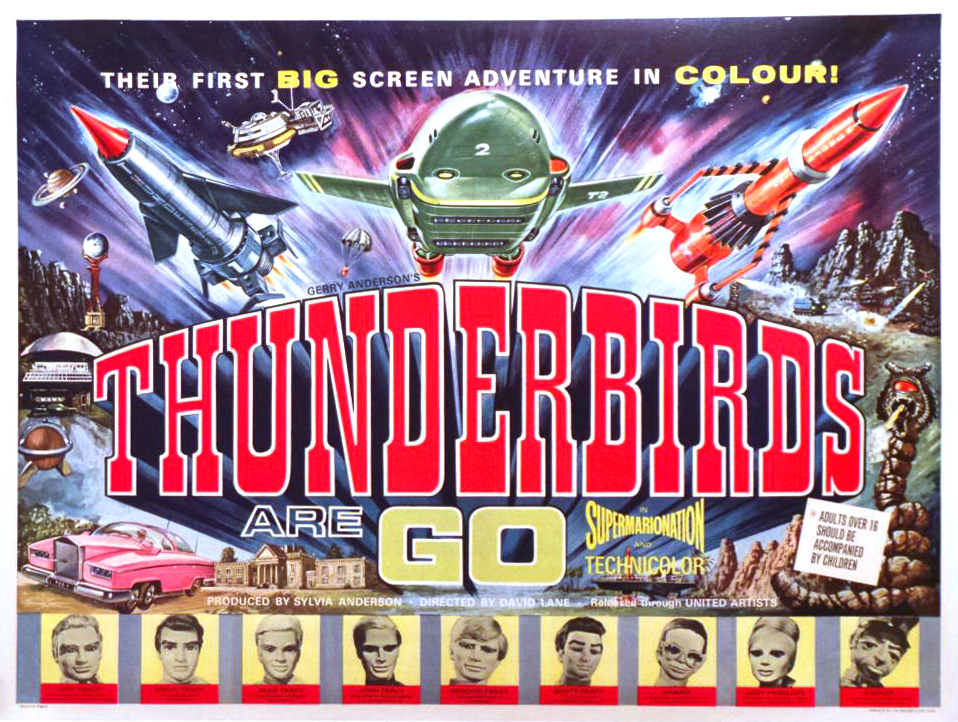
Remembering (and revisiting) Thunderbirds Are Go!

One of the UK release posters: rather boringly symmetrical... where are the explosions?
And what's the Solar Station from Lord Parker's 'Oliday doing in there?

It’s a shade over fifty years since I was taken, as a five-year-old child, to the cinema to see the first big-screen outing for International Rescue, Thunderbirds Are Go! It was my first trip on a train, too – as if the thought of seeing Thunderbirds on the big screen in colour wasn’t excitement enough – though when the train rolled into Lichfield City station I was somewhat disappointed that it didn’t resemble any of the models in my Triang-Hornby train set. It didn’t look like a train at all, frankly: no funnel, no coal tender, no huge driving wheels...

You probably think you know where this is going... from one disappointment (the end of the age of steam) to another, in the form of the cinematic let-down that was Thunderbirds Are Go! Well, no. Not in January 1967, at any rate. Aside from the baffling and pointless dream sequence in the middle of the movie, my five-year-old self was glued to the screen from start to finish, right from ‘This is Assembly Control’ to the thinly-disguised Tracy family toasting Alan at the Swinging Star. All those models... Zero-X... astonishing... rock snakes... wow! Not to mention the experience of seeing Thunderbirds in colour for the first time. If you’d asked me, even ten years later, whether the film had been a resounding success, I’d have answered in the affirmative. So it was that, much further down the line, it came as something of a surprise to realise the film had been a box office failure. The Andersons, at the time, baffled by the poor reception for their movie, attributed it to over-familiarity. Why, they argued, would people pay to go and see something at the cinema that they could get for nothing on television? Fair point, and maybe they might have thought of it a bit sooner. But it doesn’t go anywhere near far enough in addressing what was wrong with Thunderbirds Are Go!

As a child, I was up for any film that featured spaceships, UFOs, or science fiction trappings of any kind. Never mind whether or not it had a story. Thunderbirds Are Go! featured Zero-X: possibly the coolest spaceship yet depicted in any movie or TV series (a title it would soon lose to the Starship Enterprise). Zero-X was cool because it was vast... bigger than Fireflash, Fireball XL5, the lot. It was a cool colour. And perhaps coolest of all, the nose cone was actually part of the control tower (I remember being particularly impressed by this detail). Zero-X was, as the Century 21 merchandising department would later, cannily, point out, five toys in one... those five being, er... the MEV... two lifting bodies... the main body (surely not a contender for a toy in its own right?) and... well, whatever. I left the cinema convinced that I had just seen a preview of Gerry Anderson’s next TV series. How could Zero-X not be given a series of its own?

TV21’s editorial staff were evidently of the same opinion, for even while the movie was still showing at your local provincial flea pit, Zero-X was off on a series of 2-page colour comic strip adventures drawn, for the first year, by Mike Noble (now relieved of duty on Fireball XL5). But as we all know, Zero-X lived and died (twice) in the course of a single feature film. Looking back, it could never have worked on television: this was a spaceship designed specifically to take advantage of widescreen cinema, and back in 1967, widescreen television was technology beyond even Brains’ wildest dreams.

Was this, in fact, the whole high concept behind Thunderbirds Are Go!? Imagine the creative brainstorm as Gerry and Sylvia thrashed out the idea: ‘It’s a widescreen picture so we’ll have a widescreen spaceship!’ ‘Brilliant! What will we do with it?’ ‘I dunno... send it to the moon?’ ‘No, there’ll be men there before the end of the decade. What about Mars?’ ‘Okay, so it goes to Mars. What else do we do with it?’ ‘How about we destroy it in a huge explosion?’ ‘What, again?’ ‘Yes. Except that this time, just to be different, we’ll destroy it twice.’

Gerry Anderson was, by all accounts, a sucker for a big explosion. You’d never have guessed, would you? And, of course, there are plenty of pyrotechnics in Thunderbirds Are Go! But hang on just a moment. What kind of a spaceship is Zero-X that it can’t be returned to base and landed safely just because the Hood’s boot has got stuck in a single elevator control? Does Captain Travers make any attempt to do this? Of course not! We need that big explosion! Likewise, is the ship genuinely incapable of being brought down with a single Lift Body? You’d have thought the designers might have allowed for such an eventuality. But no... we’ve spent billions of dollars on this ship and we’re just going to trash it at the first niggling little technical hitch... and by the way, we’re going to destroy a whole town in the process. Glenn Field’s attorneys must have been on a nice little earner sorting out all those compensation claims...

This may sound like nit-picking, but it’s indicative of what’s wrong with the script of Thunderbirds Are Go! There simply isn’t enough of the right kind of drama, the type that made the TV series so watchable. The technical problems encountered by Zero-X are of molehill proportions, but the script uses them as an excuse for a mountain of destruction, because the script can’t differentiate between a genuinely dramatic situation and a trivial situation that happens to culminate in a bloody big explosion. The dilemmas in the TV series scripts were of a much higher order, knife-edge situations that couldn’t possibly be resolved without a call to International Rescue. The problem with Zero-X is that it’s just crap. It can’t take off or land without crashing. It isn’t even sabotaged properly... the Hood was only taking photographs after all... there’s no bomb in the landing gear or anything of that order. He just put his foot in the wrong place. Zero-X is unarguably an International Rescue just waiting to happen; but the rescue, when it finally arrives, involves nothing more exciting than a quick re-wiring job. No fantastic machinery like the Mole, or the ‘Restraining Outfit’ from The Duchess Assignment (my favourite pod vehicle as a kid). Just a bloody screwdriver...

This is a sterling example of why creators shouldn’t be let loose on their own creations... Thunderbirds was a hell of a concept, but aside from the pilot episode, Gerry and Sylvia Anderson left the writing chores to a variety of hired hands. The Andersons wrote the two Thunderbirds films single-handed, and they wrote them partly to indulge some of their own fantasies... like working with The Beatles (okay, they had to settle for Cliff in the end), and blowing up spaceships on a previously undreamed of scale. Compared to some of the Andersons’ other creations, the Thunderbirds movies feel flabby and self-indulgent, like kids let loose in a sweet shop that they already own.

Now that's more like it… if only the rock snakes had really come to earth on Zero X and destroyed Glenn Field. 

As a five-year-old, I didn’t have many boxes that needed ticking from a Thunderbirds film. It was a film, tick, and it was Thunderbirds, tick. It was in colour (added bonus), and it had most of the Thunderbird craft in it, along with all the characters – what was not to like? How about a dreadful expository scene around the pool table, where Jeff, Scott and Virgil exchange awful, clunky dialogue about what’s been happening on the Zero-X mission. Of course I didn’t notice this at the time. Nor did I notice how much screen time was being wasted on that damn assembly sequence (or the fact that we got a fair bit of it twice). I didn’t notice the rubbish, self-aware humour of Penelope asking Jeff to ‘pull a few strings.’ And I didn’t notice how little time the MEV spent on Mars, or how, instead of getting the crew out on the surface to get down and dirty with those rock snakes one-on-one, they stayed nice and cosily inside the ship while the fiendish thingies ineffectually showered them with fireworks. I still wonder what the point of the rock snakes was, as an actual life form: how did they reproduce? What did they eat? Molten lava? Why were they even there? What did they do when they weren’t attacking Zero-X? Ah, but therein lies the whole point. They were there only to attack the MEV. Bad scriptwriting rears its fire-breathing, rock-encrusted head...

In fairness to the Andersons, they improved significantly on this scenario when scripting the pilot episode of Captain Scarlet and the Mysterons... instead of a pointless life form that has no purpose other than to attack our heroes, we had the titular alien race, peaceful beings given a rude awakening by trigger-happy Captain Black and, naturally, wanting their revenge. It's neat, and it's logical. Mind you, the rock snakes looked cooler than the Mysterons who were, uh… invisible...

Still, TBAG was all good fun for a five-year-old, and it feels slightly cynical to carp at the film’s creative shortcomings. Even so, imagine how much better it might have been if, instead of that bloody Swinging Star dream sequence, there had been a dramatic rescue sub-plot in the middle of the film, something huge and spectacular that could never have been realised on television... maybe one of the boys slips up... for the first time... and redeems himself by saving the Zero-X... ideally with something more than just a screwdriver. And what if the Zero-X had gone properly wrong... MEV holed by the rock snakes and leaking oxygen... crew unconscious... beginning to burn up on re-entry? It’s not hard to imagine how the inert, flabby mass of the script might have been given a few injections of solid drama. Did Gerry and Sylvia not even watch their own TV series? Looking at Thunderbirds are Go!, you might be forgiven for drawing that conclusion.

Perhaps the most astonishing thing about Thunderbirds Are Go!, given its failure to perform at the box office, is that there was ever a second Thunderbirds movie. I remember being taken to see Thunderbird 6 when it came out, and, on this occasion, feeling slightly underwhelmed by it all. Amazingly, the Andersons not only repeated all the same mistakes of the previous feature, but added some new ones (open-mouthed, laughing puppets... an airship... set-dressing self indulgence to shame even the freakiest Carnaby Street trip-out). By 1968, in any case, Thunderbirds was beginning to look a bit tired... Captain Scarlet had been on television for over six months, and the new characters and hardware were a lot more interesting than a world tour of Lady Penelope’s wardrobe... which is what much of TB6 amounted to. The biggest let down of all, however, was saved for the end... the sixth Thunderbird that we’d been promised by the title, and had been waiting for the whole movie to see. Aaand... it was just the bloody Tiger Moth! As Jeff Tracy should have said: ‘Brains, you old son of a gun! Now sod off and build me a proper Thunderbird!’ Of all cop-out movie endings, this has to be one of the worst ever. The only thing that can be said in its favour is that it makes a kind of sense... but that’s not saying very much. Actually, I’d rather not say anything in its favour... I still feel short-changed every time I see that ending.

After those original cinema screenings, it was a long time before I saw either of the Thunderbirds movies again – something in the order of ten years – and it’s fair to say that I didn’t miss them. When they turned up on television, they looked just awful in cropped, pan-and-scan format, and what was worse, I was now watching them as a teenager ,with the first stirrings of a cynical, critical adult beginning to influence my opinion.

Just recently I saw Thunderbirds Are Go! again in its recently-remastered form on Film4, and it scrubs up pretty well. There’s nothing at all wrong with it as eye-candy for a special effects junkie, and that’s all I expected from it. Well, there was something slightly wrong with it... all of the credits were missing... including the Anderson’s own scriptwriting and production credits. The crew credits originally appeared over the Zero-X launch sequence, but somewhere along the line, during the remastering process, they’ve been lost. The technical reason for this is simple... all films and TV series retain ‘clean’ versions of their opening titles, to allow for foreign titling; this footage is always of superior quality to the titled version, which is a generation further away from the negative. Most decent restorations use the clean titles where necessary, adding new captions to match the style and content of the originals. It’s just that, this time around, someone forgot to do it. And while it’s nice to see the launch sequence in its ‘clean’ version, it’s a shameful omission not to have on-screen credits for the many talented people who actually made the film – even more so when the end titles are given over to spurious fake credits, thanking the director of Glenn Field and the Martian Exploration Centre for their contributions. Maybe there’s an option to play the film with or without credits off the blu-ray disc: if so, someone goofed at Film4.

Either way, watching the film again, and in sterling HD quality, only served as a reminder of the gap between an idea and its execution. Thunderbirds on the big screen still sounds like a pretty good idea. So why has there never been a decent Thunderbirds movie? Will there ever be? Not unless someone can write a script and finance a production good enough to bridge the idea/execution gap. As Lady Penelope helpfully says at the end of that dream sequence: ‘mind the gap, Alan.’


Wednesday, 4 January 2017

'BBC1 will now explode…' or, Ident-ity Crisis

A look back at some of Auntie's graphic endeavours…


'This is BBC1'… the so-called 'watch-strap' logo (1966-69)

Ask anyone of a certain age what the BBC uses for a symbol, and they’ll probably still say: ‘a globe.’ It hasn't been a globe since 2002 (and that was, more properly speaking, a balloon), but a globe it was for the best part of forty years. And in the week that sees a new raft of BBC1 idents rolled out across the network (of which, more later), I thought it an opportune moment to look back at some of the network’s earlier graphic attempts.

For me, growing up in the 1960s and 70s, the BBC was always a globe... Auntie clinging onto a Reithian ideal of empire, of nation speaking peace unto nation. It was not always thus. Before the globe came the… thingumajig, weird and undescribable, looking rather like a dangling mobile that had been sent back through time from the Play School studio, or ingeniously constructed out of folded paper by John Noakes. Whatever it was meant to be, it was in use for a decade starting in 1953, and I’m pleased to say that I have no recollection of it whatsoever. It was elaborate, geometric and highly artistic, perhaps refecting how the BBC felt about itself at the time. (Swimming hippopotami? This is the British Broadcasting Corporation, for heaven’s sake!)

Unlike the symbols which would replace it – all of which were broadcast in real-time by pointing a TV camera at a rotating model – this early TV symbol was transmitted from a piece of stock film (one they’d made earlier, you might say). This proved to be a wise decision, as the delicate mechanical contraption fell to pieces shortly afterwards.

In 1963, the Corporation cast aside this esoteric art deco confection in favour of something new and dynamic, a global brand for a thrusting new decade, reflecting the corporation’s status as a supplier of programmes to countries far and wide. The result was the symbol that so many of us came to associate with the BBC down the ensuing decades: a rotating globe.

One of the comfortingly real-world 3d BBC globes (the lighting alone tells you it's a model)

The original globe was exactly what it looked like: a three dimensional object, rotating mechanically in front of a locked-off camera, and for the first three years of its on-screen existence, it was labelled, simply, BBC tv. A revised version, popularly known as the ‘watch strap’ appeared in 1966 when the channel was, for the first time, identified on screen as BBC1 (although the BBC1 brand had come into being with the launch of BBC2 in 1964). This is the first BBC symbol of which I have any clear recollection. It remained in use for only three years, until a new version ushered in the era of colour broadcasting.

The new ‘colour’ symbol placed the rotating globe in front of a mirrored background image, with the colour, such as it was, added electronically. It wasn’t exactly a riot of colour, as this image illustrates: black background, blue landmass and logo – the colour contrast being deemed suitable for viewing on black and white equipment. By contrast, BBC2’s contemporaneous logo was more colourful (albeit confined to shades of blue and white) and more modern in appearance.

'BBC1 will now explode.' The original BBC1 colour ident, much parodied by Monty Python

This was the BBC1 ident I saw on our first colour television set in November 1974, but I didn’t have long to get used to it: a month later, the logo was updated again, to a brighter colour scheme of blue and yellow. I have to confess that I rather mourned the passing of the italic, boxed BBC logo, which had been around since 1963 (familiar to me from its many appearances on items of licensed merchandise such as Dr. Who and Z Cars annuals, Dalek toys and the like).

The new logo, if you can call it such, comprised the station name in a bland, heavy weight of the typeface Futura. No boxes, nothing. It may seem nostalgic now, but at the time, it looked clunky, bland and modern. It remained in vision until 1981, and is preserved on some of my earliest video recordings.

The 'acid yellow' makeover of 1981. With a font from 1970...

It was given a subtle if pointless makeover in 1981, with the warm yellow replaced by an unpleasant acid hue, and the BBC1 legend updated to a groovier font (for all that it looked a whole decade out of date). I really didn’t like this version, and the vile yellow never looked good, especially on video tapes which tended to react badly to areas of over-saturated colour. This acid yellow iteration would prove to be the last of the ‘real-time’ mechanical models, for new technology was on the horizon.

1985 saw the advent of the first computer-generated globe: by comparison with the early 80s version, and, indeed, most of what would come later, this was a model of tasteful restraint, with a blue and gold semi-transparent rotating globe sitting on a plain black ground above a faux three-dimensional BBC1 logo. It was simple and didn’t draw attention to itself. If anything, it was perhaps a little unremarkable, but that didn’t matter: no one in 1985 expected the BBC’s ident to be all-singing, all-dancing (or a bunch of synchronised swimming hippos, for that matter).

A model of taste and restraint… only it's not a model. The first computer-generated BBC globe.
For its next makeover, the BBC outsourced the work to the Lambie-Nairn agency, the first time that a station ident from the corporation had been handled by an external supplier. Lambie-Nairn had impressed the industry with their work on the Channel 4 ident, and their new BBC1 brand harked back to an earlier era, resurrecting the defunct, boxed italic BBC logo. The globe, of course, was retained, but its days were numbered.

In 1997, the BBC underwent a much-publicised rebranding exercise: indeed, there was plenty of comment at the time regarding the eye-watering cost. For reasons unknown, the BBC symbol, with a heritage of some thirty four years (barring its decade-long absence from 1981-91) was now ditched in favour of... something almost the same but not quite. The italic boxes were straightened out and the classic BBC font replaced by a variant of the blandly ubiquitous Gill Sans – a 1930s font that has been seen and used on everything from the London Underground to those annoying Keep Calm And... novelties. This new logo quickly became intrusive, with some BBC mandarin decreeing that it must appear over the opening credits of every BBC-produced programme (it was even added electronically to earlier productions). Fortunately, in a move no doubt welcomed by the designers of programme title sequences, this was later quietly dropped.

'It's only a model…' One of the mechanical globes as used until 1985.

As part of the 1997 rebrand, the BBC globe was ‘imaginatively’ updated to... a hot air balloon. Decked out in a counter-intuitive colour scheme of red and yellow, the new floating BBC symbol was filmed (and later electronically inserted) over a variety of typical British landscapes. This must have taken some doing, as hot air balloons tend to be, well, balloon-shaped (ie. an inverted pear) as opposed to perfectly spherical, like a globe.

In 2002, a short-lived new set of so-called ‘Rhythm and Movement’ (ie. dancing) BBC idents replaced the balloon, but these proved hugely unpopular with viewers and were dumped within four years of their introduction. By this time, it was almost unthinkable that a TV station should use anything as pedestrian as a static (or rotating) graphic as its on-screen identity, and filmic logos were now considered de rigeur. Thus the new set of BBC1 idents, introduced in 2006 (yes, that long ago) all featured filmed and CGI-manipulated sequences loosely themed around a circular formation (such as multi-coloured cyclists, and, yes, those damned hippos).

ITV quickly followed suit, although their efforts have always felt a bit random, with no discernible thematic link between the various sequences. Channel 4, on the other hand, with its eccentric ‘how the hell did they do that’ idents (like, those pylons...) continues to lead the way (though their recent coloured rhomboids feel somewhat infantilised, smacking of nursery bricks or cusinaire rods).

Now, with the new year, comes a brand new set of BBC1 idents. I haven’t even seen them yet, but I have seen some of the online reaction. For the record, the new theme is ‘oneness’, and the images (I’ve only seen them as still frames, but I presume they move about a bit) come courtesy of photographer Martin Parr, who, for the record, once compiled a book of ‘boring postcards’. Just saying...

Maybe it’s time to bring back the globe... I have some balloons left over from Christmas and a felt-tip pen... we can do this...