Friday, 19 January 2024

Fifty Years Ago This Week


It is January 1974. Britain is a nation in crisis. On the first of the month, the doomed Heath government introduces the notorious ‘Three-Day Week’ as a fuel-saving measure during the ongoing industrial action by the miners’ union, orchestrated by Arthur Scargill. You could hardly turn on the TV news without being subjected to his combover and haranguing anti-government diatribes. The situation would reach crisis point on 7 February when Heath, in frustration, called a General Election to settle the issue of who governed the country: his administration or Scargill’s union. The voters decided – but only just – in favour of the latter. It would take a further election in October to settle the resulting electoral stalemate and deliver a minority government into the hands of Harold Wilson.

Aged twelve, I took scant interest in such affairs of state, but it was hard not to be aware of what was going on. Our dad was affected by the Three-Day Week, and I can remember hearing it being discussed on the Today programme playing in my friend’s dad’s car as he drove us to school. On television, we were subjected to a campaign of government advertising encouraging us all to ‘Switch Off Something’. I’ve seen it stated – incorrectly – that the SOS TV campaign was never actually broadcast (like the infamous Protect and Survive films of a decade later). Yet I can well remember those commercials, voiced by John Paul late of the BBC’s Doomwatch (a highly apposite choice).

The miners’ industrial action had served to exacerbate an already critical energy situation brought about by an oil crisis in the Middle East: OPEC had imposed an embargo on those nations, including Britain, that had supported Israel in the Yom Kippur war of October 1973, and fuel supplies were running critically low in Europe and America. Here in Britain, Petrol coupons were printed, but the government stopped short of actually issuing them. Meanwhile, drivers queued up at forecourts as supplies dwindled, and arrived home to find their homes blacked out by power cuts.

In the small street where my family lived, however, blackouts were rare. We’d see the lights go out in the houses at the back of us, but our supply remained switched on: a handy quirk of being on the same circuit that served Sutton Coldfield’s Good Hope Hospital. A few mean-minded cirizens complained about this to no avail. The result was that our 1970s experience was slightly less unpleasant than one sees depicted in the many TV documentaries covering the era. The emergency supply of candles that our mum bought around this time was still extant when I cleared the house in 2021. And here they are.

Being immune from power cuts meant that my television viewing went uninterrupted, (although we were still watching in black and white), and my diary gives a snapshot of what I saw this week in January 1974 (and little else, it has to be said). Letts’ Schoolboys’ Diary was a stocking filler at Christmas, and its small pages offered little room for budding Adrian Moles. Fortunately, I was not thus inclined, and my entries are laconic to say the least: ‘UFO, SG60’ reads the entry for Sunday January 13, where we begin our look back across five decades.

Gerry Anderson’s UFO had begun a repeat run on Sunday lunchtimes the previous week, so it’s safe to say that today’s episode would have been Exposed, introducing James-Bond-who-never-was Michael Billington, in the first of several toupées essaying the role of Colonel Foster. ‘SG60’, meanwhile, was shorthand for the Sold Gold 60, Tom Browne’s weekly chart rundown which was a Sunday evening ritual, often accompanied by sardines on toast.

And what, you may ask, was troubling the pop charts in this week of national crisis? Slade’s Merry Xmas Everybody had slipped down to number three, and wasn’t getting played any longer. Well, after all, like the proverbial puppy, it was only for Christmas… meanwhile, Wizzard’s own Christmas hit had plummeted twelve places to number 16. The number one spot was currently occupied by the New Seekers’ forgettable ditty You Won’t Find Another Fool Like Me, which I’m sure was on constant rotation on Ted Heath’s jukebox, certainly if Mike Yarwood had anything to do with it. On the way up the chart we find Cozy Powell’s instrumental hit Dance With the Devil at number four (most of its melody was ‘recycled’ from Jimi Hendrix’s Third Rock From the Sun), while Netherland rockers Golden Earring’s one-hit wonder Radar Love had gone up two places to number seven. Mud’s glam floor-filler Tiger Feet was new in at number ten, while a particular favourite of my brother and myself, Pool Hall Richard, had slipped down to number 8 for Rod Stewart and the Faces. Three of the Beatles were in the Top 50: Macca’s Wings had dropped down to 41 with Helen Wheels, while John’s boring effort Mind Games stood five rungs further down, having managed a peak of only 26. And right at the bottom, at number 50, we find Ringo’s amiable Photograph – co-written with George Harrison – which had peaked at number 8 in the autumn.

Back on television, Mondays saw us staying loyal to Blue Peter, though I was nearing the end of my time as a viewer. The line-up of presenters was currently Noakes, Purvis and Lesley Judd. I don’t believe I watched the programme that followed at 5.15, an adaptation of the splendid children’s novel Tom’s Midnight Garden, but if I had a time machine I’d probably put this right. You could tell it was the 1970s because just before the news we had a visit from trippy cartoon characters Crystal Tipps and Alistair. And that was it for Monday’s children’s viewing. I’m sure I watched Nationwide after tea, and maybe even Young Scientists of the Year at 6.45. I definitely didn't bother with Z Cars, which followed at ten past seven: the programme had reverted to a fifty-minute format after seven years in a twice weekly 25-minute slot, during which time the once hard-hitting police procedural had become bogged down in dreary soap-style storylines. It had even lost its classic theme, emasculated by a ‘groovy’ 1970s makeover. Monday evening’s must-see telly was Colditz, just two weeks into its second series. This week, Flight Lt. Carter (David McCallum) devised a plan to hide two British officers to give the false impression of their having escaped – the logic being that they wouldn’t be missed when a real escape took place. I watched this episode just last night. The directorial style of Colditz was standard for all videotaped drama of the era and indeed, even more austere than was usually the case. The incarceration storyline lent itself to an entirely studio-bound production, but the real surprise here is the total lack of music other than the main theme and the odd diegetic item. Where today’s directors lazily strip music across every millisecond of the action, Colditz succeeded entirely on the merits of its cast, writers and directors. Special mention must be made of the late David McCallum, who brought a fierce intensity to his performance as Carter. You have to pinch yourself to remember that this is the same actor who’d been Ilya Kuryakiun in The Man from UNCLE.

Tuesday’s children’s line-up included Scooby-Doo – which I’d given up on quite some time ago – and Vision On, which I also ignored. The evening’s programmes kicked off with A Question of Sport – not a favourite of mine as I knew nothing about the subject – before an Abbott and Costello movie. It’s hard to convey how singularly unfunny I find Abbott and Costello, now as then, and I’m certain I didn’t bother with their 1942 effort Pardon My Sarong. Even the title fails to raise a smile. Fortunately, things got a lot better at 8.30 with Whatever Happened to the Likely Lads. Episode three of series two, going out tonight for the first time, contrasted the lifestyles of Terry – stay at home slob – and Bob, the industrious worker. Beyond the Nine O’Clock News lurked a Tuesday’s Documentary about oil exploration in the Shetland Isles, the kind of programme that Bernard Cribbins might demand to watch when staying at Fawlty Towers. We didn’t bother with that particular televisual feast...

You’ll notice we’ve been on BBC1 for most of the week so far, but Wednesday evening saw us over on ITV where The World at War was about halfway through its 26-episode run. It’s hard to mention The World at War without using the word ‘landmark’ in the same sentence, so there you go. This week’s episode, Red Star, examined conditions in the Soviet Union between 1941 and 1943. It was preceded at 8.30 by Man About the House, an incongrous pairing if ever there was one. Tonight’s episode, Colour Me Yellow, was the second episode in the second series. I’m not sure if I watched it – the diary says nothing. I don’t think the coincidence of two series with coloured episode titles is worth mentioning, so I won’t…

Thursday saw us back with BBC1 for Top of the Pops and It Aint Half Hot MumTOTP was introduced this week by the well-known airbrushed-from-history presenter with a face like a halloween lantern. Amongst the acts featured were Andy Williams, miming to his hit Solitaire; Suzi Quatro, prancing around in Devil Gate Drive; The Sweet ripping it up with their Teenage Rampage; and Mud stomping up to number one with Tiger Feet.

As if you-know-who wasn’t enough to offend modern sensibilities, TOTP was followed by It Aint Half Hot Mum, featuring Michael Bates in blackface. I certainly watched this – the diary says so – and found it funny at the time, not so much for Bates as for Windsor Davies who always raised a smile with his endless bellowing ‘shut up!’ and insistence that the concert party was just ‘a bunch of poofs’. Different times, indeed.

Friday teatime saw the old black and white set switched back to ITV where we caught a repeat run of Timeslip (ironically missing the last chance to see the show in colour before the tapes were wiped), followed by The Flintstones. Bedrock’s finest had become a Friday teatime staple a year or so earlier, and despite the series hailing from the early 60s, we were watching Fred, Barney and co for the first time. I was so taken with the characters that I pained two huge watercolour portraits of Fred and Barney onto a piece of hardboard originally intended for an abandoned model railway. It stood in the corner of my bedroom for years.

I’d become a fan of Jeff Rawle’s Billy Liar back in the autumn – inevitably, I identified with his daydreamy personality – and I’m sure I was still watching when he showed up at 8.30 on ITV in the last of the present series. Billy Fisher was hardly an ideal role model for life, but it’s a bit too late to do anything about that now… Following his escapade on ITV, we switched back sharpish to BBC1 to avoid exposure to the horror of Within These Walls. Fortunately, auntie had a treat in store beyond the Nine O’Clock news in the form of Cricklewood’s intrepid trio, The Goodies, with a repeat of the episode Superstar, promising to lift the lid on the pop scene. Within the year, the trio would be part of the scene themselves with their own chart singles Inbetweenies and The Funky Gibbon.

Rounding off the week in my diary, on Saturday 19 January, we find the second episode of one of Dr. Who’s less successful serials, Invasion of the Dinosaurs. Rubber monsters notwithstanding, the story dragged on for weeks, including a sequence involving a group of people who thought they were in a spaceship but were actually in a warehouse in London. Which, as a description, pretty well nails 70s Who to a ‘T’. The Doctor and his chums led us nicely into Saturday evening on BBC1, where we find The Generation Game, followed by Dixon of Dock Green. Mid-evening variety came courtesy of Cilla, who was elbowed out of the way at 8.20 by Chief Ironside. The inevitable Match of the Day rounded off proceedings at 9.25 but was roundly ignored in our house. If that seems unusually early for MOTD, bear in mind that broadcasting closed down at 10.30 in line with the national crisis. Assuming you were able to tune in at all.

As we’ve seen, ITV scarcely got a look in this week. In retrospect, that’s probably no bad thing given the cover star of this week’s TVTimes whose headline reads ‘The Frantic Art of Rolf Harris’. Fifty years on, that could well be subject to misinterpretation. In fact, the single most interesting aspect of the week’s edition is the inclusion of the following caveat on the listings pages: ‘Owing to Government measures in support of the economy, programmes scheduled for transmission may be subject to late changes. Watch for screen announcements to this effect.’

Back in crisis-hit 1974 Britain, I’m sure there can’t have been many who wouldn’t have leapt at the chance to ride fifty years into the future in a time machine, and get away from it all. They’d have had a shock in store. For all its black and white, fuel crisis, Switch-Off-Something, Jimi-Savile-on-the-telly brutalist-concrete instant-mash awfulness, I’d still take 1974 in preference to where we are now. So if you happen to see a time machine with seats available, let me know...


Saturday, 23 December 2023

Christmas at the Radio TImes


Christmas wouldn't be Christmas without the Radio Times. At least that's what this year's advertising campaign tells us. Well, I beg to differ. With the double issue now weighing in at a budget-busting five quid, I've decided to do without it, breaking a tradition that goes back almost as far as this gallery of covers. To mark this unauspicious and Scrooge-like decision, I've found this run of festive RT covers which I present here for your seasonal entertainment, complete with a sometimes caustic commentary...

The double issue was already an established tradition when I had sight of my first example, second from left on the top line, way back in 1970. I'm rather glad we didn't get it in 1969 as the cover is pretty awful and not specially festive either. The collage looks like someone was trying to re-create a Victorian postcard, or possibly Monty Python. Either way, I think we can agree it was a dud. This was the first year of the RT's classic swash caps masthead, which seems to have been influenced by the fad for Edwardiana in the late 1960s. It certainly wasn't typical of the era, and I have to confess that I never really liked it. One got used to it over time, but would have preferred something more like the RT mastheads of the 1960s. I'm still amazed at how long it lasted.

1970's festive spread felt far more in keeping with Christmas. I can't quite make out who all the dinner guests are, but I think Morecambe and Wise might be among them. The Two Ronnies nabbed the cover for 1971, which was the first year of their enduring TV comedy partnership. As if to ensure fair play, Morecambe and Wise got the gig in 1972, and all four were present for 1973's line-up. I don't care for that 1972 cover, though. Who says that circuses equal Christmas? There's not a bit of snow, holly or even a bauble in evidence. Frank Spencer made the cover in 1974, but the design was austere to say the least. That's the 1970s for you...


1975 saw a return to illustrated covers – back in the 20s and 30s, there had been some fine artworks gracing the Christmas numbers of RT, and the mid-70s would keep up this tradition. 1975's cover could easily have come from several decades earlier, and was a fine festive composition, albeit with rather low-key colour values. 1976's stained glass effort depicting Good King Wenceslas has the look of a Royal Mail Christmas stamp issue, while 1977's design, again in muted colours, pulled off a neat visual trick. Just when readers were getting acclimatised to artworked covers, 1978 was a throwback to earlier in the decade, with the year's biggest Christmas star – Mike Yarwood – getting pride of place. His Christmas Day show was now one of the big draws on BBC1, and would continue until 1981 when he moved to ITV. Artwork covers were back for 1979 although once again the colour values look decidedly muted when set against more recent examples. 1980's cover was even worse in this respect. The flat colour just looks drab, and the children look more bored than excited. Couldn't the artist have added Santa and his reindeer in the sky? As it is, they appear to be looking out at a the glow from a distant nuclear detonation. But it was 1980 after all, and the Third World War was just around the corner. Or so we imagined...


Artwork covers would rule the roost for the next four years, with 1981 again looking like a Christmas stamp contender: a nice, restrained festive image, happily ignoring all the season's visual clichés. 1982 was probably a step too far in that direction. Yes, we get the 'I Saw Three Ships' motif, assuming that was the artist's intent, but a galleon, even in festive trappings doesn't exactly scream out 'It's Christmaas' in a Noddy Holder stylee... 1983 was back to postage stamp land, with a design incorporating the twelve days of Christmas. The kind of thing you might see sold as a Christmas card in a National Trust shop. 1984's pariedolia cover is just scary. Who is that face meant to be? Santa, the Green Man or the spirit of Christmas past? Either way, I hate it. Back then, I'm not sure I even saw the face when viewed at full size. But in all honesty, I was less interested in what the Radio Times chose to put on the cover than in the programme listings. Photographs were back for the next two years, suggesting that the Christmas cover images were decided on the basis of which programme had scored the highest ratings the year before. The Only Fools cover could have been from a decade earlier, but the saturated orange background overwhelms the characters and isn't exactly festive. The EastEnders cover is just boring. Who wanted to look at the Albert Square crowd for a fortnight over the festive season? Having them on the TV was bad enough. The cover designer seems to have realised that the photograph simply wasn't Christmassy enough, and has added a festive border, the only nice touch on what is arguably the dullest cover here.


1987 was another Victoriana throwback, a cloying sickly design and one of my least favourites. Festive yes, but not in a good way. 1988's panto artwork was fine, and the lack of distracting text admirable. The kind of cover you didn't mind having on your festive coffee table. 1989's choirboy cover was a rare example of RT drawing attention to the true meaning of Christmas and was a welcome change from Del Boy, EastEnders et al. It just didn't make for a very interesting cover. 1990, by contrast was as cloyingly traditional as it gets. Nice artwork, but horrible image. Santa looks decidedly like his famous Coca-Cola incarnation. For the first time ever, the cover depicts what the Christmas RT was all about – watching the telly. And if Santa hadn't already eaten all the pies, he was certainly about to. I wonder who won the seventy grand? 1991's cover set the tone for almost all subsequent Christmas RTs. A lot of text there, and bigging up the fact that you could now get all channel listings in a single publication. The artwork was traditional to a fault, and one of the most unimaginative Christmas covers RT had served up to date. It's also self-congratulatory in a most un-Reithian fashion. Who cared if RT was magazine of the year? And who knew Santa needed specs? 1992's snowman wasn't much better, but at least the amount of text had been reduced. This would be the first year of the cover flagging up the staggering amount of movies available over the festive season – more than 500. But there was worse to come...


If there has to be a wooden spoon for the least popular Christmas RT cover of all time, 1993's effort wins it by a mile. Mick Brownfield's artwork played on the song 'All I Want for Christmas', but despite being nicely executed, it wasn't what RT readers wanted on the cover of their double issue. I detect the heavy hand of editorial influence here. Next year's cover played safe by revisiting a classic illustration from the 1930s. One notable change this year is the modification of the 'classic' swash caps masthead, which would endure for only six more years. The movie count is now up to 700. That's more than any video recorder could cope with.

1995's cover was just horrible. Yes, I know, it was Christmas, and Santa Claus is all part of the festive iconic mix, but it's hard to imagine a more yucky rendition of him. Movies now seem to be the magazine's raison d'etre, judging from the clapperboard motif. And what's that I spy? Snow-lined lettering... a publisher's cliché that RT had admirably resisted until now. It hadn't thawed by the time of 1996's snowman – acceptable but lacking in imagination – while 1997's stylised Santa at least had the virtue of minimal text. Where would it have gone, anyway? In his beard? No logo snow this year, either, but it was back in 1998, by which time the the movie count had doubled from its original 1992 quota. I don't care much for this cover, either. Santa riding his reindeer like a cowboy across a snow-covered prairie? Nah.


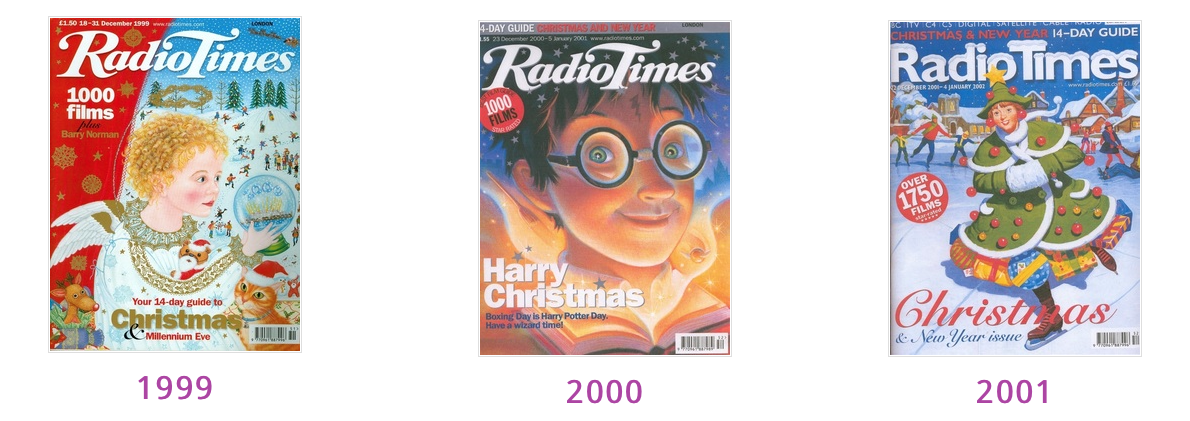
Those films just kept on coming... 1750 of them in 2001, 2000 the following year. Artwork continued to dominate the covers. Naive in 99 (hated it), un-festive Harry Potter in 2000 (hated it again), contrived in 2001, and as many festive trappings as you could imagine over the next three years. Was there a rule in the art department that the Christmas covers had to feature a blue background? Taken together like this, their paucity of imagination is quite striking. And we've also seen the last of the swash caps RT logo that had dominated the cover since 1969. 2001's sans font was just boring, but it was probably easier for snow to settle on sans serifs. This boring look dominated the next four years.


The sans title block evidently wasn't popular, and was gone by 2005's Tardis snowglobe cover, replaced with a heavy, condensed font. It still wasn't much to look at, but it made for a bolder cover design. The Dr. Who imagery reflected the show's much anticipated return to the screen that year. In 2006 you even got a 'free Doctor Who CD' whatever that might have been. And it was actually inside, rather than a mail-away offer. I have no recollection of seeing this, so must conclude that 2006 was a year in which I chose to go without the festive RT. At £1.99, the price was rather more than we'd been paying back in the 1980s, but seems like a bargain compared to the five quid they want for 2023's edition. Santa's snow angel of 2007 reflects a trend that must have gone viral around this time – we certainly didn't do it in the 1960s or 70s – and it was back to photographs with Wallace and Gromit in 2008. A welcome change from cheesy paintings of Santa, but don't outstay your welcome, guys. 2009 saw a return visit for that Coca-Cola Santa, and the first in a regrettable trend of offering alternative covers. If this wasn't taking advantage of collectors, I don't know what was...


Originality was nowhere to be seen in 2010 when Wallace and Gromit again nabbed the Christmas cover: the only characters since Morecambe and Wise and the Two Ronnies to make it onto the cover twice. 2011's alternate covers looked like charity Christmas cards. At least the blue background was gone, but one wonders what was the point. At least we were spared sickly Santas. It's hard to argue with the next two years' Raymond Briggs covers, but I've never been a fan of Judith Kerr's art, and felt her 2014 cover was playing too much to the younger members of the gallery. One regrettable trend to emerge from this run of covers is the self congratulatory puff 'The Legendary Double Issue.' Traditional, I'll grant you, but magazine covers have never been the stuff of legends. Get a grip, editior!


If you couldn't have Wallace and Gromit again, then the next best thing was Sean the Sheep... and is it just me, or did Santa look suspiciously like Shane McGowan? 2016's cover reverted to twee family friendly art, while 2017 looks like it may have been the work of Raymond Briggs. 2018 certainly was. Readers who had held onto their 2012 copies might have been tempted to spot the difference. I'll tell you the answer: 2012's cover was promoting that year's new arrival, The Snowman and the Snowdog, while 2018's image hails from the original. 2019's reindeer cover rings no (sleigh) bells with me, but that's not to say I didn't buy it: more likely it's down to visual fatigue. After so many years of Christmas RT covers, they all become a blur. 2020's Santa was so generic you could be forgiven for not noticing it at all... which brings us almost up to date.

2021 set a corpulent Briggsian Santa against a backdrop of chimneys, and that traditional dark blue sky. By now, the amount of snow on the logo had reached excessive proportions. It's about time someone swept it all off. 2022 meanwhile, was another throwback cover. Surely that's 2011 again? It was certainly hard to tell them apart. Fortunately, you didn't have to, unless you were a time traveller. This year we have Mog, star of the by now obligatory heart-warming Christmas cartoon. Is there room on the broom for any more? Evidently yes. Merry Christmas from your resident designer Scrooge.


Larger copies of these scans, along with the covers spanning the years 1936-1968 can be found here:


Decades of Christmas Past: 1993


Christmas 1993 saw some changes in my personal circumstances compared with a decade earlier. For one thing, I was no longer going out to work: I’d become freelance in 1991, so aside from work commitments, I was a free agent – albeit one with limited resources. I kept a partial diary this year, mostly as a place to record out-of-pocket expenses that could be claimed back on my tax return, and the Christmas period saw a full run of entries beginning on Monday 20th December and continuing on into January.

Monday 20th December brought what everyone wants for Christmas – snow. I'd spent the afternoon visiting a friend, and drove home into a virtual blizzard. Despite the worsening conditions, I went out later to meet up with some other friends at a rural pub: surely not a great idea. The gritters had been caught out, and even the dual carriageway A38 was like driving through mashed potato. At home later, I watched Newman and Baddiel’s Christmas in Pieces. Now, there’s a comedy double act that time has forgotten. I think this 30-year-old relic must now qualify as a ghost of Christmas past; or to put it in the idiom of the show’s two infantile history professors: “You see an old television programme that nobody remembers apart from really old people? That’s you, that is.”

The snow endured overnight, thanks to sub zero temperatures, and the following morning I took some Christmas card-type photos around the Cathedral in Lichfield, where I was now living. The odds on a White Christmas must have upped considerably, but we were to be disappointed: the following day brought a thaw and heavy rain. Bah, humbug…

One festive tradition that has endured down the years is the Christmas Double Issue of the Radio and TV Times. As the above image shows, the RT now included complete programme listings across all available channels, meaning that one no longer had to buy the TV Times as well. The cover artwork was by Mick Brownfield, whose work monopolised the festive RT covers during the early 90s. I didn't care for this year's offering, and I seem to recollect seeing a few complaining letters about it in the new year. You couldn't argue with Brownfield's technique, but the toothless kid was an ugly image to have staring up at you from the coffee table over the festive season. I folded the front cover inside out so as to avoid looking at it. Brownfield had provided the covers for 1991 and 1992, but 1993 was his last year on the job, and I bet that gappy-toothed kid had something to do with it.

Wednesday the 22nd gives us a couple more clues to the prevailing televisual climate. At 6pm, the BBC2 offered us a Star Trek premiere in the form of the previously unbroadcast Plato’s Stepchildren. Best described as interesting but awful. Later in the evening, my diary records that I watched the final episode of Stark, a three-part serial produced in collaboration between the BBC and the Australian ABC network, and based on Ben Elton’s novel of 1989. I remember the novel generating a fair amount of media interest on its release. Comedian writes novel? Whatever next? Step forward Stephen Fry and… just about everybody else. As to the TV adaptation of Stark, if it wasn't for my diary entry, I’d have assumed I never saw it. Less than nothing of it remains in my recollection. Which is probably for the best. Having said which, I suspect Elon Musk may still be hoping to turn the novel’s premise – super rich bastards abandon eco-disaster Earth in spaceships – into a reality.

That same evening (December 22nd), on video, I watched Monday night’s episode of Prime Suspect, now in its third series. But again, like Newman and Baddiel, this award-winning show seems to be sliding slowly into obscurity. Netflix made it available to stream in 2013, but that’s a decade ago, as was the blu-ray release from now-defunct Acorn Media. It was certainly one of the most talked about TV series of its decade, and made Helen Mirren a household name if she wasn’t one already.

Thursday 23rd December saw the UNCLE movie The Karate Killers get an airing on BBC2. I’d probably already got this taped, so didn’t bother with it. BBC1 offered us David Attenborough’s Life in the Freezer, a compelling 6-part profile of Antarctia. And you can still watch it, as the whole series has been made available on iPlayer.

My diary reports that I also watched the rom-sitcom Goodnight Sweetheart, in which Nicholas Lyndhurst cheated on his present day girlfriend by wandering back in time to the Second World War. Wikipedia describes this as a ‘science fiction’ sitcom, but that makes it sound like Red Dwarf. There was no sci-fi on show here, just a rather pedestrian form of time travel (he merely strolls down a certain street). This week’s was the final episode of its first series. I didn't follow it into the future, but I’m sure it’s probably playing on some satellite channel even as we speak.

Christmas Eve started with a Just William reading on Radio 4. In the afternoon, I watched the classic film Genevieve for possibly the first time. It would not be the last. The evening’s entertainment all came courtesy of VHS tape, on which format I revisited the old Christmas editions of Get Some In! and The Likely Lads. The latter was my prized recording from Tuesday 23 December 1980 of what was only the second screening of this Christmas comedy classic. These days, it can no longer be seen in its original form as Bob’s line ‘I can even take Rolf Harris’ (in reference to Christmas televisual tat) has been excised from all future broadcasts.

Over on ITV, meanwhile, Melvyn Bragg might shudder today at the recollection that The South Bank Show presented a special programme about... Cliff Richard.

That was it for Christmas Eve on the box. Christmas Day on BBC1 offered the resistable Back to the Future III for the afternoon’s entertainment (we didn’t bother), and the by now obligatory Only Fools and Horses at 18.05: ‘the worst ever’ according to my diary. This year’s piece of festive ‘fun’ saw Del put through the emotional wringer when his wife Racquel walked out on him. If that wasn’t enough, hard on its heels came EastEnders which could always be relied on to serve up a thick slice of seasonal misery. Birds of a Feather (8pm) may have done better, but as I seldom watched the series, I neither knew nor cared. The evening’s big film was Ghost, but I’d already seen that at the cinema. My diary records that I spent much of the day at our parents’ house reading one of my brother’s Christmas presents – The Kenneth Williams Diaries, which I’d given him myself (cunning, eh?) Boxing Day  on BBC1 included Keeping Up Appearances and One Foot in the Grave, which are almost the yin and yang of 1990s suburban sitcom. Did BBC2 do any better? Well, yes, as a matter of fact: Christmas Day brought us another repeat of The Treasure of Abbot Thomas, now getting its third outing. And this time I taped it.

Boxing Day was not, technically speaking Boxing Day this year, falling as it did on a Sunday. In years past, such as 1976, when December 26th fell on a Sunday, it was known as Christmas Sunday, and 'Boxing Day' became the Bank Holiday Monday, the 27th. My 1976 diary confirms this, but by 1993, the diary insists that Boxing Day was December 26th, with the 27th listed as 'Christmas Holiday'. I always think it's a pity when these old traditions fall out of use.

Despite Monday being a Bank Holiday, some of the shops were open – another sign of the times. From our local Woolworths, I bought a VHS tape of Gerry Anderson's The Secret Service at the reduced price of £5.99, for which you got a whopping four episodes. VHS tapes had also been amongst my Christmas presents, including the Dr. Who serial Terror of the Autons, which I was already making my way through. The evening's TV on BBC1 included shows that I either never watched (Lovejoy) or had fallen out of love with (Last of the Summer Wine). Fortunately, over on BBC2, we were offered a night of programmes curated by comedy flavours of the month Vic Reeves and Bob Mortimer. I sat through most, if not all of this, taping selected items including a rare Dad's Army sketch from 1972's Christmas Night With the Stars. The big draw for me was Mike Leigh's Nuts In May, which I'd never seen before.

Snow fell again overnight, with my diary recording that there was 'quite a covering' the next morning. This was inconvenient, as I'd arranged to test drive a brand new Vauxhall Corsa that day, and had to postpone until the 29th. My current vehicle, a Rover Metro ('they've rebadged it, you fool' – Alan Partridge) was utterly unreliable, having a tendency to run slow and/or stop altogether in driving rain. The designers had included two pointless vents on the bonnet, which seemed to serve no purpose other than to allow rain into the engine compartment. It was only a few years old, but it had to go, and indeed it did. The snow didn't last either – the diary records that it was gone by evening.

And with that final thaw of 1993, we reach the end of this seasonal look back across the decades. I won't be visiting 2003, its having being a festive season that I'd prefer not to remember; and 2013 is just, well, too recent innit? Whatever decade you choose to inhabit, have a very merry Christmas and a happy new year. 1964 is just around the corner – for me, at any rate.


Friday, 22 December 2023

Decades of Christmas Past: 1983


Strange as it is to recount, I have less recollection of Christmas 1983 than I do of the festivities ten years earlier. Not having kept a diary that year, I have no idea what gifts I gave or received, though by this time, LPs were almost guaranteed for Christmas, and annuals had been replaced by gift books of varying quality, none of which has left any lasting impression.

One thing I can say definitively about this festive season was that it was my first as an employee: I’d joined the staff of a small Birmingham-based advertising agency back in May, and in the week before Christmas we all decamped to a corner pub diagonally opposite the Hippodrome Theatre. The pub retained its Victorian interior and was decorated with photos, playbills and sheet music reflecting its long history as a watering hole for thesps and music hall entertainers like Dan Leno. Our traditional Christmas dinner was served in a rear function room of Dickensian aspect, the smell of boiled sprouts and turkey wafting through to the saloon bar while we had our pre-dinner drinks. The jukebox was playing Paul Young’s Love of the Common People, which was currently riding high in the charts. The windows were all steamed up from the cooking. This is the clearest memory I have of that forty-year-old Christmas, and I have to look elsewhere to get a better idea of what else might have been going on.

The pop charts offer a few clues, but nothing significant. Christmas singles were, of course, unavoidable by 1983, with the most enduring of this year’s crop proving to be the Pretenders’ 2000 Miles. I’d heard a novelty single on the radio one afternoon at work, which Steve Wright suggested might be the work of XTC. I didn’t believe it myself – surely they wouldn’t stoop to such banal festive tat as Thanks for Christmas? But Wrighty was right: under the pseudonym The Three Wise Men, the Swindon trio had released a Christmas single replete with trumpets, twelve-string guitars and sleighbells. Despite getting Radio One airplay, it failled enter the Top 100 singles chart (as a meaasure of its lack of success, the theme from Terrahawks sold more copies). I bought a copy of XTC’s effort out of loyalty to the band, and got over my initial antipathy towards it.

Elsewhere in the Top 100 of Christmas week, Elton John’s dreary Cold as Christmas had crawled up to an unimpressive number 33 while Slade’s Merry Xmas Everyone was out on its third release, ten years on from its original success. Slade’s activities weren’t confined to reissues, however, and their current release My Oh My was aimed squarely at the New Year’s Eve crowd with its folksy singalong melody. The top spot that year had been annexed by acapella vocal group The Flying Pickets, whose arrangement of Yazoo’s Only You had nothing whatsoever to do with Christmas: this didn’t stop them from appearing on the Christmas Top of the Pops dressed as snowmen. I hated it as much then as I do today. Also appearing in the ‘Christmas single that isn’t Christmassy’ category was Paul McCartney, whose Pipes of Peace included Indian tablas but not a single sleighbell. Only the video made clear its festive aspirations, with Macca recreating the famous Christmas truce between the front line troops of 1914. By this time, my musical tastes were drifting away from the Top 20, and in the whole top 100 of Christmas week, there are only a handful of records I own – and two of those were reissues.

I was also drifting away from the television set, so I don’t have any particular fond memories of that year’s festive line-up. Christmas Eve on BBC1 included a repeat of the Some Mothers Do ‘Ave ‘Em special of 1978, followed by a seasonal edition of Pop Quiz. The evening’s main event was the premiere of the movie Flash Gordon, a mere three years on from its theatrical release. Flash (ah-ah) was bookended by Little and Large and Val Doonican. Later in the evening came an edition of Bergerac (snore) and a Christmas special of The Good Old Days, a show I always took great care to avoid seeing. In fact, judging by the schedule, I’m sure I must have been out that evening. I didn’t see Flash Gordon until nearly twenty years later.

BBC2 offered a more interesting line-up, including an adaptation of Laurie Lee’s Cider With Rosie and a couple of Cary Grant movies. But none of it rings any bells.

Christmas Day television no longer included the once obligatory visit to a children’s ward, but children featured prominently in the morning schedule, offering ‘songs, pictures and thoughts about the Nativity’ at 9.50. Not a broken leg or later-to-be-disgraced celebrity presenter in sight. But not so fast… because the dread antipodean bearded one whose name we dare not utter managed to worm his way into the listings, with an animated adventure, The Little Convict, featuring his character Jake the Peg.

Christmas Top of the Pops occupied its time-honoured post-prandial slot of 2pm, leading viewers nicely up to the Queen’s speech. The rest of the afternoon was given over to Blanketty Blank and the 1950 film of Treasure Island, which despite its 33-year-old vintage was at least in colour. Following the news at 5.25pm, up popped another Ghost of Christmas Past in the shape of Jim’ll Fix It, whose contents included ‘how to crack Christmas walnuts.’ I’m saying nothing.

The evening’s big hitters came courtesy of The Two RonniesAll Creatures Great and Small and the inevitable Only Fools and Horses – which in scheduling terms was surely The Mrs. Brown’s Boys of its day. Except that it was funny. I’m sure I sat through all that lot. In the immortal words of Robert Scarborough Ferris, ‘Christmas night, full of food, you just want to sit back in an armchair and watch the box.’ Unusually, the Christmas edition of The Likely Lads does not appear to have been dusted off this year, although The Good Life’s Silly But it’s Fun got a lunchtime outing on Boxing Day. I most likely recorded this. It was followed by the feature film Bridge on the River Kwai, perfect scheduling for a Boxing Day afternoon. Pass the nuts…

Boxing Day’s festive nightmare came courtesy of Keith Harris and (the) Orville, who hosted their Christmas party at 4.35pm. I declined the invitation. And, oh dear me, it just got worse after that. Who, honestly, wanted to see the Circus World Championships on this or any other day? Only the participants, I’ll wager. I bloody hate circuses (sorry, I seem to be turning into Alexei Sayle...)

Then… having seen off that sawdust-ridden offering, we got... Paul Daniels (good magician, but whose brand of schtick I liked not a lot)… Kenny Everett (never got him at all… the endless manic carrying on. Next, please…) Oh God, Rocky. As in Sly Stallone, rather than the chocolate biscuit or Raccoon. I may even have watched a bit of this, though I promise never to do so again.

Over on BBC2, the evening line-up included A Life in the Theatre: Gwen Ffrangcon-Davies (thanks, but no thanks) and the ballet of La Scala presenting Romeo and Juliet (cue old Man Steptoe grimacing face). These were the days when BBC2 was still determinedly BBC2. It was left to the graveyard slot to bring out the best two items of the day, and wouldn’t you know it, they clashed. Over on BBC1, we got the first ever repeat of 1974’s Ghost Story for ChristmasThe Treasure of Abbot Thomas, while BBC2 offered us The Ipcress File. You could, of course, record one whilst watching the other, but you couldn’t record both. My VHS copy of Abbot Thomas dates to a decade later, so if either offering made it onto tape, it was Ipcress.

So much for popular culture, but what of the climate? Did it snow? This was, after all, the 1980s, and only two years on from a notably wintry December where snow lay crisp and even for most of Christmas week, although the failure of a single flake to land on the Met Office roof during December 25th meant it failed to meet the criteria for an official White Christmas (as recognised by bookmakers). Christmas 1981 certainly had lying snow where I lived in the Midlands, but 1983 didn’t quite measure up, with the Met Office monthly report summarising conditions as ‘mostly mild and unsettled’, the monthly maximum temperature having been recorded at Colwyn Bay on the 27th, at a balmy 16.5 degrees. And you thought global warming was invented by Greta Thunberg… Snow did actually fall, albeit too early for Christmas, by which time the milder weather had set in. Moderate to heavy accumulations were recorded on the 11th and 12th, mostly over higher ground from Wales and the Midlands northwards. I can’t remember whether we got any at home in Birmingham, but I usually photographed any notable snowfalls and have nothing to show for this particular year.

So this was Christmas… and what did we do? Sorry, I can’t remember. Maybe I’ll do better in another ten years’ time…


Thursday, 21 December 2023

Decades of Christmas Past: 1973

 
State of the nation circa Christmas 1973? This TV Times cover says it all...

Last time, I pushed the boundaries of memory and attempted to rediscover Christmas of 60 years ago. Memories were foggy if not non existent. But jump forward another decade and it's a different matter.

Autumn and winter of 1973 had been a period of crisis, both at home in Britain and on the global stage. A new Arab/Israeli conflict had created the so called 'oil shock' that saw the price of petrol and deisel spiralling upwards. Here in Britain, garages ran dry and there was even talk of rationing. Parallel with these developments, industrial action in the energy sector led to the notorious three-day week, power cuts and, in the coming February, the downfall of Edward Heath's Conservative government. Sid and Babs were doing their best to get festive on the cover of the TV Times, but it was hard for many people to anticipate having a merry Christmas with so much doom and gloom in the news. Enter Noddy Holder and Slade, with a seasonal singalong to lift the mood of the nation.

The preceding paragraph is, in a nutshell, Christmas 1973 as seen by today's self-appointed cultural commentators like Dominic Sandbrook (who wasn't even born at the time). It's a popular conception. But is it a misconception? I can remember enough of that winter to paint a slightly more upbeat portrait – as glimpsed from where I was standing, in middle class Midland suburbia. Power cuts never troubled us – for reasons I don't entirely understand, our street would escape being blacked out whilst the estate beyond our back garden was regularly plunged into darkness. A neighbour offered the explanation that our supply was on the same grid that served the local hospital (although it was about two miles away). I'm not saying we got off entirely, but we certainly used a lot fewer candles than other families nearby.

As festivities went, we were in a better position financially than had been the case for a couple of years, with our dad now back in regular employment running a distribution warehouse for an electrical manufacturer. My big present this year was an amplifier for my electric guitar. This would have set our dad back something in the region of £70. So I reckon I was doing all right.

On the domestic scene, our kitchen had been upgraded earlier in the year. The Hygeina units would remain in place for nearly 50 years. It wasn't the greatest ever kitchen makeover: the original 1950s tiles, in a dreary shade of creamy yellow, were left in place. But it was better than what we'd had before. In the lounge, we had a recently acquired Fidelity hi-fi system on which to play our records, and probably new wallpaper – our mum tended to paper at least one room every year. She was working too, in the canteen of a local school. Between them, our mum and dad had never had it so good. So the popular myth of the early 70s equating to penury is just that: a myth.

There was only one front on which we still lagged behind in the luxury goods arena: our television set. Colour broadcasts had been available across all three TV channels since November 1969, but we were still watching in monochrome. Our first colour set would arrive in time for Christmas the following year, but in 1973 we were stuck with black and white. On Christmas Day itself, however, we were watching in colour, on account of a minor family spat. Our household tended to decamp to our grandparents’ house for Christmas Day, and had done so every year since 1967. This didn’t sit well with other branches of the family, and I have in 1973 our dad’s sister more or less demanded to host Christmas Day round at their place. We had dinner at home – I can clearly recall watching the Christmas Top of the Pops in our front room – but went round to the relatives’ for the evening where we got to see Von Ryan’s Express on their colour television, whilst eating their nuts, Quality Street and crystallised fruit...


Von Ryan's Express was a mere eight years old, so still qualified as a Christmas night blockbuster. But what of the rest of the schedule? Last time, I had a brief trawl through the Christmas Day listings of 60 years ago, and little had changed by the time we reached 1973, where the ITV/ BBC1 schedule reads like a check-list of time-honoured traditions to be ticked off: circuses? You had a choice of two: Chipperfield’s on ITV at 1pm, and Billy Smart’s on BBC immediately after the Queen. Nicely scheduled so you could watch both if you were so inclined. We weren’t. Elsewhere in that half-a-century old line-up, we find Abbott and Costello (again!) on ITV at 11.30am, and, of course, a pantomime, Robin Hood, on BBC1 at 4.20pm. If you didn’t fancy that, you could switch over to ITV for… another panto.

The BBC’s Christmas Night With the Stars had come to an end the previous year, but ITV gamely kept up the tradition with their All Star Comedy Carnival, introduced by Jimmy Tarbuck. This offering still exists (and was released as a Network DVD a few years back). The presentation is cringe-making, but some decent sitcoms and shows were included, amongst them Dr. in Charge, Sez Les and Man About the House. Its 6.30pm slot meant that it clashed with Bruce Forsyth’s Generation Game and Mike Yarwood’s Christmas Show over on BBC1. No contest, really. BBC1’s dominance of the evening schedule was further assured by a classic Morecambe and Wise Show at 7.35. Further into the evening, viewers who didn't fancy a ride on Von Ryan's Express could join The Odd Couple (1968) on BBC1. Late evening was devoted to classical music on both channels, with BBC1 rounding off the schedule with another of their M.R. James adaptations, Lost Hearts.

Of course, by 1973 viewers now had a mind-boggling three channels to choose from, so what of BBC2’s festive fare? Play School opened the batting at 11am, following which much of the day’s schedule was given over to feature films: White Christmas (1954) at 11.35, Far From the Madding Crowd (1967) at 3.15pm, and Quatermass and the Pit (1967) at 10.30. In amongst these offerings, we find Buster Keaton revisiting his classic The General in The Railrodder at 5.55pm; a Parisian Puppet Theatre at 6.20, and even the venerable What’s My Line.

The biggest deal on television for me this Christmas was to be found on the morning of Boxing Day, in the form of the Beatles’ first feature film A Hard Day’s Night. This was in fact the third time it had been shown on the BBC, the first broadcast coming at Christmas 1970, a mere six years after the film’s release. I’d missed out on this and its subsequent repeat, but it was a case of third time lucky. I didn’t exactly need converting to the cause of The Beatles: I knew them well enough in the 1960s, and had already seen the TV premiere of Help! on its Boxing Day broadcast in 1972. But with the focus on the glam rock bands in the weekly pop charts, the fabs had fallen off my radar somewhat. 1973’s broadcast of A Hard Day’s Night would prove to be the turning point. Slade may have been at number one in the charts, but that Boxing Day broadcast of A Hard Day’s Night more or less cured me of glam rock at a stroke. Bands didn’t have to look ridiculous. The Beatles of 1964 were sharply dressed and looked cool. If was looking for role models, I’d just found them.

Until this point, we’d had no Beatle records in our household, but immediately after Christmas, my brother used a record token to buy a copy of the Hard Day’s Night album. The same post-Christmas shopping trip landed me a Beatles song music book spanning the years 1962-65. This was immediately turned to good effect in learning the songs off the Hard Day’s Night album. With my newly arrived amplifier, plus the 1960s Ludwig kit that our dad had handed down to my brother, it should come as no surprise to learn that within a matter of days, many of the fabs’ songs were being bashed out by us in the back bedroom. It sounds like the beginning of many a pop music career, but events were to pan out quite differently.

There is one other musical aspect of Christmas 1973 that has stayed with me ever since. That autumn I’d started at grammar school, and within a few weeks had been conscripted into the choir. Practise sessions took place on Monday lunchtimes, and from late September onwards, we began preparing for that year’s carol concert. Most of the programme consisted of the usual standards, but there was one song that caught my ear with its radical modality. ‘Wassail!’ (not to be confused with the traditional ‘Wassail Carol’) was almost brand new, having been published as recently as 1966. It was written by Welsh composer William Mathias, a former child prodigy who had been composing since the age of five. As soon as our music teacher, ‘Doc’ Terry began to block it out on the piano, I realised this was something a bit different. After a rousing choral introduction, the piano began to pick out an intriguing six-note phrase in the Lydian mode. Lydian mode has a flattened fifth, which lends it a slightly sour but interesting quality, the kind of musical trick one occasionally hears in pop songs. As a song for a school choir to learn, it was a challenge, and we devoted more time to it than anything else on the programme. We would go from those choir practises down to the games field (Monday afternoons meant rugby), with that song ringing in our ears – well, mine at any rate. Its modal melody became part of the zeitgeist of that first Michaelmas term at the grammar school. Came Christmas, we gave the concert. And I never heard the song again. Yet it stuck in my mind.

Someone, surely, must have made a recording of it? I’d neglected to note the name of the composer from the score, so I had nowhere to start looking. Nearly two decades later, I came across the sheet music in the local library and his identity was finally known to me. I began to search through collections of choral works for Christmas – plenty of choirs had recorded the familiar Wassail Carol but none had performed William Mathias’ radical modern composition. I even found album collections of Mathias’ choral works, but as ‘Wassail’ was a short, standalone piece of around two minutes’ duration, it had been overlooked. Every Christmas, I would scour the Radio Three listings in case anyone was planning to give a rendition. I was determined to hear it again.

In the end, it took me nearly thirty years to track down a recording of that carol. It had been included in a collection from the choir of Kings College, Cambridge. The original release was out of print, but it could be bought as a download from Amazon. Today, it can even be found on YouTube and Spotify. And if my tale has intrigued you, it can be heard here: 

https://www.youtube.com/watch?v=8KSDI6oc9wo

From modernist choral music to glam rock via The Beatles is quite a musical journey: and it all took place in December 1973.


Wednesday, 20 December 2023

Decades of Christmas Past: 1963


Over the next few posts, I’m going to be revisiting festivities from decades past. Beginning sixty years ago...

Do I remember Christmas 1963? Not with any degree of clarity. Aside from fragmentary glimpses, my memories of childhood don’t begin until around 1964. What I do know with reasonable certainty is that my big present of Christmas 1963 was a Triumph Herald pedal car, made by Tri-ang. It was unusual for toy manufacturers to make pedal cars of actual production models, so the fact that they’d chosen to make a child-size version of the selfsame model driven by our dad was felicitous to say the least. I can be seen pedalling it around the back garden in a cine film taken the following summer, which is how I can date the toy’s arrival to Christmas ‘63. Our dad always told the story of how, shortly before Christmas and aged just two and a half, I casually asked one day why there was a Triumph Herald on top of my parents’ wardrobe. I’d been in their bedroom for some reason and, glancing upward, had seen the end of the cardboard carton – curiously, and most likely on account of our dad’s recollection, I can still just about picture that moment. Had I actually read the name Triumph Herald? More likely, there would have been a line drawing of the toy on the side of the box. Either way, I’d caught out Santa – but it didn’t stop me from believing in him.


That Triumph pedal car, as seen in the summer of 1964

The ‘real’ father Christmas was to be found not at the North Pole, but in Lewis’s department store in Birmingham. His grotto contained a posting box for letters to Santa: what more proof did one require? 1963 was very likely the first year in which we made our pilgrimage to Lewis’, to find ourselves in a queue winding up the stairwell to the 5th or 6th floor where the grotto was located. Lewis’s Santa was always more convincing than others. Maybe the beard was real? He certainly had the voice off to a tee – think of James Hayter’s voice-over in the classic ‘Mr. Kipling’ cake commercials and you’ve got it. He sounded as if his cheeks were stuffed with cotton wool, which they very likely were. The grotto was always attractively done out with festive tableaux, of which I can remember next to nothing: these scenic distractions provided something to stare at while we each waited for our audience with Father Christmas. Aside from Santa himself, Lewis’s – in line with other Selfridges’ stores – employed a seasonal ‘minder’ to preside over the grotto and ensure good behaviour on the part of the young visitors. His name was ‘Uncle Holly’, and he was done up in hunting green and a white curly wig and sideburns, giving him the appearance of a kind of festive John Bull, although as a child I thought he looked like Hughie Green. Uncle Holly handed out badges to well-behaved children, who automatically became members of the ‘Uncle Holly Circle’.


Having whispered in Santa’s ear what they wanted for Christmas, each child was allowed a pick from his bran tubs – one for boys, one for girls. The presents were usually a simple boxed game, or plastic toy. Once, memorably, I was given a girl’s present by Santa. This was one of the ‘imposter’ Santas one found in other stores, in this case the long-vanished Co-Op department store in Lichfield. Opening my gift, I found it to be a small plastic kewpie-style doll sitting in a pink bathtub. I can still see it as clear as day: the toy came in a thin cardboard container, with a cellophane window. Our dad found this a source of great hilarity, and the incident of the ‘dolly in the bath’ was often referred to in later years.

Aside from the pedal Trumph Herald, I’m not sure what other presents arrived at Christmas 1963. Our dad, who earned a modest income from his clerical job at GEC, supplemented his earnings by playing drums in dance bands several nights a week – activities which he referred to as ‘earning pennies for toys.’A sizeable chunk of this supplementary income went on providing Christmas presents for my brother and myself, and his generosity knew no bounds. There were certainly plenty of other toys under the tree on that Christmas Day of sixty years ago, but the only items I can identify for certain were a pair of that year’s annuals, some of the first I ever owned.

Fireball XL5 Annual was a gift from my grandparents, who would go on to buy me all four editions as a kind of Christmas ritual. This particular volume was certainly well-loved. Within a year or so, its board covers had ‘done a Fireball Junior’ and become detached from the main body of the book, along with the last twelve pages. It remained in this state for years, until I decided to draw the missing pages myself, and stick them back in with sellotape. Today, one could find a copy in seconds on ebay. That annual became as important to me as the TV series itself, if not more so. Fireball was scarcely off the screen during 1963 and 64, but it was only on once a week, while the annual could be enjoyed at any time – including in the bath, which probably took care of those covers!

The other annual I received that year fared much better than Fireball, and was clearly less of a favourite. Indeed, it survives intact to this day, with only some minor damage to the spine to show for its age. Coincidentally or not, the book came from the same publisher as the Fireball annual, W.M. Collins and son, and was an example of their ‘Children’s Annual’. Printed on heavy pulp boards, in the same line and spot colour technique employed in the Fireball volume, this was a collection of mostly text stories, varying between realistic adventure and fairytale whimsy, the kind of book intended to be read aloud (which probably accounts for how it survived in such good condition). All the contributors to this volume were credited in the frontispiece, a rarity in children’s annuals, but none of the names is familiar. Illustrations were in a variety of styles, some imitative of the likes of Arthur Rackham, whilst others had a more contemporary feel. I found some of the drawings a bit unpleasant, and would refrain from looking at them. My personal favourite story, and one which I asked for time and again was called ‘Lost in the Snow’, a heart-warming tale of a little girl who gets lost in a snowstorm on ‘the downs’ while taking lunch to her father, the farmer. The story is credited to E.M. Langford, whilst the line and tone illustrations – in a kind of early 60s knitting pattern style – came from one H.C. Gaffron. The name is unfamiliar, but Google reveals him to have been Horace Gaffron, a reasonably prolific, though obscure illustrator active in the children’s book field at this time.

As to the actual activities of Christmas Day 1963, I’m sure they must have been in line with what we did on subsequent years. Our grandparents would have come for Christmas dinner and tea, and no doubt the television would have been turned on at some point. I was aware of television from a very young age, but a glance at the programme schedules for Christmas 1963 rings no bells. ITV’s programmes began at 10.35 with The Christmas Tree, a party involving Pussy Cat Willum and friends. Christmas Morning Service was followed by the story of the nativity and a half-hour film looking at some of the people who have to work on Christmas Day. Following the news at 1pm, a pre-Crossroads Noele Gordon was the hostess of Christmas Box, an hour-long entertainment. Cliff Richard and the Shadows were top of the bill at 2pm with Christmas Swingtime, which led viewers nicely into the Queen’s message to the commonwealth, at its traditional time of 3pm. The rest of the afternoon was devoted to a movie, The Charge of the Light Brigade (1936). By teatime, a near normal weekday schedule had resumed, with Desmond Morris presenting Zoo Time at 4.50, followed by an episode of William Tell. At 5.45 came a festive edition of the 1960s equivalent of Give Us a Clue – Don’t Say a Word – followed by another news summary at 6.10. A ten-minute address from the Archbishop of Canterbury was followed by Carols, Coffee and Crackers, described as a ‘light-hearted carol sing-song… from the Youth Club of Yardley Parish Church, Birmingham’. Clearly, this one was for Midland viewers only. Regular weekday programmes resumed at 7pm with the quiz Take a Letter, followed at 7.30 by Coronation Street (this being a Wednesday). 8pm brought Christmas Startime, a variety showcase featuring the likes of Bruce Forsyth, David Nixon, Bernard Braden and Barbara Kelly, to say nothing of Mr. Acker Bilk. The news at 8.55 was followed by a reimagining of Charles Dickens’ Pickwick Papers, starring Arthur Lowe. The decidedly un-festive University Challenge followed at 10.40, then at 11.10, a compilation of regional entertainment filled the forty-odd minutes left until the Epilogue and Closedown.

Over on BBC Television, the day’s programmes began in Welsh, before the Queen’s Christmas Message (curiously in sound only) at 9.30. The rest of the day’s programmes included an obligatory visit to a children’s hospital ward, in the company of Frankie Howerd. Tittered they not, I have no doubt. The afternoon was taken up by an hour-long profile of the still living Walt Disney, and a visit to Billy Smart’s Circus. BBC’s film choice wasn’t quite as venerable as ITV’s – Abbott and Costello Meet Captain Kidd was a mere ten years old. Sooty and Sweep invited viewers to their Christmas Party at 5.15, then the evening news was followed by a charity appeal by the Mills family – John, Mary, Juliet, Hayley and Jonathan. It being Christmas Day, viewers weren’t going to escape without a panto, which arrived in the shape of Dick Whittington, starring Terry Scott, Hugh Lloyd and Reg Varney. At 7.15, we had a festive edition of Z Cars, followed by the traditional Christmas Night With the Stars compilation. Curiously, the contents included a segment of Juke Box Jury, and even a visit to Dock Green. Charlie Chaplin’s The Gold Rush followed at 9.25, then after a five-minute news summary, a programme of classical music rounded off the day.

Did I see any of these entertainments? I’m sure the television would have been turned on by the evening, if not in time for the Queen’s speech, but I was probably too engrossed with new toys to pay any attention.

A popular misconception – primarily held by people too young to know better – is that Christmases of the past were often snowy. So did we have snow for Christmas 1963? The Met Office Monthly report summarises the situation: ‘On the evening of the 24th a depression to the west of Ireland deepened rapidly as it moved north, and associated fronts brought rain to most districts that night and for much of Christmas Day.’

As Greg Lake would put it in his hit single of twelve years later, ‘it just kept on raining.’